
Flight Surgeon Module D Practice Test
$69.00
- Buy to unlock unlimited access to all Quiz questions and Answers in this Quiz.
- After purchase you can print a PDF of the whole quiz at any point. The PDF will contain the questions and the correct answers.
About this Exam
The Flight Surgeon Module D Practice Exam is a targeted preparatory tool for military physicians and aerospace medicine specialists in training. This specific module focuses on a critical, highly-specialized niche within the field: Aeromedical Safety and Mishap Investigation. It is designed for doctors who have completed basic medical training and are specializing in supporting aircrews. The exam assesses a candidate’s ability to analyze aviation accidents, understand the human factors involved, and apply medical knowledge to both prevent future mishaps and investigate past ones. A Flight Surgeon is the natural interface between medicine, safety, and operational aviation, and Module D is the core academic segment that bridges these disciplines. This practice test is essential for ensuring mastery of this complex and high-stakes material before taking the official certification.
Ready to test your knowledge?
Buy Now to Access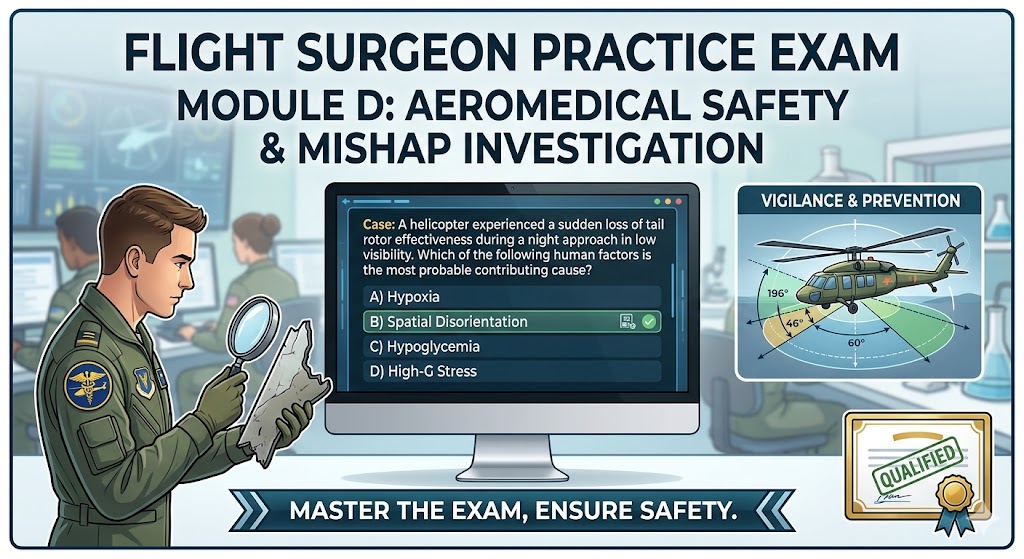
Additional Information
What the Course Entails and Exam Details
The Flight Surgeon Module D course provides a comprehensive syllabus on aeromedical safety and the methodology of aircraft accident investigation. Candidates study the "Swiss Cheese Model" of accident causation, analyzing how a chain of human errors, environmental factors, and supervisory failures leads to a catastrophe. Key topics include: human factors in aviation, including fatigue, spatial disorientation, hypoxic effects, and G-force effects; interpreting injury patterns and identifying specific life support equipment failures; and the structure of a mishap investigation board, from initial scene response to final reporting. The exam details are structured to match the intensity of the official curriculum, often set within military academic centers like the US Army Department of Aviation Medicine (DAM) or the Naval Aerospace Medical Institute (NAMI).
What to Expect in the Final Exam
You can expect the Flight Surgeon Module D final exam to be a robust assessment of your practical and theoretical knowledge. The standard format is a multiple-choice, closed-book exam, heavily reliant on complex scenario-based questions. Instead of just recalling facts, you will be given crash scenarios and asked to identify the likely human factor causes, recommend survival improvements, or interpret autopsy and life support equipment data. This is a timed exam, simulating the pressure of operational demands. While the exact passing score varies by service, it is generally high, often 80% or above, reflecting the non-negotiable nature of flight safety. Strict adherence to time limits is enforced, and candidates must demonstrate a comprehensive grasp of both the medical and technical aspects of mishap investigation.
How to Study and Exam Centers
Effective study for this specialization requires a deep dive into official Flight Surgeon training materials. Your primary resources will be the official manuals and regulations provided by your service, such as Army Regulation 40-5 and specified aviation medicine course guides. Practice by analyzing real accident reports and case studies to understand the application of human factors theory. Create flashcards for critical physiological concepts (e.g., types of hypoxia, stages of spatial disorientation). Leverage official practice question banks, ensuring you understand the rationale behind both correct and incorrect answers. Crucially, this is not a test administered at public centers like Pearson VUE. The exam for Module D occurs internally, within the dedicated military academic facility where you are undergoing training, such as the US Army Department of Aviation Medicine at Fort Novosel or NAMI in Pensacola.
Job Opportunities from the Course
A Flight Surgeon who has specialized with Module D is uniquely qualified for various high-responsibility roles within military, civil, and commercial aviation. Completion of the course unlocks several critical career paths, including:
Military Flight Surgeon (Army, Navy, Air Force, Coast Guard): A primary care physician for aircrew, who also serves as a critical member of aircraft mishap investigation boards.
Aerospace Medicine Specialist: Working in research and development to improve aviation safety systems and human-machine interface.
FAA Aviation Medical Examiner (AME): While requiring separate FAA certification, this background provides superior expertise for civil aviation exams.
Mishap Investigation Consultant: Working for government bodies like the NTSB or private aviation safety firms.
NASA Flight Surgeon: Supporting astronauts and high-altitude research pilots, using expertise in extreme environments and human factors.
Airline Medical Director/Consultant: Advising commercial carriers on crew health, safety, and mishap prevention programs.
Frequently Asked Questions
Reviews
5.0
Based on 0 reviews
Leave a Review
No reviews yet. Be the first to review!