
Floral Certification Practice Test
$69.00
- Buy to unlock unlimited access to all Quiz questions and Answers in this Quiz.
- After purchase you can print a PDF of the whole quiz at any point. The PDF will contain the questions and the correct answers.
About this Exam
Embarking on a career in floristry requires passion, dedication, and a validated level of expertise. A comprehensive floral certification program, which this practice exam is designed to support, serves as the industry’s benchmark. Designed for both aspiring individuals looking to break into the floral arts and seasoned professionals seeking to formalize their credentials, this certification validates core skills in design, care, and business operations. Obtaining this prestigious designation signifies to clients, employers, and the industry that you have met a high standard of professional achievement. This practice exam is an essential tool to measure your readiness, identify areas for improvement, and build the confidence needed to succeed in the final evaluation.
Ready to test your knowledge?
Buy Now to Access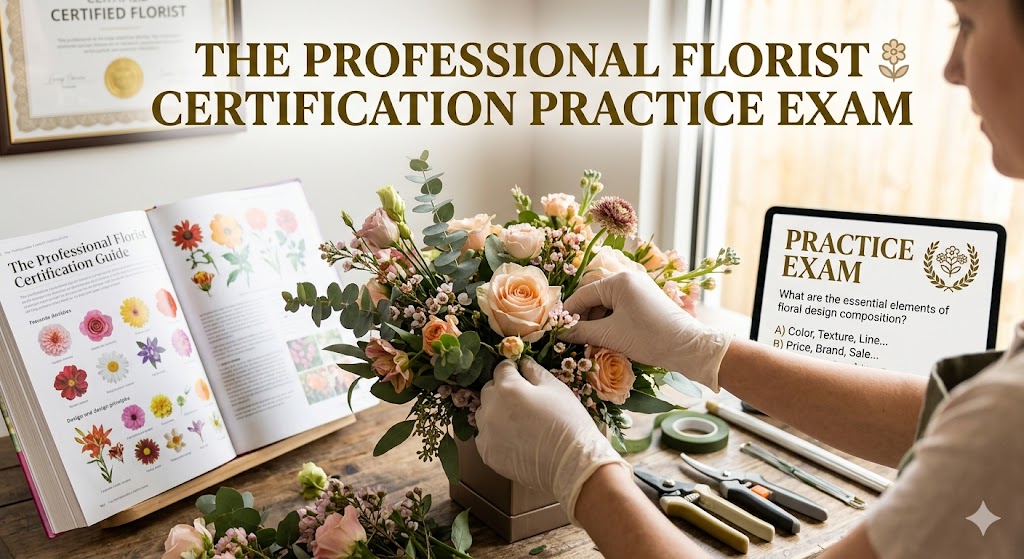
Additional Information
What the Course Entails and Exam Details
The comprehensive certification curriculum and its subsequent exam cover a diverse and critical range of topics essential for modern professional florists. Participants in the core course should expect robust instruction and assessments on:
Floral Design Principles: Comprehensive understanding of balance, proportion, scale, rhythm, dominance, unity, and color theory as applied to all styles.
Flower & Foliage Identification & Care: Mastery of recognizing hundreds of standard and specialty varieties, their seasonal availability, and best practices for conditioning, storage, and life extension.
Practical Techniques: Development of core practical skills including hand-tied bouquets, vase arrangements, floral foam techniques, and specialized designs for weddings, sympathy, and special events.
Tool Usage & Safety: Safe and efficient operation of fundamental floristry tools and adherence to workplace safety guidelines.
Floral Business Management: Foundational knowledge of pricing strategies, sourcing, inventory management, customer service, and essential business ethics.
The knowledge-based portion of the final exam will contain a substantial range of questions, including multiple-choice, matching, and short-answer.
What to Expect in the Final Exam
While specific structures vary, a final, full certification exam commonly consists of two major components, designed to rigorously test both knowledge and practical proficiency:
Knowledge-Based Written Exam: This component typically involves multiple-choice and short-answer questions, covering all theoretical topics mentioned in Section 2. Candidates can expect a timed test, often requiring a passing score of 70% or higher to demonstrate standard proficiency.
Practical Design Evaluation: Following the knowledge test, candidates are often required to complete specific, timed floral arrangements under the observation of experienced judges or facilitators. This section assesses a candidate’s ability to apply the principles and techniques learned, evaluating aspects like mechanics, design execution, adherence to specific criteria (e.g., creating a symmetrical design within specified dimensions), and efficient time management. The actual final exam is a comprehensive assessment and should not be underestimated. This practice test is a vital step in preparing for this dual challenge.
Passing both the knowledge and the practical evaluations is essential to obtaining the full certification.
How to Study and Exam Centers
Preparation for both the knowledge and practical aspects of the floral certification exam is key to success. Active engagement with various resources, including this practice exam, is highly recommended:
In-Depth Study: Dedicate significant time to reviewing all provided course materials, relevant textbooks, instructional videos, and practical workshops.
Practice with Purpose: Utilize this practice exam repeatedly. Carefully review incorrect answers, identify weak areas, and focus subsequent study efforts.
Hands-On Practice: Do not ignore the practical component. Practice creating different design styles, timing yourself, and critically evaluating your own work against standard design principles. Seek feedback from mentors or instructors.
Review Evaluation Criteria: For any practical exam, understand and internalize the specific evaluation sheets or rubrics provided. This will ensure you understand exactly what the judges are looking for.
Job Opportunities from the Course
Successfully obtaining a respected floral certification is a powerful career accelerator. Not only does it validate your professional competence, but it also opens doors to enhanced credibility, greater salary potential, and a wider range of career opportunities:
Certified Floral Designer: The most direct career path, working in shops, event companies, or independently.
Floral Shop Manager/Owner: Use your expertise to lead teams or run your own successful business.
Event & Wedding Floral Stylist: Specialize in the complex and creative area of large-scale events.
Floral Instructor or Educator: Share your knowledge and passion by training the next generation.
Wholesale Floral Rep: Work on the supply side of the industry, connecting growers and florists.
Floral Industry Consultant: Advise on design trends, business operations, and sourcing.
Corporate Floral Designer: Create and maintain floral displays for offices, hotels, and events.
Frequently Asked Questions
Reviews
5.0
Based on 0 reviews
Leave a Review
No reviews yet. Be the first to review!