
Florida Bar Practice Exam
$69.00
- Buy to unlock unlimited access to all Quiz questions and Answers in this Quiz.
- After purchase you can print a PDF of the whole quiz at any point. The PDF will contain the questions and the correct answers.
About this Exam
The Florida Bar Exam is a rigorous and comprehensive assessment required for admission to the Florida Bar. Passing this exam is the final hurdle for individuals aiming to practice law as a licensed attorney in the state of Florida. The exam evaluates an applicant's understanding of both general legal principles (as tested by the Multistate Bar Examination) and specific Florida law concepts across various practice areas. A "Florida Bar Practice Exam" isn't a single official "course," but rather a set of practice materials, including sample essays and multiple-choice questions, often offered by private bar prep companies or through the Florida Board of Bar Examiners' resources, designed to simulate the final testing environment and assess readiness. It is designed for recent law school graduates and experienced out-of-state attorneys seeking Florida licensure.
Ready to test your knowledge?
Buy Now to Access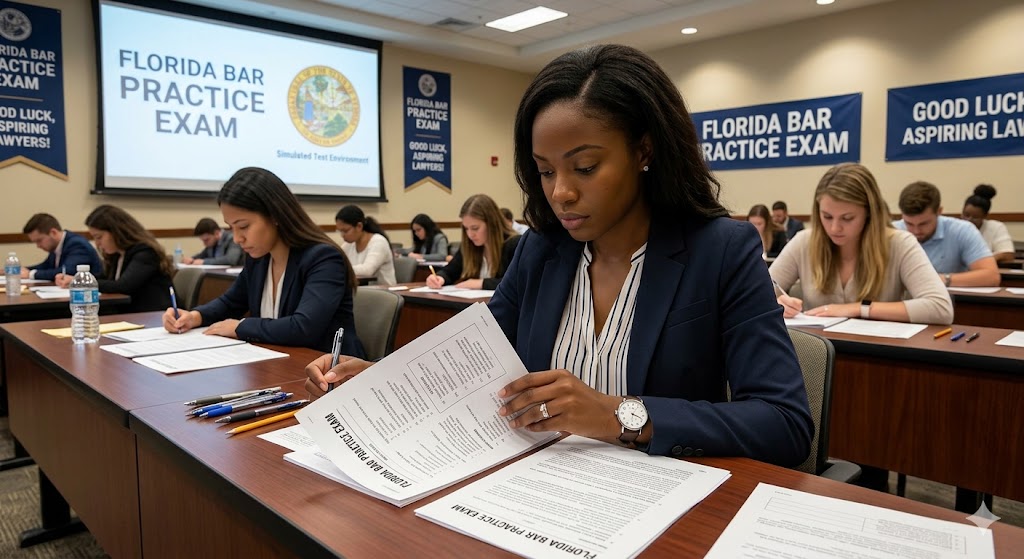
Additional Information
What the Course Entails and Exam Details
Preparing for the Florida Bar Exam demands a focused study regimen covering a vast array of legal subjects. While not a structured course itself, a practice exam environment mirrors the subjects tested. You must demonstrate proficiency in:
Florida-Specific Law: This includes Florida Constitutional Law, Civil and Criminal Procedure, evidence, Family Law, Real Property, Torts, Contracts, Trusts, and Commercial Law.
The Multistate Bar Examination (MBE): This national multiple-choice exam covers fundamental areas of American law: Constitutional Law, Contracts, Criminal Law and Procedure, Evidence, Real Property, Torts, and Civil Procedure.
Professional Responsibility: Knowledge of the Florida Rules of Professional Conduct is mandatory for all applicants.
Essay Writing: Applicants must master legal analysis and writing, effectively communicating complex legal arguments within a limited timeframe across various tested subjects in the Florida section.
Multiple-Choice Practice: Both Florida-specific multiple-choice questions and the MBE require rapid reasoning and recall under time pressure.
What to Expect in the Final Exam
The actual Florida Bar Examination is typically administered over two intensive days in February and July. The format is carefully structured:
Florida Portion (Day 1): This usually consists of three hour-long essay questions and 100 multiple-choice questions covering Florida law across multiple subjects. Candidates are given 3 hours for the essays in the morning and 3 hours for the multiple-choice section in the afternoon.
MBE Portion (Day 2): This part consists of 200 multiple-choice questions from the national bar examiners, spanning fundamental legal principles. It is administered in two three-hour sessions, 100 questions in each.
Passing Score: Florida uses a scaled score calculation. An overall scaled score of 136 is required to pass the exam, considering the combined performance on both the Florida and MBE portions.
Security and Rules: The exam is strictly proctored with rigid rules regarding allowed items, timing, and conduct to ensure fairness and integrity. Violation of these rules can lead to disqualification.
Multi-State Professional Responsibility Examination (MPRE): Beyond the bar exam, a separate scaled score of 80 on the MPRE is also required for admission to the Florida Bar.
How to Study and Exam Centers
Successfully navigating the Florida Bar Exam requires disciplined preparation. Utilizing a range of study strategies is key:
Commercial Bar Review Courses: Enroll in a reputable bar preparation program that provides comprehensive outlines, lectures, practice essays, and extensive multiple-choice question banks tailored to the Florida Bar Exam structure.
Active Learning and Practice: Don't just read outlines. Actively engage by creating flashcards, writing rule statements, and, critically, taking numerous timed practice exams (both essay and multiple-choice). Simulating the actual test environment builds stamina and time management skills.
Focus on Strengths and Weaknesses: Analyze your performance on practice questions. Allocate extra study time to areas where you are less confident while reinforcing your strengths.
Florida Board of Bar Examiners Resources: Utilize the resources provided by the official Florida Board of Bar Examiners, including past essay questions and sample answers. These offer valuable insights into the expected level of analysis.
Exam Centers: The actual Florida Bar Examination is centrally administered by the Florida Board of Bar Examiners at designated large venues, typically in Tampa or Orlando, and does not use individual commercial testing centers like Pearson VUE. Applicants must complete a detailed application process through the Board's online portal months in advance to secure a seat.
Job Opportunities from the Course
Passing the Florida Bar Exam unlocks diverse and rewarding career paths within the legal profession throughout the state:
Associate Attorney
Corporate Counsel
Prosecutor (State Attorney's Office)
Public Defender
Judicial Law Clerk
Private Practice Attorney
Government Attorney
Legal Aid/Public Interest Attorney
Frequently Asked Questions
Reviews
5.0
Based on 0 reviews
Leave a Review
No reviews yet. Be the first to review!