
Florida BRT Corrections - Firearms Practice Exam
$69.00
- Buy to unlock unlimited access to all Quiz questions and Answers in this Quiz.
- After purchase you can print a PDF of the whole quiz at any point. The PDF will contain the questions and the correct answers.
About this Exam
The Florida Basic Recruit Training (BRT) Corrections Firearms course is a mandatory component of the basic recruit training program required for individuals seeking certification as correctional officers in the state of Florida.
This course is specifically designed for recruits currently enrolled in an approved Florida Department of Law Enforcement (FDLE) criminal justice academy. The training focuses on developing the essential knowledge, skills, and attitudes necessary for the safe, responsible, and proficient handling of firearms within a correctional setting. This exam ensures that future officers meet the stringent safety standards required by the state.
Ready to test your knowledge?
Buy Now to Access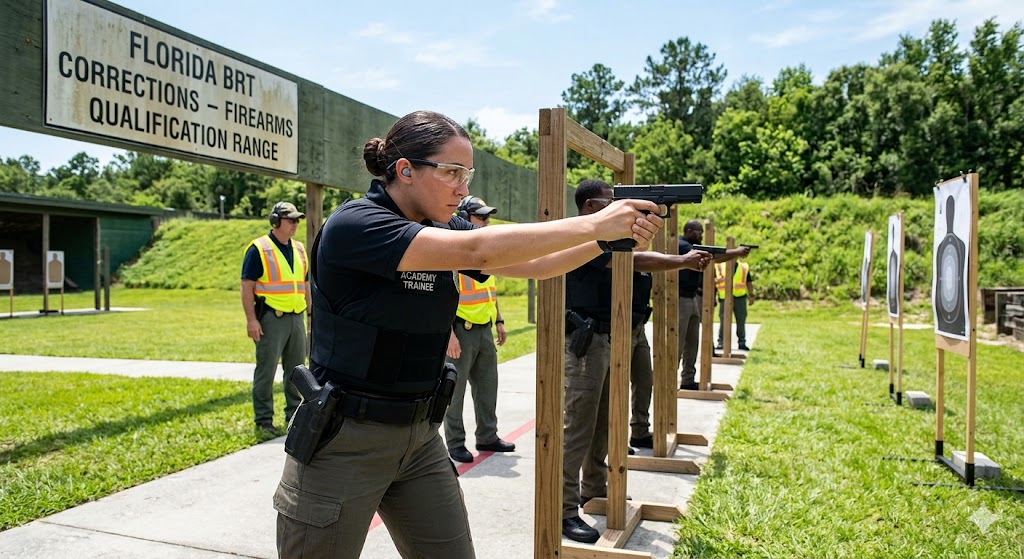
Additional Information
What the Course Entails and Exam Details
This specialized firearms training program provides extensive hands-on instruction and theoretical knowledge essential for corrections officers.
Core topics covered include:
Universal firearm safety rules and principles.
The legal aspect of the use of force, including lethal force, under Florida law.
Comprehensive nomenclature and mechanical operation of standard-issue duty weapons (specifically the semi-automatic handgun and, typically, a shotgun).
Correct procedures for loading, unloading, and reloading.
Fundamentals of marksmanship, including proper grip, stance, sight alignment, and trigger control.
Immediate action drills for clearing common firearm malfunctions.
Procedures for proper firearm cleaning, maintenance, and secure storage.
What to Expect in the Final Exam
The comprehensive evaluation at the conclusion of the BRT Corrections Firearms course consists of two primary components that candidates must pass to achieve certification:
1. The Written Knowledge Exam
This section typically includes multiple-choice questions assessing your understanding of safety protocols, Florida state statutes regarding the use of force, weapon nomenclature, and maintenance procedures. Recruits must achieve a minimum passing score (usually 80% or higher) to proceed.
2. The Practical Skills Qualification
This is a high-stakes, hands-on assessment conducted on a firing range under the direct supervision of certified instructors. Recruits must successfully complete a prescribed "course of fire" with their duty handgun. This qualification requires firing a specific number of rounds at targets from varied distances (such as 3, 7, and 15 yards) and shooting positions within mandated time limits.
Crucially, the practical exam is strict. Any serious safety violation, such as pointing a weapon in an unsafe direction, will result in an immediate failure of the course, regardless of accuracy. Candidates must demonstrate both proficiency and unwavering commitment to safety protocols.
How to Study and Exam Centers
Successfully passing the Florida BRT Corrections Firearms exam requires dedication and focused preparation, encompassing both technical knowledge and practical skills.
Effective Study Strategies:
Review Instructor-Led Materials: Thoroughly study the training manuals and handouts provided during the academy course. Take detailed notes during lectures.
Focus on Safety First: Memorize and apply the four universal firearm safety rules. This is non-negotiable.
Practical Visualization: Mentally rehearse the loading, unloading, and malfunction clearing procedures. If safe and supervised opportunities for dry-fire practice exist within your academy, utilize them diligently.
Take Practice Exams: Utilize practice tests specifically designed for the Florida BRT firearms curriculum to identify knowledge gaps and become familiar with the written exam format.
Where to Take the Exam:
The firearms exam is not taken at public testing centers or through online portals. The final written and practical examinations are administered directly at the authorized Florida Department of Law Enforcement (FDLE) criminal justice training academy or certified firing range where you are completing your Basic Recruit Training program. The testing is scheduled as an integrated part of your academy coursework.
Job Opportunities from the Course
Completing the Florida BRT Corrections certification, including the critical firearms qualification, is the required pathway to several essential careers in public safety.
This certification unlocks opportunities for the following roles within Florida:
State Correctional Officer (Florida Department of Corrections)
County Correctional Officer or Deputy (within Florida County Sheriff’s Offices)
Municipal Correctional Officer (within city police departments managing local holding facilities)
Juvenile Justice Officer (within Department of Juvenile Justice facilities, though some roles may differ in firearms requirements)
Frequently Asked Questions
Reviews
5.0
Based on 0 reviews
Leave a Review
No reviews yet. Be the first to review!