
Florida Certified Recovery Peer Specialist Practice Exam
$69.00
- Buy to unlock unlimited access to all Quiz questions and Answers in this Quiz.
- After purchase you can print a PDF of the whole quiz at any point. The PDF will contain the questions and the correct answers.
About this Exam
The Florida Certified Recovery Peer Specialist (CRPS) designation is a vital credential for individuals with lived experience in recovery from mental health conditions or substance use disorders. This certification, administered by the Florida Certification Board (FCB), formally recognizes professionals who use their unique perspective to offer support, advocacy, and mentoring to others navigating similar paths to wellness. The practice exam is designed for aspiring peer specialists who have completed the required training and are preparing to take the final certifying examination. It provides an opportunity to gauge readiness, familiarize oneself with the exam structure, and identify areas needing further study before attempting the official test.
Ready to test your knowledge?
Buy Now to Access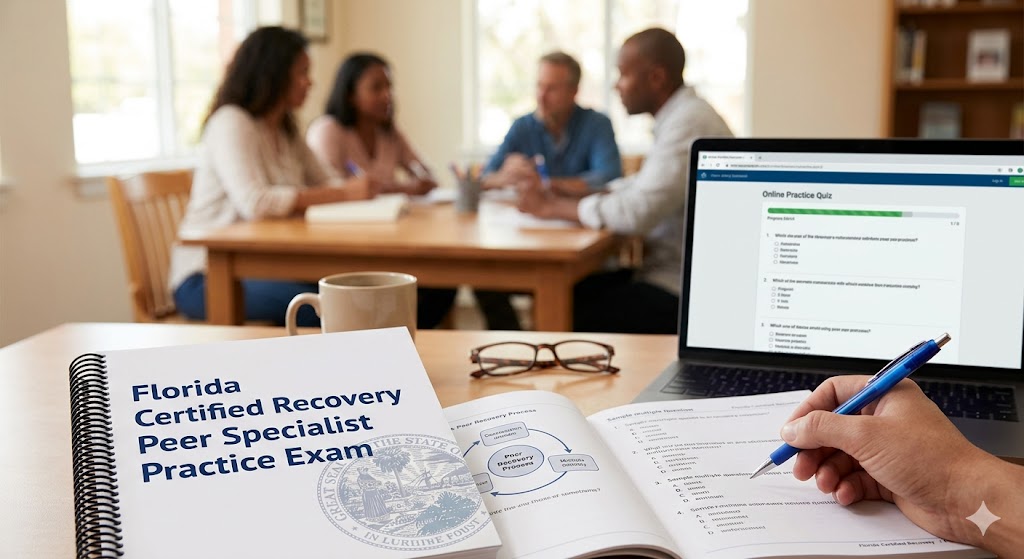
Additional Information
What the Course Entails and Exam Details
Preparing for the CRPS exam involves understanding the core competencies defined by the Florida Certification Board. While there isn't a single "course" that constitutes the entirety of the preparation, candidates must complete 40 hours of FCB-approved training covering specific domains. The exam evaluates knowledge across four primary performance domains: Advocacy (e.g., protecting rights, promoting choice), Mentoring and Education (e.g., sharing recovery stories, teaching life skills), Recovery and Wellness Support (e.g., developing recovery plans, identifying resources), and Professional Responsibility (e.g., ethical conduct, confidentiality, documentation). The practice exam mirrors these domains, providing sample questions that reflect the real-world scenarios and ethical challenges peer specialists encounter.
What to Expect in the Final Exam
The official Florida Certified Recovery Peer Specialist examination is a standardized, computer-based test consisting of 75 multiple-choice questions. Candidates are allotted two hours (120 minutes) to complete the exam. The questions are designed to assess the application of knowledge within the four core domains mentioned above. A passing score is determined by the Florida Certification Board using standard psychometric procedures. The exam is administered in a proctored setting to ensure integrity. Candidates must receive authorization from the FCB to schedule their exam, usually after submitting proof of completed training, lived experience, work/volunteer hours, and supervision.
How to Study and Exam Centers
Effective study strategies for the CRPS exam go beyond just memorizing definitions; you must understand how to apply peer support principles ethically and effectively.
Review FCB Standards: Utilize the Florida Certification Board’s Candidate Handbook and the specific CRPS job task analysis. These documents outline the exact competencies tested.
Utilize Training Materials: Revisit the materials from your required 40-hour peer specialist training. Focus on practical applications and the CRPS code of ethics.
Practice Active Learning: Use the practice exam to simulate testing conditions. Analyze incorrect answers to understand why the correct choice is the most appropriate response based on peer support principles.
Form Study Groups: Collaborating with other prospective peer specialists can provide diverse perspectives and help clarify complex ethical scenarios.
The official CRPS exam is typically administered through authorized testing centers in Florida, such as Pearson VUE. After your application is approved by the FCB, you will receive instructions on how to schedule your exam appointment at a location convenient for you.
Job Opportunities from the Course
Earning the Florida Certified Recovery Peer Specialist credential opens doors to various rewarding career paths within the behavioral healthcare field. This certification validates your expertise and lived experience, making you a valuable asset to employers.
Potential job opportunities include:
Certified Recovery Peer Specialist
Peer Support Specialist
Recovery Coach
Substance Abuse Counselor Aide
Mental Health Technician
Wellness Coordinator
Community Outreach Worker
Case Management Assistant
Housing Navigator for recovery programs
Peer Support Program Coordinator (with experience)
Frequently Asked Questions
Reviews
5.0
Based on 0 reviews
Leave a Review
No reviews yet. Be the first to review!