
Florida Department of Children and Families (DCF) Behavioral Observation and Screening Practice Exam
$69.00
- Buy to unlock unlimited access to all Quiz questions and Answers in this Quiz.
- After purchase you can print a PDF of the whole quiz at any point. The PDF will contain the questions and the correct answers.
About this Exam
The Florida Department of Children and Families (DCF) Behavioral Observation and Screening requirement is a fundamental training component for all child care personnel, including family day care home operators and large family child care home operators. This course and subsequent exam are designed to empower child care providers with the essential skills to observe, document, and identify children who may be at risk for or exhibiting signs of developmental delays or special needs. Early identification and referral to proper services are critical for a child’s long-term health and educational outcome.
This certification ensures you have the knowledge necessary to maintain a safe, nurturing, and developmentally appropriate environment for the children in your care, directly supporting Florida’s commitment to early childhood well-being.
Sample Questions
Explanation:
Explanation:
Explanation:
Explanation:
Explanation:
Ready to test your knowledge?
Buy Now to Access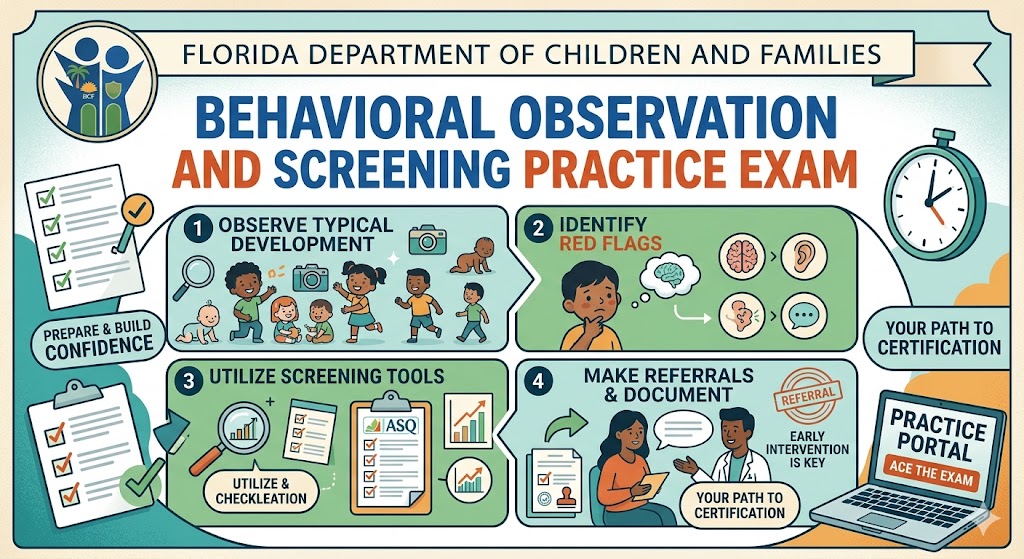
Additional Information
What the Course Entails and Exam Details
The comprehensive course covers a structured set of competencies focused on child development and standard observation practices. The core topics you must master include:
Understanding developmental domains: Physical Health, Cognitive Development, Language and Communication, Social and Emotional Development, and Approaches to Learning.
Differentiating between observation and screening procedures.
Identifying typical milestones and recognizing “red flags” or atypical development at various ages.
Developing objective observation techniques, including anecdotal records, running records, and checklists.
Utilizing standard screening tools and understanding their purposes and limitations.
Recognizing the critical role of parents and families in the screening and referral process.
Navigating the referral and early intervention systems within Florida, such as the Florida Diagnostic and Learning Resources System (FDLRS) and Child Find.
Maintaining ethical standards and child confidentiality in all observation and reporting activities.
Understanding reporting requirements, particularly for suspected child abuse or neglect.
The exam itself is a multiple-choice competency assessment that tests your proficiency across these domains. You will be expected to apply the concepts learned in the course material to real-world scenarios in a child care setting.
What to Expect in the Final Exam
The Final DCF Behavioral Observation and Screening competency exam is a crucial step in your child care career in Florida.
The exam format consists entirely of multiple-choice questions. These questions are designed to be clear and assess your practical knowledge. The exam is typically offered in both English and Spanish.
To successfully pass and receive your certification, you must achieve a passing score of at least 70%.
The time allowed for this exam is generally around 45 to 60 minutes. Candidates are advised to manage their time effectively to ensure all questions can be reviewed and answered.
This is a standardized competency exam, and no reference materials are permitted during the testing session.
How to Study and Exam Centers
The key to success on this exam is a solid understanding of the mandated DCF course content. Below are actionable study strategies and information on exam centers:
Actionable Study Strategies
Thoroughly Review DCF Training Modules: The most critical resource is the official DCF candidate guides and course modules. Pay close attention to definitions, specific techniques, and the purposes of different screening tools.
Practice Observation and Reporting: Apply the techniques in your daily work or a practice environment. Create dummy observation notes or checklists based on hypothetical scenarios. Practicing this application will make scenario-based exam questions much easier to navigate.
Take Practice Exams: Dedicate significant time to taking the Florida DCF Behavioral Observation and Screening Practice Exam. Use these practice tools to identify your weak areas and to become familiar with the multiple-choice format and style of questioning. Practice tests are an invaluable tool for boosting your confidence and improving your scores.
Join a Study Group: Collaborating with peers preparing for the same exam can provide new perspectives and motivation.
Exam Centers and Registration
You cannot simply walk into a center to take the exam. You must first register and pay for your exam through the official Florida DCF Child Care Training System portal at [myflfamilies.com/childcare](https://myflfamilies.com/childcare). Once logged in, you will be able to schedule your exam at an authorized proctor site near you.
Testing centers are located throughout Florida. These locations can include community colleges, universities, local Training Coordinating Agencies (TCAs), and specific child care training schools approved by DCF. When scheduling, you will choose from a list of available locations and dates. Ensure you arrive with valid, state-issued identification on the day of your exam.
Job Opportunities from the Course
Successfully passing this exam and obtaining your DCF Behavioral Observation and Screening certification is a fundamental requirement for numerous career paths within the early childhood education field in Florida. It is a mandatory credential that unlocks a variety of specific job titles, including but not limited to:
Child Care Worker
Preschool Teacher
Lead Teacher (in child care facilities)
Child Care Facility Director (as part of foundational training)
Family Child Care Home Operator
Large Family Child Care Home Operator
Early Learning Assistant
Frequently Asked Questions
Reviews
5.0
Based on 0 reviews
Leave a Review
No reviews yet. Be the first to review!