
Florida Fire State Practice Exam
$69.00
- Buy to unlock unlimited access to all Quiz questions and Answers in this Quiz.
- After purchase you can print a PDF of the whole quiz at any point. The PDF will contain the questions and the correct answers.
About this Exam
The Florida Firefighter Certification Exam is the definitive state-level assessment required for individuals seeking to become professional, certified firefighters within the state.
This rigorous examination is administered by the Florida Bureau of Fire Standards and Training (BFST) to ensure candidates meet the strict safety and performance standards of the profession.
It is designed primarily for aspiring public safety professionals who have recently completed an approved Firefighter I and II minimum standards training program.
Passing this test proves that a candidate has the essential theoretical knowledge and practical hands-on skills necessary to protect lives and property in emergency situations.
Whether you are aiming to join a bustling municipal fire department or a specialized county rescue team, achieving this certification is your first mandatory step.
Ready to test your knowledge?
Buy Now to Access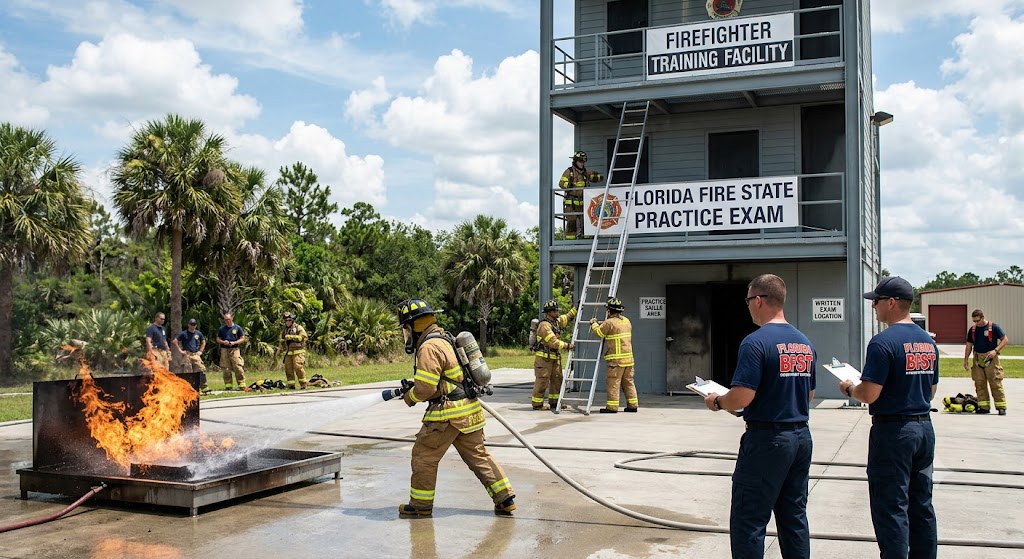
Additional Information
What the Course Entails and Exam Details
The preparatory coursework and the exam itself comprehensively cover the National Fire Protection Association (NFPA) standards alongside specific Florida state regulations.
Candidates are tested extensively on fire behavior, building construction, and the proper use of personal protective equipment (PPE).
The syllabus heavily emphasizes life-saving rescue operations, forcible entry techniques, and tactical ventilation.
Students also dive deeply into the mechanics of fire hoses, water supply dynamics, and ground ladder deployments.
In addition to physical firefighting tactics, the curriculum entails essential protocols for hazardous materials (HazMat) awareness and operational-level response.
Overall, the course ensures that every candidate understands both the scientific principles of fire and the mechanical skills needed to extinguish it safely.
What to Expect in the Final Exam
The official Florida Firefighter State Exam is divided into two distinct components consisting of a written test and a practical skills evaluation.
The written examination typically consists of multiple-choice questions that evaluate your comprehension of fire science, safety regulations, and emergency protocols.
Candidates are given a strict time limit, usually around three hours, to complete the written portion of the exam.
To achieve a passing grade, you must secure a score of at least 70% on the written test.
Following the written assessment, candidates must pass the practical exam where they physically demonstrate firefighting tasks in a simulated environment.
During the practical skills test, examiners will grade your ability to execute tasks like donning gear rapidly, deploying hoses, and executing search and rescue methods under pressure.
How to Study and Exam Centers
Success on the Florida Firefighter State Exam requires a blend of academic studying and intense physical repetition.
You should consistently use high-quality practice exams and flashcards to memorize codes, terminology, and fire behavior theories.
Forming study groups with your academy peers can be incredibly beneficial for testing each other on situational judgment questions.
For the practical portion, muscle memory is vital, so spend as much time as possible physically repeating the hands-on drills at your training facility.
When it comes time to test, exams are typically scheduled through the Florida Bureau of Fire Standards and Training portal.
You will take the written and practical exams at approved regional testing sites, which often include state-certified fire academies or the primary Florida State Fire College campus located in Ocala.
Job Opportunities from the Course
Earning your Florida Firefighter Certification opens the door to a rewarding and highly respected career in public safety.
The most common path is becoming a Municipal Firefighter, where you will respond to urban and suburban emergencies, fires, and medical calls.
You also become eligible to work as a Wildland Firefighter, protecting Florida's vast natural landscapes and state parks from brush and forest fires.
With additional experience, this certification serves as the foundation for becoming a Fire Inspector, ensuring local businesses comply with safety codes.
You might also pursue a career as a Fire Investigator, working with law enforcement to determine the origins of complex fires.
Finally, many certified individuals advance to become Fire Apparatus Operators or Engineers, taking on the crucial responsibility of driving the fire engines and managing water pump operations on the scene.
Frequently Asked Questions
Reviews
5.0
Based on 0 reviews
Leave a Review
No reviews yet. Be the first to review!