
Florida General Instructor Techniques (CJSTC 1186) Practice Test
$69.00
- Buy to unlock unlimited access to all Quiz questions and Answers in this Quiz.
- After purchase you can print a PDF of the whole quiz at any point. The PDF will contain the questions and the correct answers.
About this Exam
The Florida General Instructor Techniques course, officially designated as CJSTC 1186, is a cornerstone certification for public safety professionals in Florida. It is meticulously designed for individuals within the Florida criminal justice system—including law enforcement, corrections, and correctional probation officers, as well as support personnel—who aspire to become certified instructors. This dynamic 64-hour, proficiency-based course transforms field experts into effective classroom educators. It focuses on the fundamental concepts of adult learning theory, enhancing communication skills, and mastering the art of facilitation, ensuring that the next generation of first responders is trained with the highest level of competence and motivation.
Sample Questions
Explanation:
Explanation:
Explanation:
Explanation:
Explanation:
Ready to test your knowledge?
Buy Now to Access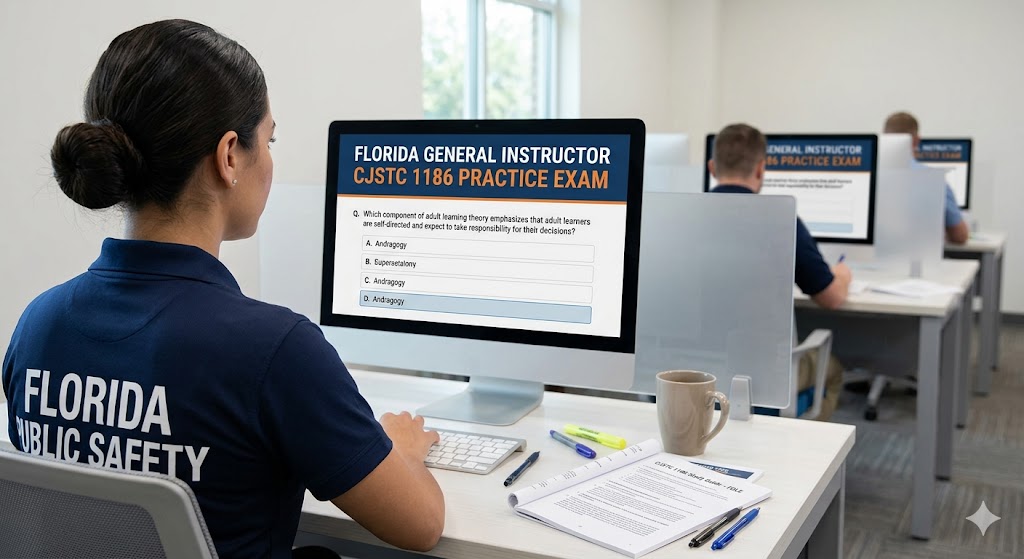
Additional Information
What the Course Entails and Exam Details
The CJSTC 1186 curriculum is comprehensive, covering the vital skills needed to excel in a training environment.
Over the 64 hours of instruction, students dive into:
Training Liability & Instructor Certification Requirements: Understanding the legal and ethical responsibilities of an instructor.
Training the Adult Learner: Applying principles of andragogy to effectively teach experienced professionals.
Diversity in the Classroom: Strategies for creating an inclusive and effective learning environment for all.
Communication Skills: Mastering verbal, non-verbal, and instructional communication.
Lesson Plan Development: Learning to structure, write, and utilize detailed lesson plans, a mandatory skill.
Facilitation Skills and Group Management: Leading discussions, managing classroom dynamics, and fostering engagement.
Instructional Aids: Effectively incorporating technology, visual aids, and simulators into training.
Evaluation, Measurement, & Simulation: Designing and administering valid assessments and reality-based training scenarios.
What to Expect in the Final Exam
As this is a proficiency-based course, the final assessment has two distinct and mandatory components. You cannot be certified without passing both.
1. Written End-of-Course Examination:
Students must complete a comprehensive written final exam, typically in a multiple-choice format, which covers all cognitive aspects of the curriculum. While the exact minimum passing score can be set by the individual training center, instructor courses in Florida typically require a high level of mastery, often an 85% or higher.
2. Graded Final Presentation (The Teach-Back):
This is the practical, hands-on demonstration of your instructional abilities. Every student must develop a full lesson plan and deliver a 30-minute to one-hour graded final presentation to their peers and a panel of instructors. This presentation is evaluated on lesson plan accuracy, communication, use of instructional aids, and facilitation skills. You must demonstrate proficiency (100% on safety skills, and an overall passing grade on the instructional evaluation form) to succeed.
How to Study and Exam Centers
The key to succeeding in CJSTC 1186 is not just memorization, but active application of the skills.
Actionable Study Strategies:
Create and Practice Your Lesson Plan Early: Do not wait until the final week. Pick a topic, develop your plan, and rehearse your teach-back multiple times. Time yourself to ensure you hit the required 30-60 minute window.
Utilize Practice Tests: Focus on practice questions that mimic the multiple-choice format of the cognitive exam, especially regarding adult learning principles and legal liability.
Record Yourself: Record your practice presentations. Watching yourself can reveal habits and areas for improvement in your non-verbal communication.
Review FDLE Curriculum Materials: The Florida Department of Law Enforcement (FDLE) provides the standardized curriculum. Ensure you are familiar with the specific "High-Liability" topics if your presentation covers them.
Exam and Course Locations:
The CJSTC 1186 course, including its final written exam and presentation, is not taken through a general test provider like Pearson VUE. It must be completed through a specific, authorized FDLE-approved training school. These are typically located at:
Criminal Justice Standard and Training Commission (CJSTC) authorized colleges and public safety institutes throughout Florida (e.g., Eastern Florida State College, Florida Public Safety Institute, Miami Dade College).
Specific public safety agencies with state-certified training facilities.
Job Opportunities from the Course
Earning your CJSTC 1186 certification is the gateway to a specialized and rewarding career as a public safety educator.
This certification unlocks numerous opportunities, including:
Adjunct Instructor at a Criminal Justice Academy: Teaching basic recruit classes for law enforcement or corrections.
Agency Training Coordinator: Developing and managing in-service training programs for your department.
High-Liability Instructor (After further specialization): The prerequisite to become a certified instructor in Defensive Tactics, Firearms, Vehicle Operations, or First Aid.
Field Training Officer (FTO): Enhanced instructional skills to mentor new recruits in the field.
Public Safety Education Specialized Instructor: Teaching specialized courses like School Resource Officer (SRO) or breath test operations.
Corporate Public Safety Trainer: Transitioning to private sector roles focused on security and safety training.
Frequently Asked Questions
Reviews
5.0
Based on 0 reviews
Leave a Review
No reviews yet. Be the first to review!