
Florida Home Health Aide Competency Practice Test
$69.00
- Buy to unlock unlimited access to all Quiz questions and Answers in this Quiz.
- After purchase you can print a PDF of the whole quiz at any point. The PDF will contain the questions and the correct answers.
About this Exam
The Florida Home Health Aide certification is an essential milestone for compassionate individuals looking to build a rewarding career in healthcare.
This credential is specifically designed for prospective caregivers who want to assist elderly, disabled, or convalescent patients in the comfort of their own homes.
By passing the Florida Home Health Aide Competency Practice Test, you demonstrate that you possess the vital knowledge required to ensure patient safety and well-being.
This exam serves as a necessary quality-control measure mandated by state and federal health guidelines.
It is the perfect stepping stone for anyone aiming to enter the medical field quickly while making a profoundly positive impact on the lives of vulnerable individuals in their community.
Sample Questions
Explanation:
Explanation:
Explanation:
Explanation:
Explanation:
Ready to test your knowledge?
Buy Now to Access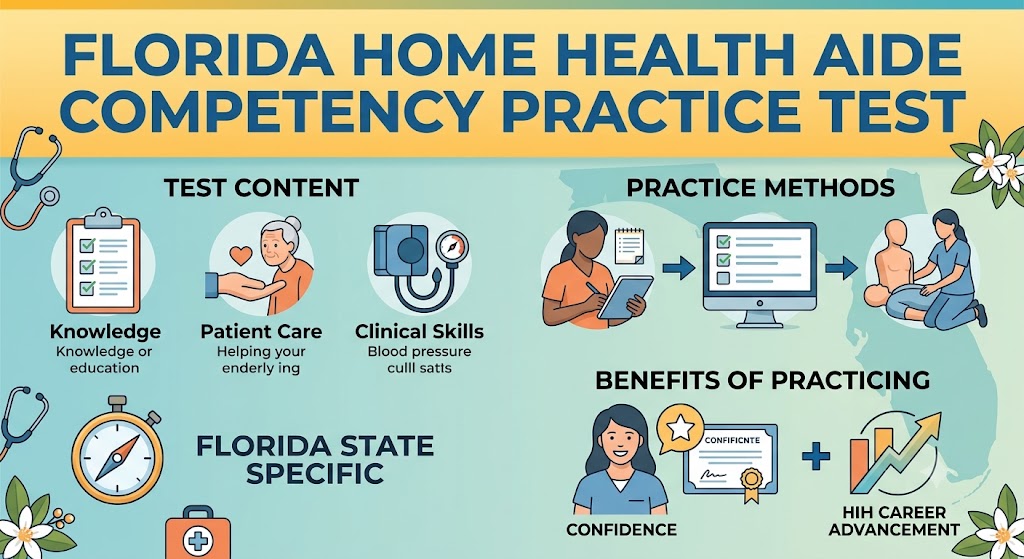
Additional Information
What the Course Entails and Exam Details
Preparing for the Florida HHA Competency exam requires a comprehensive understanding of daily patient care.
The core syllabus covers a broad spectrum of critical healthcare skills designed to keep both the patient and the caregiver safe.
Students will thoroughly explore personal care techniques, including proper bathing, grooming, and oral hygiene assistance.
The coursework also dives deep into basic medical assistance, teaching you how to accurately read and record vital signs like temperature, pulse, and blood pressure.
Furthermore, you will learn essential infection control protocols to prevent the spread of diseases in a home setting.
Emergency response techniques, proper body mechanics for safe patient transfers, and an extensive overview of patient rights and confidentiality are also highly prioritized in the training.
What to Expect in the Final Exam
When the time comes to take your final competency exam, knowing the format will help alleviate any testing anxiety.
The evaluation is traditionally divided into two distinct sections to test both your theoretical knowledge and your practical abilities.
The first part is a written or oral examination consisting of multiple-choice questions that cover the core concepts of home health care.
Most Florida agencies and training programs require a passing score of at least 75% to 80% on this written portion.
You can generally expect a time limit of about one to two hours to complete the multiple-choice section.
The second part is a hands-on clinical skills evaluation where an instructor observes you performing specific duties, such as hand washing or safely moving a patient.
You must typically perform these critical safety steps with 100?curacy to pass the practical component.
How to Study and Exam Centers
Achieving a high score on your competency exam is incredibly attainable with the right study strategies.
Begin by utilizing practice exams to familiarize yourself with the phrasing of multiple-choice questions.
Creating flashcards for medical terminology, vital sign ranges, and infection control rules is a highly effective way to retain crucial information.
Forming study groups with your peers can also help you practice your clinical skills through hands-on repetition.
In Florida, there is no single centralized state board testing facility for Home Health Aides like there is for Certified Nursing Assistants.
Instead, the exam is usually administered directly by the licensed home health agency looking to hire you, or by the state-approved vocational school where you completed your training.
Always check with your specific educational provider or prospective employer for their exact testing schedules and authorized physical locations.
Job Opportunities from the Course
Earning your competency certification immediately unlocks a variety of fulfilling career paths in the healthcare industry.
You will be fully qualified to work as a Home Health Aide, directly visiting patients in their residences to provide essential daily support.
Another popular path is becoming a Personal Care Aide, focusing heavily on companionship, household management, and mobility assistance.
Many graduates also secure positions as Hospice Aides, offering gentle, palliative care and emotional support to end-of-life patients and their families.
You can also find rewarding work as a Live-in Caregiver or Companion, providing round-the-clock assistance and supervision for seniors who wish to maintain their independence at home.
This certification ultimately serves as a powerful foundation for a lifelong, upwardly mobile career in nursing and professional healthcare.
Frequently Asked Questions
Reviews
5.0
Based on 0 reviews
Leave a Review
No reviews yet. Be the first to review!