
Florida Home Inspector Practice Test
$69.00
- Buy to unlock unlimited access to all Quiz questions and Answers in this Quiz.
- After purchase you can print a PDF of the whole quiz at any point. The PDF will contain the questions and the correct answers.
About this Exam
The Florida Home Inspector certification is a mandatory state-level credential designed for professionals who want to legally perform residential property inspections in the state of Florida.
This certification ensures that inspectors possess a thorough understanding of building standards, structural safety, and state-specific regulations.
It is specifically tailored for aspiring home inspectors, general contractors looking to expand their service offerings, and real estate professionals aiming to pivot into the property evaluation industry.
By passing this exam, you prove to the state—and to future clients—that you are fully qualified to assess the condition of homes and protect buyers from unforeseen property defects.
Sample Questions
Explanation:
Explanation:
Explanation:
Explanation:
Explanation:
Ready to test your knowledge?
Buy Now to Access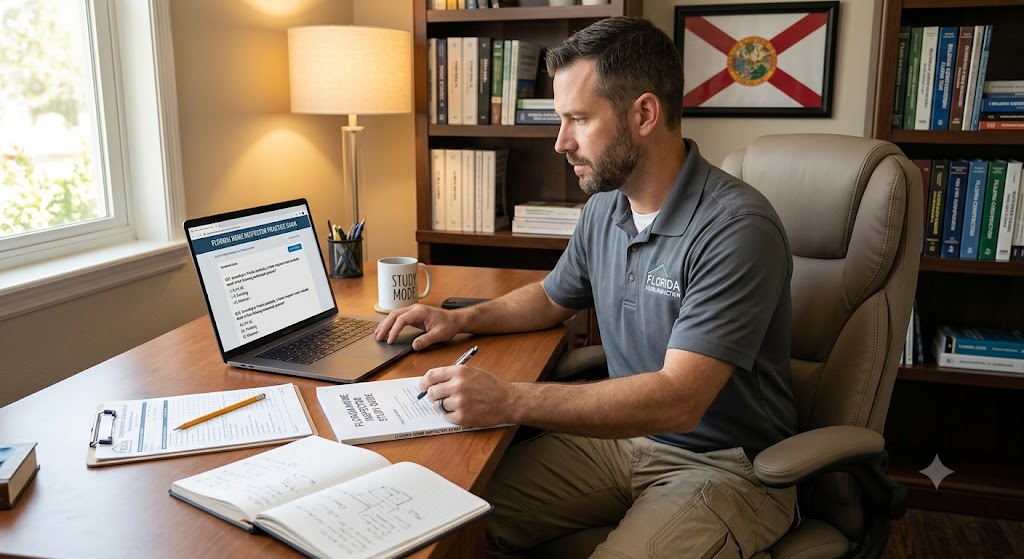
Additional Information
What the Course Entails and Exam Details
To qualify for the Florida Home Inspector exam, candidates are generally required to complete 120 hours of state-approved, comprehensive classroom or online training.
This rigorous syllabus is built to cover every major system of a residential property from the foundation to the roof.
Core topics include roofing systems, exterior and interior structural components, electrical systems, plumbing, and heating, ventilation, and air conditioning (HVAC) units.
Additionally, the curriculum places a heavy emphasis on Florida-specific building codes and environmental challenges.
You will spend significant time learning about wind mitigation, hurricane preparedness, and moisture control, which are critical skills for inspecting homes in the Florida climate.
What to Expect in the Final Exam
The final Florida Home Inspector licensing exam is a rigorous test designed to evaluate your practical knowledge and theoretical understanding of home inspection standards.
The exam format typically consists of 120 to 130 multiple-choice questions, depending on whether you take the state test, the National Home Inspector Examination (NHIE), or another DBPR-approved exam like those from FABI or InterNACHI.
You will be given a strict time limit to complete the test, which is usually set at two to four hours depending on the specific testing provider.
To achieve a passing score, candidates are generally required to score a scaled 70% or higher, meaning you must demonstrate strong competence across all subject areas.
Specific rules apply on test day, including strict no-phone policies, the requirement to present two forms of valid identification, and restrictions on bringing personal reference materials into the testing room.
How to Study and Exam Centers
Success on the Florida Home Inspector exam requires a strategic, disciplined approach to your study routine.
Start by taking multiple practice exams to familiarize yourself with the question formats and identify your weak subject areas.
Utilize flashcards for memorizing specific Florida building codes, and dedicate extra time to mastering wind mitigation and structural safety topics.
Many successful students also join study groups or online forums to discuss complex scenarios and share practical inspection tips.
When you are ready to take the final test, you will need to register through an approved proctoring service.
Exams are primarily administered at designated physical testing centers, such as Pearson VUE facilities, which are located throughout Florida and the rest of the country.
Some approved testing organizations also offer secure, live-proctored online exams, allowing you to take the test from the comfort of a quiet room in your own home.
Job Opportunities from the Course
Earning your Florida Home Inspector license unlocks a variety of rewarding and lucrative career paths in the real estate and construction sectors.
The most direct route is becoming a Licensed Residential Home Inspector, where you can work independently or join an established multi-inspector firm.
You can also specialize as a Wind Mitigation Inspector, a highly sought-after role in Florida where homeowners constantly need specialized inspections for insurance discounts.
Other incredible opportunities include working as a Commercial Property Inspector, evaluating larger business buildings and multi-family units.
Additionally, your expertise qualifies you for roles such as an Insurance Claims Adjuster, assessing property damage after storms, or a Real Estate Consultant, advising investors on the structural integrity of potential property acquisitions.
Each of these paths offers immense growth potential, schedule flexibility, and the rewarding experience of protecting consumers in the real estate market.
Frequently Asked Questions
Reviews
5.0
Based on 0 reviews
Leave a Review
No reviews yet. Be the first to review!