
Florida Professional Guardianship Practice Exam
$69.00
- Buy to unlock unlimited access to all Quiz questions and Answers in this Quiz.
- After purchase you can print a PDF of the whole quiz at any point. The PDF will contain the questions and the correct answers.
About this Exam
Becoming a professional guardian in Florida is a deeply rewarding career choice dedicated to protecting vulnerable adults and managing their personal or financial affairs.
The Florida Professional Guardianship Examination is the mandatory competency test that individuals must pass to legally register and practice within the state.
This certification is specifically designed for aspiring professional guardians, elder law advocates, social workers, case managers, and legal consultants who wish to serve incapacitated individuals ("wards") under Florida Statutes Chapter 744.
By ensuring candidates possess the core ethical, legal, and operational skills required, this exam guarantees the highest standard of care and protection for the community.
Sample Questions
Explanation:
Explanation:
Explanation:
Explanation:
Explanation:
Ready to test your knowledge?
Buy Now to Access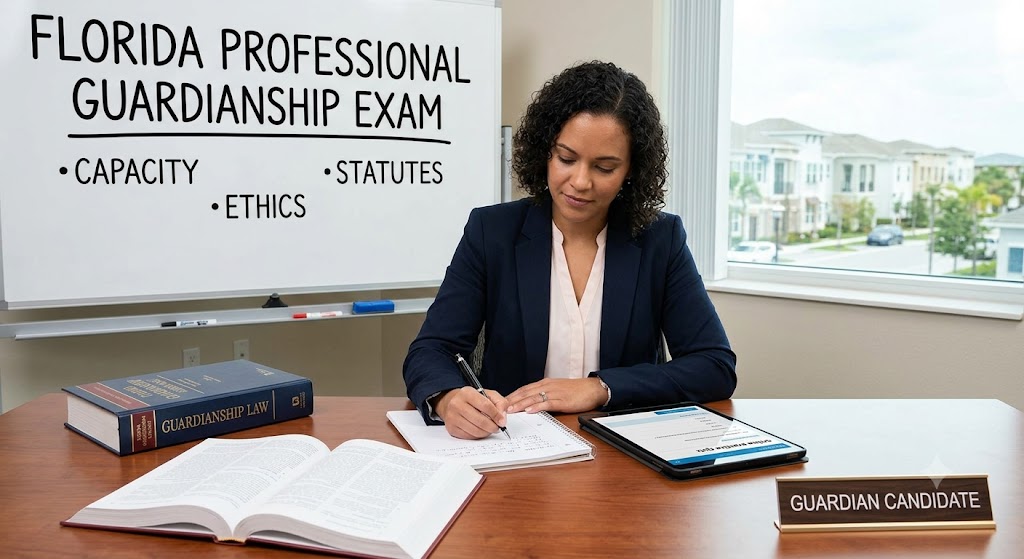
Additional Information
What the Course Entails and Exam Details
Before sitting for the competency exam, candidates must successfully complete an approved 40-hour Professional Guardianship training course.
The comprehensive syllabus covers foundational knowledge necessary to handle both the personal health and the complex financial estates of wards.
Core topics include Florida Statutes Chapter 744 (Guardianship Law), Section 393.12 (Guardian Advocacy for individuals with developmental disabilities), and Section 394.4598 (Guardian Advocacy for mental health issues).
Students will gain deep skills in ethical decision-making, understanding medical directives, and evaluating an individual's capacity.
The curriculum also places heavy emphasis on the operational duties of a guardian, including asset management, preparing detailed court inventories, financial accounting, and filing annual reports according to the Florida Probate Rules of Court.
What to Expect in the Final Exam
The Florida Professional Guardian Examination is a rigorous, comprehensive assessment designed to evaluate your practical competency and knowledge of best practices.
The final exam strictly consists of 100 multiple-choice questions covering all aspects of personal and estate guardianship.
Candidates are allocated a maximum time limit of 2 hours to complete the test, with an additional 30 minutes provided for administration, seating, and check-in preparation.
Per Florida Statutes, the mandatory passing score requirement is 75%, meaning you must correctly answer at least 75 out of 100 questions.
The testing environment is highly controlled; walk-ins are prohibited, and you must bring a valid government-issued photo ID, your official admission letter, and several sharpened #2 pencils.
Absolutely no books, notes, cell phones, or electronic devices of any kind are permitted inside the examination room, and no breaks are scheduled during the 2-hour window.
Official score reports are processed and mailed out within three weeks of the test administration date.
If a retake is necessary, candidates must wait a minimum of 31 days from their last attempt and submit a new application with the required testing fees.
How to Study and Exam Centers
Achieving a passing score requires structured preparation, beginning with an active review of your 40-hour course materials and the 58M-2 Florida Administrative Code.
Utilizing a high-quality practice exam is one of the most effective actionable study strategies to familiarize yourself with the framing of situational multiple-choice questions.
Focus on mastering the distinctions between guardianship of the person versus guardianship of the property, as well as the strict filing timelines mandated by Florida probate courts.
The exam is officially administered in person by The MacDonald Research Institute (TMRI) under contract with the Florida Department of Elder Affairs (DOEA).
Testing sessions are held throughout the year at specific authorized physical testing centers and physical sites scheduled across the state of Florida.
To register, candidates must submit a formal application online or via mail to TMRI along with the standard $300 testing fee (or $150 for retakes).
Once you pass the exam, you will receive a competency letter to submit alongside your $50,000 blanket bond, background screening, and application to register with the Office of Public and Professional Guardians (OPPG).
Job Opportunities from the Course
Earning your certification unlocks a diverse array of stable and fulfilling career paths in the rapidly expanding elder care and legal sectors.
Specific job titles and career paths unlocked by this certification include:
Private Professional Guardian
Registered State Professional Guardian
Public Guardian Case Manager
Guardian Advocate (Developmental Disabilities or Mental Health)
Elder Care Coordinator and Consultant
Probate Court Estate Administrator
Trust Liaison and Fiduciary Asset Specialist
Non-Profit Public Guardianship Office Representative
Frequently Asked Questions
Reviews
5.0
Based on 0 reviews
Leave a Review
No reviews yet. Be the first to review!