
Florida Pump Operator Practice Exam
$69.00
- Buy to unlock unlimited access to all Quiz questions and Answers in this Quiz.
- After purchase you can print a PDF of the whole quiz at any point. The PDF will contain the questions and the correct answers.
About this Exam
The Florida Fire Apparatus Pump Operator certification is a prestigious credential designed for dedicated firefighters looking to advance their careers.
This specialized certification is issued by the Florida Bureau of Fire Standards and Training (BFST) and proves a candidate's absolute mastery of fire ground hydraulics.
It is tailor-made for frontline firefighters, engineers, and apparatus driver-operators who want to take on the massive responsibility of operating multi-million dollar fire apparatus.
Achieving this designation proves you possess the critical technical expertise needed to maintain seamless water flow and pressure during high-stakes emergency suppression operations.
By utilizing a high-quality Florida Pump Operator Practice Exam, candidates can confidently transition from basic firefighting roles into advanced tactical positioning and apparatus management.
Sample Questions
Explanation:
Explanation:
Explanation:
Explanation:
Explanation:
Ready to test your knowledge?
Buy Now to Access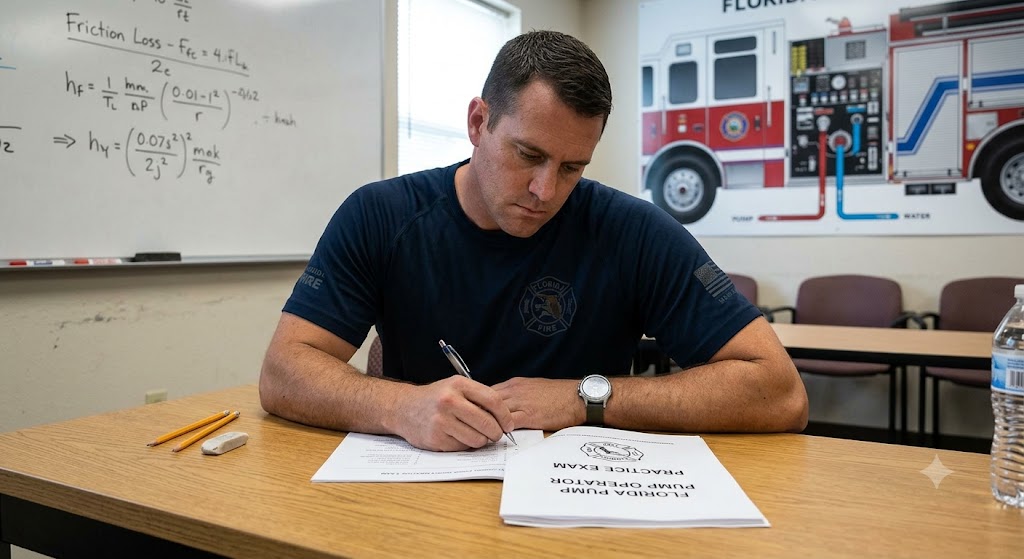
Additional Information
What the Course Entails and Exam Details
To qualify for the official state examination, candidates must successfully complete an intensive 80-hour basic certification training program.
This comprehensive curriculum is traditionally split into two core 40-hour courses known as Fire Service Hydraulics (BFST1301 / FFP1301) and Fire Apparatus Operations (BFST1302 / FFP1302).
The educational pathway incorporates rigorous classroom theory along with hands-on field operations to ensure total operational readiness.
Key topics covered within the official course syllabus include:
Fireground Hydraulics and Water Stream Mathematics: Calculating precise friction loss, nozzle pressure, engine discharge pressure, and head pressure.
Apparatus Maintenance and Inspections: Performing routine, daily, and complex preventative maintenance checks on municipal fire vehicles.
Safe Emergency Vehicle Driving Techniques: Mastering defensive driving, tactical apparatus positioning, and navigating obstacle courses according to NFPA 1002 standards.
Advanced Pumping Operations: Operating centrifugal fire pumps, managing pre-connected hoselines, handling master streams, and executing tandem pumping.
Specialized Water Logistics: Setting up drafting relays, evaluating water shuttle efficiency, and deploying rural water supply networks.
Foam Systems and Testing: Understanding foam concentrates, utilizing application equipment, and executing certified apparatus service tests.
What to Expect in the Final Exam
The final written certification exam is an intensive, highly structured assessment designed to thoroughly evaluate your cognitive understanding of pump mechanics and safety regulations.
Administered as a computer-based test, this challenging exam features multiple-choice questions aligned with the strict job performance requirements of NFPA 1002.
Crucial exam details you must prepare for include:
Passing Score Requirement: Candidates must achieve a score of 70% or higher to successfully pass the examination and earn their state credentials.
Calculator Regulations: Hand-held, battery-operated or solar-powered, non-programmable, numeric keypad calculators are explicitly permitted.
Prohibited Electronics: Smartphones, smartwatches, and programmable devices are strictly banned from the examination environment.
Evaluation Scope: Questions focus heavily on real-world fireground scenarios, water delivery optimization, safety protocols, and complex hydraulic formulas.
Time Management: The exam features a strict time limit, meaning you must be both exceptionally accurate and swift in your mathematical calculations.
How to Study and Exam Centers
Mastering the official Florida state assessment requires a deliberate, structured approach to studying and extensive exposure to high-yield practice materials.
Utilizing a targeted Florida Pump Operator Practice Exam is the absolute best way to identify hidden knowledge gaps, practice arithmetic speeds, and get used to exam phrasing.
Actionable study strategies include:
Master the Core Textbooks: Extensively review and outline the IFSTA Pumping Apparatus Driver/Operator Handbook or state-approved manuals.
Practice Daily Hydraulic Calculations: Spend time every single day solving friction loss and engine pressure equations entirely by hand.
Simulate Real Test Conditions: Take timed practice exams repeatedly without any notes to build your psychological pacing and exam-day stamina.
Reinforce with Practical Skills: Treat your mandatory 16-hour in-person practical skills checkout as a live reinforcement of the written theory.
To register for the official exam, you must first submit your application and processing fees through the FireTRAQ student portal managed by the Florida Department of Financial Services.
Once authorized by the Bureau, testing is scheduled independently and administered securely through professional Pearson VUE testing centers.
Pearson VUE features state-of-the-art physical testing centers distributed across major regions in Florida, allowing you to choose a highly convenient time and location window.
Job Opportunities from the Course
Earning your official state pump operator certification significantly accelerates your fire department promotional timeline and unlocks competitive career paths.
This technical credential transforms you into an indispensable asset on the fireground, qualifying you for several distinct, higher-paying roles:
Fire Apparatus Driver-Operator (FAO)
Fire Department Engineer / Motor Pump Operator (MPO)
Firefighter Specialist / Apparatus Specialist
Wildland Fire Engine Operator
Water Tender Operator / Logistics Specialist
Municipal Fire Equipment Maintenance Technician
Hazardous Materials Tactical Pump Specialist
Assistant Fire Training Officer / Emergency Driving Instructor
Frequently Asked Questions
Reviews
5.0
Based on 0 reviews
Leave a Review
No reviews yet. Be the first to review!