
Elevate Your Career • Unlock Premium Study Materials Today

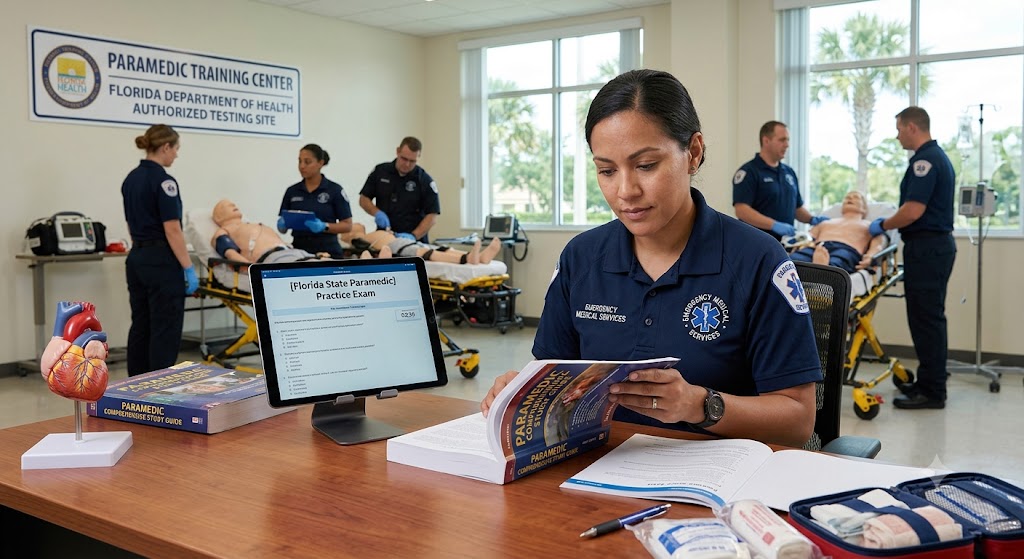
Florida State Paramedic Practice Exam

  • Buy to unlock unlimited access to all Quiz questions and Answers in this Quiz.
  • After purchase you can print a PDF of the whole quiz at any point. The PDF will contain the questions and the correct answers.

About this Exam

The Florida State Paramedic certification is a prestigious credential designed for ambitious Emergency Medical Technicians (EMTs) who are ready to advance their life-saving capabilities.

This rigorous examination acts as the ultimate gateway for emergency medical professionals seeking to practice advanced life support in the state of Florida.

It is specifically tailored for dedicated first responders who want to take on leadership roles during critical medical emergencies and trauma situations.

Achieving this certification proves that you have mastered the complex medical knowledge required to stabilize and treat patients before they reach the hospital.

Sample Questions

Question 1
A 58-year-old male presents with sudden onset of crushing substernal chest pain radiating to his left arm and jaw. He is diaphoretic and pale, with a blood pressure of 90/60 mmHg and a heart rate of 110 bpm. His ECG shows ST elevation in leads II, III, and aVF. What is the most appropriate initial management for this patient?
Administer 325 mg aspirin orally, chewable.
Administer nitroglycerin 0.4 mg sublingually.
Administer oxygen via nasal cannula at 2 LPM.
Prepare for immediate synchronized cardioversion.
Explanation:
The patient is experiencing an inferior wall myocardial infarction (STEMI) given the ST elevation in leads II, III, and aVF. Aspirin is a critical initial intervention to inhibit platelet aggregation. Nitroglycerin is contraindicated with a blood pressure of 90/60 mmHg due to the risk of further hypotension. Oxygen is only indicated if SpO2 is below 94% or signs of hypoxia are present. Synchronized cardioversion is not indicated for this rhythm.
Question 2
You are assessing a 3-year-old child who presents with a sudden onset of barking cough, stridor, and mild respiratory distress. The child is afebrile and has no history of recent illness. The parents report the child was playing with small toys prior to the onset of symptoms. What is the most likely cause of these findings?
Croup
Epiglottitis
Foreign body aspiration
Bronchiolitis
Explanation:
The sudden onset of symptoms, barking cough, stridor, and a history of playing with small toys strongly suggest foreign body aspiration. Croup typically presents with a prodrome of upper respiratory symptoms and fever. Epiglottitis is characterized by a rapid onset of high fever, dysphagia, and drooling. Bronchiolitis usually affects infants and presents with wheezing and crackles.
Question 3
A 24-year-old male was involved in a high-speed motor vehicle collision. He is unresponsive, has shallow respirations at 8 breaths per minute, and a palpable radial pulse of 120 bpm. His pupils are unequal, and he has decerebrate posturing. What is the most critical immediate intervention?
Initiate rapid fluid resuscitation with 2 liters of normal saline.
Perform a rapid trauma assessment and apply a cervical collar.
Secure the airway with an advanced airway device and assist ventilations.
Administer a bolus of 50% dextrose to rule out hypoglycemia.
Explanation:
The patient's shallow respirations and decreased respiratory rate indicate impending respiratory failure. Securing the airway with an advanced airway device and assisting ventilations is the most critical immediate intervention to ensure adequate oxygenation and ventilation, especially in a patient with signs of severe head injury. While a rapid trauma assessment and cervical collar are important, airway management takes precedence. Fluid resuscitation should be judicious in head trauma to avoid increasing intracranial pressure, and dextrose is not the primary intervention here.
Question 4
You respond to a 72-year-old female complaining of sudden onset of severe, tearing back pain that radiates to her legs. She has a history of hypertension. Her blood pressure is 180/100 mmHg in her right arm and 140/80 mmHg in her left arm. Her radial pulses are diminished bilaterally. What is the most likely diagnosis?
Acute myocardial infarction
Pulmonary embolism
Aortic dissection
Renal colic
Explanation:
The patient's presentation with sudden, tearing back pain radiating to the legs, a history of hypertension, and a significant blood pressure differential between arms is highly suggestive of an aortic dissection. Myocardial infarction typically presents with chest pain, not primarily back pain with unequal pulses. Pulmonary embolism would likely present with dyspnea and pleuritic chest pain. Renal colic presents with flank pain, often radiating to the groin.
Question 5
A 6-month-old infant is found unresponsive and apneic. The parents state the infant had a sudden episode of crying and turned blue. There is no obvious trauma. What is the most likely underlying cause of cardiac arrest in this infant?
Sudden Infant Death Syndrome (SIDS)
Respiratory arrest
Cardiac arrhythmia
Aspiration of foreign body
Explanation:
In infants, cardiac arrest is most commonly secondary to respiratory compromise leading to hypoxia, then bradycardia, and finally asystole. While SIDS is a diagnosis of exclusion and foreign body aspiration is a possibility, respiratory arrest is the most common pathway to cardiac arrest in non-traumatic settings for this age group.

Ready to test your knowledge?

Buy Now to Access
Additional Information

What the Course Entails and Exam Details

Preparing for the Florida Paramedic exam requires an extensive understanding of advanced pre-hospital care.

Your coursework and syllabus will dive deeply into crucial topics like advanced airway management, complex pharmacology, and intricate cardiology including ECG interpretation.

Candidates will also master specialized emergency responses for pediatrics, obstetrics, geriatrics, and psychiatric crises.

You will develop critical hands-on skills such as administering intravenous medications, performing surgical airways, and managing life-threatening trauma.

The curriculum is rigorously built to ensure you can think critically under immense pressure while delivering high-level medical interventions.


What to Expect in the Final Exam

Florida utilizes the National Registry of Emergency Medical Technicians (NREMT) cognitive exam to fulfill the state's official testing requirement.

This final exam is a Computer Adaptive Test (CAT), meaning the difficulty of the questions adjusts based on your previous answers to accurately gauge your true competency.

You can expect to face anywhere from 80 to 150 scenario-based, multiple-choice questions during the examination.

Candidates are given a strict time limit of 2.5 hours to complete the test.

To pass, you must demonstrate a standard level of competency across all core medical and trauma subjects, rather than simply hitting a static percentage score.

In addition to the cognitive test, you must also pass a demanding psychomotor (practical) exam where you will physically demonstrate your clinical skills to certified evaluators.


How to Study and Exam Centers

Success requires a disciplined and highly strategic study plan.

Begin by taking numerous timed practice exams to familiarize yourself with the challenging phrasing of NREMT-style questions.

Focus heavily on understanding the underlying pathophysiology of diseases and the "why" behind treatments, rather than just memorizing symptoms.

Form study groups with your peers and utilize reputable online test banks, textbook companion portals, and interactive flashcards.

When you are ready to test, you will need to create an account and schedule your cognitive exam through Pearson VUE.

Pearson VUE operates highly secure, physical testing centers across Florida and the entire country.

Your hands-on psychomotor exam will be scheduled and conducted at specific, state-approved EMS training centers or authorized educational schools.


Job Opportunities from the Course

Earning your paramedic license in Florida opens the door to a wide variety of exciting, well-paying, and highly respected career paths.

You can pursue a role as a Lead Paramedic on a 911 ambulance, directing patient care during critical community emergencies.

Many ambitious graduates transition into specialized roles such as a Flight Paramedic, providing critical care aboard medical helicopters and fixed-wing aircraft.

You might also work as an Emergency Room Technician or Paramedic, supporting nurses and doctors in fast-paced hospital trauma centers.

Becoming a Firefighter Paramedic is another highly sought-after position, combining community rescue and fire suppression duties with advanced medical response.

Additionally, you can find lucrative opportunities as an Industrial Medic, working in unique environments like offshore oil rigs, luxury cruise ships, or large-scale construction sites.


Frequently Asked Questions

This quiz contains a total of 0 practice questions carefully selected to test your knowledge on this subject.
Yes, you will have exactly 0 minutes to complete the exam. A countdown timer will be visible once you start.
Yes, you can retake this practice test as many times as you need. The questions and options may be randomized on subsequent attempts to ensure comprehensive learning.

Reviews

5.0

Based on 0 reviews

Leave a Review

No reviews yet. Be the first to review!