
Florida State Service and Repair Pool Contractor Practice Exam
$69.00
- Buy to unlock unlimited access to all Quiz questions and Answers in this Quiz.
- After purchase you can print a PDF of the whole quiz at any point. The PDF will contain the questions and the correct answers.
About this Exam
The Florida State Service and Repair Pool Contractor license is a crucial credential for professionals dedicated to the maintenance, repair, and servicing of existing swimming pools and spas. This certification is specifically designed for individuals who want to legally operate a pool service business, or hold a leadership position within one, in the state of Florida.
Unlike construction-focused licenses, this classification focuses entirely on the after-market care of the pool structure and its mechanical systems. This includes water chemical balancing, equipment installation and repair (such as pumps, filters, heaters, and chlorinators), and routine maintenance essential for safety and sanitation.
Sample Questions
Explanation:
Explanation:
Explanation:
Explanation:
Explanation:
Ready to test your knowledge?
Buy Now to Access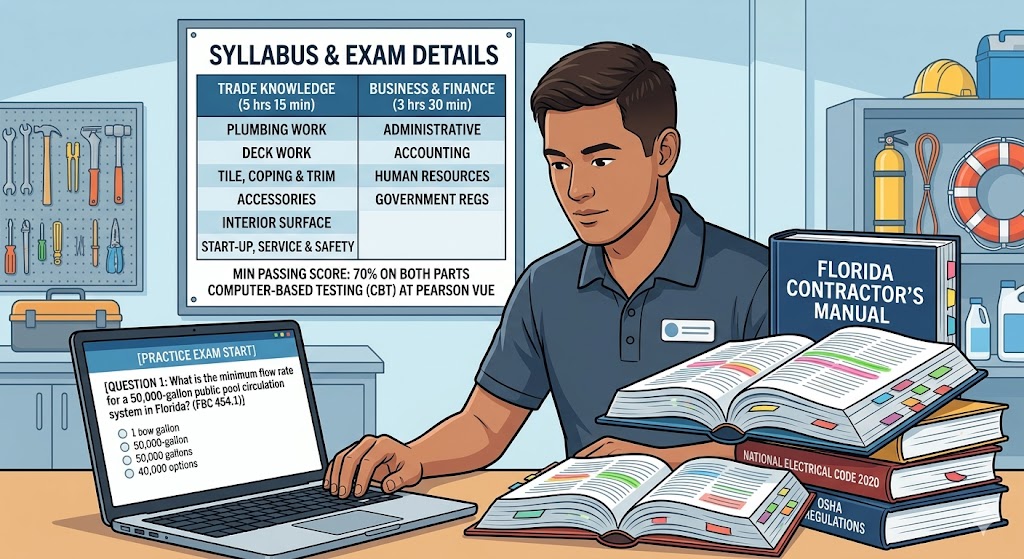
Additional Information
What the Course Entails and Exam Details
This examination is rigorous and tests a candidate’s comprehensive knowledge across several key competency areas defined by the Florida Department of Business and Professional Regulation (DBPR). A comprehensive prep course or practice exam program covers the following essential topics:
Pool & Spa Management and Operation: Understanding water chemistry, testing procedures, chemical application safety, and the calculation of pool volume and chemical dosages.
Equipment Installation and Repair: Deep knowledge of the circulation system, including pump hydraulics, filter types (sand, D.E., cartridge), heater troubleshooting (gas and electric), and automated control systems.
Applicable Laws and Regulations: Mastery of the Florida Building Code as it pertains to pools (specifically the residential and commercial pool sections), Florida State Statutes Chapter 489, and OSHA safety standards.
Safety Standards: Proper handling of hazardous materials, electrical safety requirements for pool areas (NEC requirements), and entrapment prevention standards (VGB Act).
What to Expect in the Final Exam
The actual Florida State Service and Repair Pool Contractor Exam is a challenging assessment administered by a state-approved testing vendor (typically Pearson VUE). You must expect the following format:
Exam Format: The exam is open-book, consisting of multiple-choice questions. Do not underestimate the difficulty simply because it is open-book; the exam is timed, and you must know exactly where to find the answers within the approved reference manuals.
Time Limit: Candidates are typically allotted a substantial block of time (often 4 to 5 hours) to complete the examination. Efficient time management is critical.
Passing Score: A passing grade of 70% is required to qualify for licensure.
Reference Materials: You will be required to bring your own copies of the official reference books permitted by the DBPR. These usually include the Florida Building Code, various APSP/PHTA manuals, and contractor business guides. Highlighting and indexing your books is essential.
How to Study and Exam Centers
Preparation is the absolute key to success on this open-book exam. Simply reading the materials is insufficient. You need an active study strategy:
1. Obtain the Official Reference List: Before doing anything else, download the current list of approved reference manuals from the Florida DBPR website. You must study from the exact editions listed.
2. Master the Reference Books: Your study should focus on navigating these books quickly. Use permanent plastic tabs to index key chapters and regulations. Highlight critical data, formulas, and safety requirements.
3. Utilize Practice Exams: Taking practice tests—like the Florida State Service and Repair Pool Contractor Practice Exam—is the best way to acclimate to the exam format and time pressure. Practice exams help you identify gaps in your knowledge and improve your lookup speed.
4. Schedule Your Exam: The exam is administered year-round at Pearson VUE testing centers throughout Florida and across the United States. You must first apply to the DBPR and receive authorization before you can schedule your specific exam date and location.
Job Opportunities from the Course
Successfully passing this exam and obtaining your license opens numerous career paths in Florida’s booming aquatics industry. This license allows you to act as the qualifying agent for a business, enabling you to legally perform contract work.
Potential job titles and career paths include:
Licensed Pool Service & Repair Business Owner
Lead Service Technician
Pool Repair Specialist / Mechanic
Commercial Pool Maintenance Supervisor (for hotels, resorts, and HOAs)
Pool Service Department Manager
Water Quality Specialist
Frequently Asked Questions
Reviews
5.0
Based on 0 reviews
Leave a Review
No reviews yet. Be the first to review!