
Florida Unlimited Electrical (1-57) Practice Exam
$69.00
- Buy to unlock unlimited access to all Quiz questions and Answers in this Quiz.
- After purchase you can print a PDF of the whole quiz at any point. The PDF will contain the questions and the correct answers.
About this Exam
The Florida Unlimited Electrical certification is a prestigious milestone for electrical professionals looking to elevate their careers.
This comprehensive credential is specifically designed for ambitious electricians who want to operate without commercial or residential project restrictions.
Holding an unlimited license means you are legally recognized by the state of Florida to install, repair, and maintain any electrical wiring or equipment.
It is the ultimate goal for those aiming to become master electricians or independent electrical contracting business owners in a booming construction market.
Achieving this certification proves your mastery of the trade and commitment to public safety.
Sample Questions
Explanation:
Explanation:
Explanation:
Explanation:
Explanation:
Ready to test your knowledge?
Buy Now to Access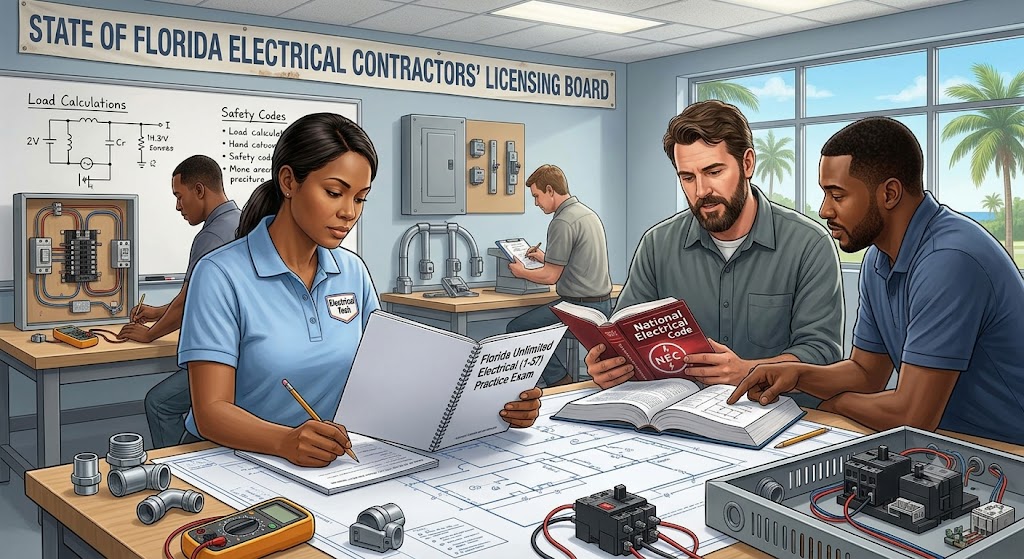
Additional Information
What the Course Entails and Exam Details
Preparing for this certification requires a deep understanding of advanced electrical theories and practical, real-world applications.
The core syllabus heavily focuses on mastering the latest National Electrical Code (NEC) standards and Florida-specific building and safety codes.
Candidates will dive extensively into complex wiring methods, grounding and bonding, motor controls, and sophisticated transformer calculations.
You will also cover crucial safety regulations mandated by OSHA to ensure all job sites and personnel remain safe.
Beyond the technical trade skills, a successful candidate must also understand basic blueprint reading, fire alarm system integration, and voltage drop formulas.
What to Expect in the Final Exam
The actual examination is a rigorous test of your applied knowledge and your code-referencing speed.
You will face a comprehensive multiple-choice format that simulates real-world electrical contracting scenarios and mathematical problems.
Because this is typically an open-book exam, your ability to quickly navigate the NEC and associated reference materials is just as important as your memorization skills.
The technical trade portion of the exam allows approximately five hours for completion, requiring intense focus and strategic time management.
Candidates must achieve a passing score of at least 75 percent to successfully earn their certification and proceed with their licensure application.
How to Study and Exam Centers
The most effective study strategy is to properly tab and highlight your approved code books for rapid reference during the timed test.
Taking full-length, timed practice exams is critical to building your mental endurance and identifying areas where your code lookup speed needs improvement.
Many professionals find exceptional success by joining dedicated exam prep courses that break down complex electrical calculation formulas into simple, manageable steps.
When you are fully prepared and ready to test, the official exams are regulated by the Florida Department of Business and Professional Regulation (DBPR).
You will need to schedule and take your computer-based test at an authorized Pearson VUE physical testing center, which has convenient locations spread all across the state.
Job Opportunities from the Course
Earning this license immediately opens the door to top-tier roles and lucrative contracts within the electrical and construction industries.
Certified Electrical Contractor
Master Electrician
Electrical Project Manager
Commercial Electrical Inspector
Electrical Business Owner
Chief Electrical Estimator
Senior Facilities Maintenance Manager
Frequently Asked Questions
Reviews
5.0
Based on 0 reviews
Leave a Review
No reviews yet. Be the first to review!