
Florida US History EOC Practice Exam
$69.00
- Buy to unlock unlimited access to all Quiz questions and Answers in this Quiz.
- After purchase you can print a PDF of the whole quiz at any point. The PDF will contain the questions and the correct answers.
About this Exam
The Florida U.S. History End-of-Course (EOC) assessment is a crucial milestone for high school students across the state.
It is designed to measure student achievement of the Next Generation Sunshine State Standards (NGSSS) in American history.
This standardized exam is primarily meant for high school students who are completing their required United States History course.
Successfully navigating this exam demonstrates a firm understanding of the nation's past and ensures students meet the state's graduation requirements.
Sample Questions
Explanation:
Explanation:
Explanation:
Explanation:
Explanation:
Ready to test your knowledge?
Buy Now to Access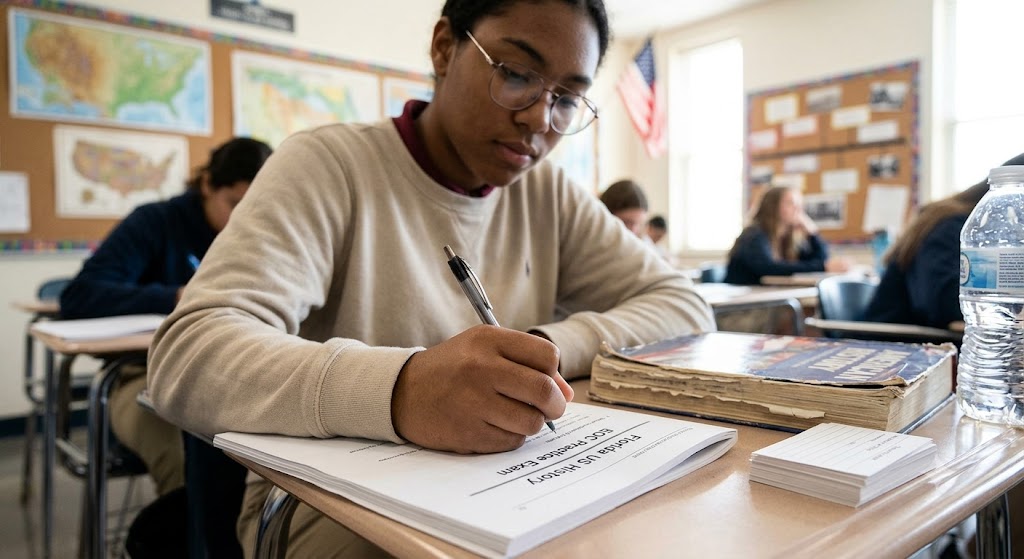
Additional Information
What the Course Entails and Exam Details
The Florida U.S. History course provides a comprehensive journey through the development of the United States.
It specifically focuses on the nation's historical timeline from the Civil War and Reconstruction era all the way to the present day.
Students will delve deeply into major historical eras, including the Late Nineteenth Century, the World Wars, the Cold War, and the Civil Rights Movement.
Key syllabus areas assess a student's ability to analyze primary source documents, understand global military and economic encounters, and grasp the social and political changes that shaped modern America.
The exam tests critical thinking, reading comprehension, and historical analysis skills rather than just the rote memorization of dates.
What to Expect in the Final Exam
The U.S. History EOC is administered as a computer-based test (CBT), though paper-based accommodations are available for eligible students.
You can expect a variety of question formats, including multiple-choice items and technology-enhanced questions that require drag-and-drop or multi-select answers.
Typically, the exam contains between 50 and 60 questions in total.
Students are given 160 minutes to complete the test, but testing centers often allow students to continue working through a standard school day if they need more time.
It is important to remember that this EOC exam accounts for 30% of a student's final course grade, and achieving a Level 3 or higher is considered a passing score.
How to Study and Exam Centers
Effective preparation is the key to passing the U.S. History EOC with flying colors.
Begin by taking a Florida US History EOC practice exam to identify your weak points and familiarize yourself with the question formats.
Utilize resources like the Florida Virtual School (FLVS) practice tests, review historical timelines, and create flashcards for major historical figures, acts, and events.
Practicing with primary source documents, such as political cartoons and historical speeches, will significantly boost your analytical skills.
The exam is typically administered directly at the student's enrolled public high school.
For virtual school or homeschooled students, the school district will assign a specific authorized public testing center or local high school where the exam can be safely proctored.
Job Opportunities from the Course
While this is a high school level examination, mastering U.S. History and earning your diploma builds a strong foundational knowledge for several high-level career paths.
Understanding history develops critical thinking, research, and communication skills that are highly valued in the workforce.
Here are several career opportunities and fields this educational foundation can unlock:
Historian: Researching, analyzing, and preserving historical records for universities or government agencies.
Lawyer or Paralegal: Utilizing the analytical skills and understanding of constitutional history to navigate the legal system.
Political Scientist: Analyzing the origin, development, and operation of political systems and public policy.
Museum Curator or Archivist: Preserving historical artifacts and designing educational exhibits for the public.
Educator or Teacher: Guiding the next generation of students through history at the secondary or post-secondary level.
Journalist or Reporter: Using historical context to investigate and report on modern societal and political events.
Public Relations Specialist: Understanding cultural backgrounds and historical precedents to craft effective public messaging.
Frequently Asked Questions
Reviews
5.0
Based on 0 reviews
Leave a Review
No reviews yet. Be the first to review!