
FMC Marketing and Merchandising Practice Test
$69.00
- Buy to unlock unlimited access to all Quiz questions and Answers in this Quiz.
- After purchase you can print a PDF of the whole quiz at any point. The PDF will contain the questions and the correct answers.
About this Exam
The FMC Marketing and Merchandising Practice Test is an essential preparatory tool designed for individuals aiming to achieve professional certification in the retail and fashion sectors. This exam serves as a comprehensive assessment of a candidate’s understanding of the core principles of marketing, consumer behavior, and tactical product placement within the retail landscape.
It is ideal for aspiring retail managers, visual merchandisers, product developers, and assistant buyers who want to validate their knowledge and gain a competitive edge in the fast-paced fashion and retail industries. By successfully navigating this practice exam, candidates demonstrate their readiness to handle the complexities of product life cycles, trend forecasting, and customer relationship management.
Ready to test your knowledge?
Buy Now to Access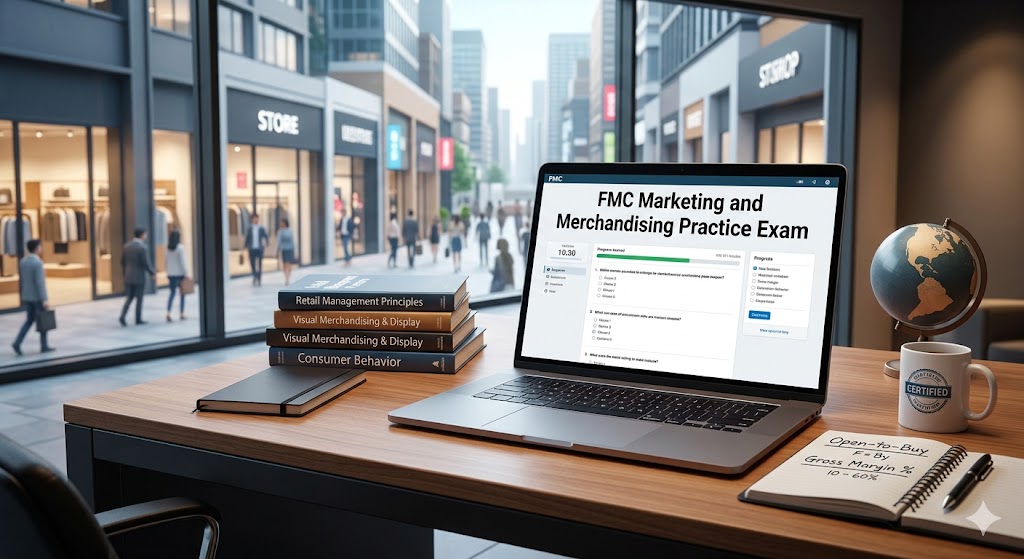
Additional Information
What the Course Entails and Exam Details
The final exam is built on a robust curriculum that blends analytical skill with creative application. The following topics represent the foundational pillars covered:
Retail and Fashion Industry Landscape: Understanding the structure, key players, and global dynamics of the fashion and general retail market.
Marketing Principles and Consumer Behavior: Analyzing market segmentation, target demographics, psychology of the shopper, and effective promotional strategies.
Merchandising Operations and Financials: Master the mathematics of retail, including open-to-buy planning, pricing strategies, inventory allocation, and profit margin analysis.
Visual Merchandising and Store Design: The principles of window and floor display, product placement, atmospheric design, and creating compelling customer experiences.
Trend Forecasting and Product Development: How to research, identify, and apply upcoming trends to product assortments, and manage the product life cycle.
Supply Chain and Vendor Management: Logistics, global sourcing, effective negotiation techniques with suppliers, and quality control.
What to Expect in the Final Exam
The actual certification exam typically adopts a computerized, multiple-choice format, designed to test both theoretical knowledge and practical application through situational questions. While specific details may vary based on the certifying body, here is a general overview of the exam structure:
Format: 100 to 150 multiple-choice questions.
Duration: Candidates usually have between 2 and 3 hours to complete the examination.
Passing Score: The pass mark is often in the range of 70% to 75%.
Type of Assessment: A significant portion of the test will focus on case studies and scenario-based questions where candidates must apply their knowledge to solve real-world marketing and merchandising challenges.
Restrictions: Exams are typically closed-book, and candidates may be provided with an on-screen calculator for financial questions.
How to Study and Exam Centers
Effective preparation for the FMC Marketing and Merchandising Practice Test requires a structured study plan:
Utilize Official Study Guides: Begin with the core textbook or study material provided by your course provider or the certifying organization. These are the most accurate reflection of the exam content.
Take Multiple Practice Tests: Engage with several different practice exams. This will familiarize you with the question format, improve your time management, and highlight areas where you need further review.
Master Retail Mathematics: Do not underestimate the quantitative sections. Dedicate specific study time to practicing open-to-buy, gross margin, and inventory turnover calculations until they become second nature.
Form Study Groups: Collaborating with peers can provide new perspectives on complex visual merchandising or strategic marketing problems.
Exam Centers and Administration
The official certification exam is typically administered in two ways:
Authorized Physical Testing Centers: Many candidates take the proctored exam in person at established testing centers such as Pearson VUE, which have locations globally.
Online Proctored Exams: There is an increasing option to take the exam remotely from a private, secure location via an approved online proctoring portal, which requires a stable internet connection and a webcam.
Job Opportunities from the Course
Earning a certification in marketing and merchandising unlocks diverse career paths across the retail, fashion, and consumer goods industries. Below is a list of job titles this credential can help you secure:
Retail Merchandiser
Visual Merchandiser
Assistant Buyer
Retail Store Manager
Marketing Coordinator
Product Development Associate
Inventory Planner
Brand Manager Assistant
Allocation Analyst
Fashion Marketing Specialist
Frequently Asked Questions
Reviews
5.0
Based on 0 reviews
Leave a Review
No reviews yet. Be the first to review!