
FOA Certified Premises Cabling Technician Practice Exam
$69.00
- Buy to unlock unlimited access to all Quiz questions and Answers in this Quiz.
- After purchase you can print a PDF of the whole quiz at any point. The PDF will contain the questions and the correct answers.
About this Exam
The FOA Certified Premises Cabling Technician (CPCT) is an essential, entry-level certification for professionals aiming to design, install, and operate premises cabling networks. This comprehensive program, offered by the Fiber Optic Association (FOA), is tailored for technicians working on infrastructure within buildings and on campuses, for applications such as computer LANs, security systems (CCTV, alarms), building management systems, and distributed antenna systems (DAS) for cellular and Wi-Fi. It is designed to provide the foundational knowledge, practical skills, and abilities required to validate expertise in this vital, rapidly growing field. This certification serves as a benchmark for competence, opening doors for aspiring technicians and allowing experienced workers to officially validate their skills.
Ready to test your knowledge?
Buy Now to Access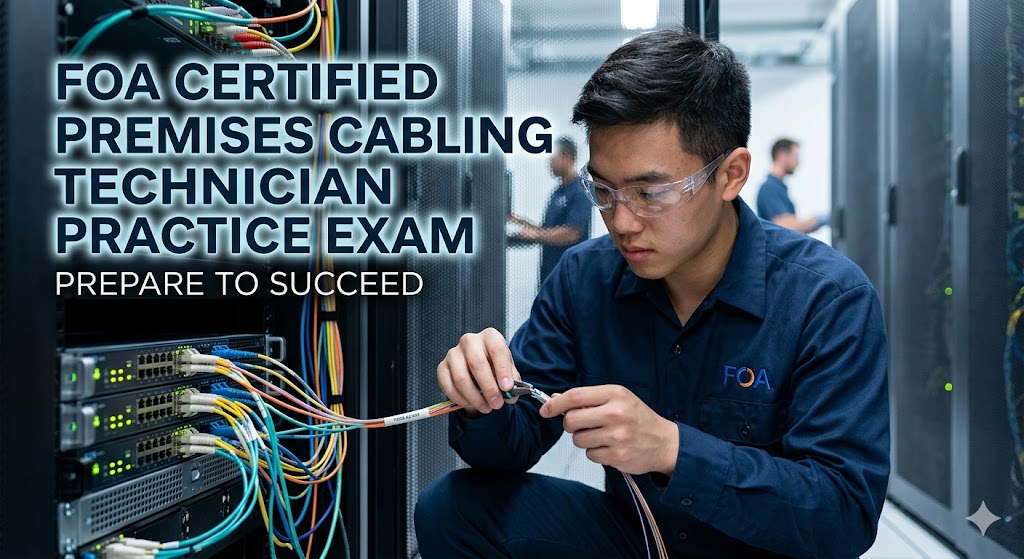
Additional Information
What the Course Entails and Exam Details
To achieve the CPCT certification, candidates must demonstrate competence in both theory and practical application. The training curriculum at FOA-approved schools covers a wide array of topics crucial to the premises cabling technician. These include:
An extensive overview of premises cabling systems, including structured cabling standards.
In-depth study of copper cabling, focusing on Unshielded Twisted Pair (UTP) and coaxial cables.
Comprehensive knowledge of fiber optic cabling used within premises networks.
Understanding of cabling for wireless communications, including DAS.
Principles of premises cabling network design.
Step-by-step procedures for the installation of both copper and fiber cabling.
Industry-standard testing and troubleshooting methods for complete cable plants.
Critical safety practices for installers working in a premises environment.
A major component of CPCT training is hands-on laboratory exercises, which verify a student's ability to prepare, terminate, and test premises cabling networks.
What to Expect in the Final Exam
The final FOA CPCT exam is a rigorous assessment that measures a candidate's mastery of the program's objectives. It is a comprehensive, closed-book test administered by FOA-approved schools or online through their portals. The exam typically consists of 100 items, presented in multiple-choice, matching, and true/false question formats. To successfully pass and earn the certification, candidates are required to achieve a minimum score of 70%, which corresponds to answering at least 70 questions correctly. While exact time limits can vary by testing location, most students are allotted between 1.5 to 2 hours to complete the examination. In some cases, and depending on specific exam protocols, a standard calculator may be permitted, but no other reference materials are allowed.
How to Study and Exam Centers
Preparation for the CPCT exam requires a combination of study and practical experience. Start by obtaining the official exam objectives from the Fiber Optic Association website to focus your efforts. A key, free resource is Fiber U, the FOA's online learning platform, which offers the Premises Cabling self-study course as an excellent starting point for all students. Creating a dedicated study plan, joining study groups, and utilizing practice questions to simulate the exam environment are effective strategies. Most importantly, nothing replaces hands-on lab experience; you should maximize your time in a training lab, perfecting techniques for termination and testing. The primary way to take the official exam is through one of the many FOA-Approved Fiber Optic Training programs located globally. These authorized schools are well-equipped with labs for hands-on training and are the only entities authorized to administer the final certification exam.
Job Opportunities from the Course
A Certified Premises Cabling Technician (CPCT) designation is a valuable asset that opens up diverse career paths in the telecommunications and IT industries. Certified technicians are in high demand to build and maintain the physical network infrastructure that powers modern businesses. Some of the specific job titles and career paths this certification can unlock include:
Premises Cabling Technician
Structured Cabling Installer (Copper and Fiber)
Network Infrastructure Installer
Security System Technician (CCTV and Alarms)
Building Management Systems Tech
Distributed Antenna System (DAS) Installer
IT Technician (Physical Layer Specialist)
Field Service Technician
Frequently Asked Questions
Reviews
5.0
Based on 0 reviews
Leave a Review
No reviews yet. Be the first to review!