
FOCL Practice Test
$69.00
- Buy to unlock unlimited access to all Quiz questions and Answers in this Quiz.
- After purchase you can print a PDF of the whole quiz at any point. The PDF will contain the questions and the correct answers.
About this Exam
The FOC Fiber Optic Practice Exam is a comprehensive preparatory tool designed for professionals and students aspiring to become certified in fiber optic technology. This practice exam is based on the core competencies required for recognized certifications in the field, such as the Certified Fiber Optic Technician (CFOT) and other industry-standard credentials offered by organizations like The Fiber Optic Association (FOA) and BICSI. The primary goal of the practice test is to simulate the final exam experience, allowing candidates to assess their knowledge, identify critical skill gaps, and build confidence before taking the formal certification assessment. It is ideal for field technicians, network engineers, cable installers, and IT professionals who design, install, or maintain fiber optic communication systems.
Ready to test your knowledge?
Buy Now to Access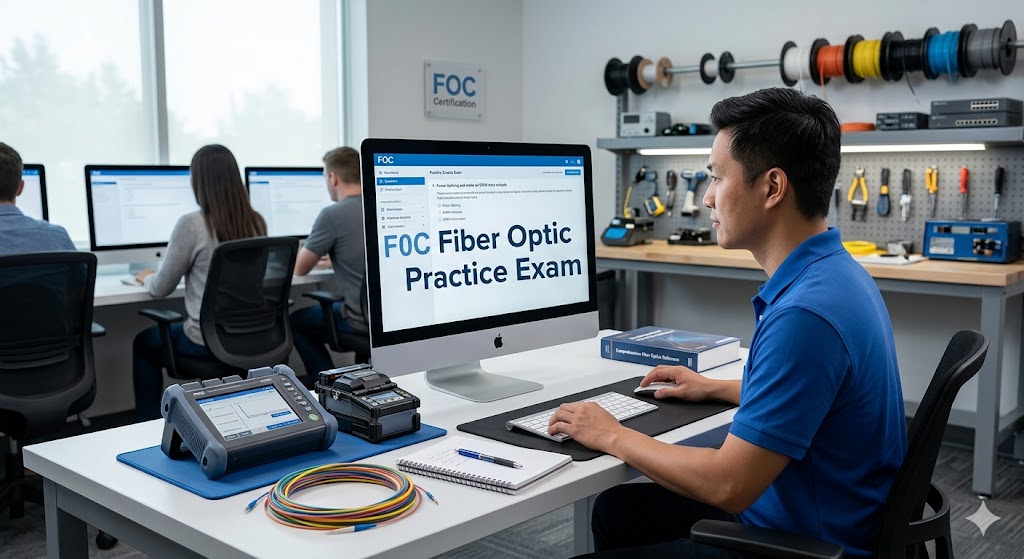
Additional Information
What the Course Entails and Exam Details
This practice exam covers the essential body of knowledge found in comprehensive fiber optic courses. While it does not substitute for hands-on training, it evaluates a candidate’s understanding of the theoretical and practical applications of the technology. The core topics, which align with a typical FOC syllabus, include:
Fiber Optic Theory: Principles of light propagation, total internal reflection, attenuation, and dispersion.
Fiber and Cable Types: Distinguishing between single-mode and multimode fibers, and understanding various cable constructions.
Connectors and Termination: Knowledge of popular connector styles, termination methods (adhesive, anaerobic, mechanical), and best practices for polishing.
Splicing Techniques: Principles of fusion splicing and mechanical splicing, including splice protection and loss factors.
Testing and Troubleshooting: Proficiency in using optical loss test sets (OLTS) and Optical Time-Domain Reflectometers (OTDRs) for link loss testing and fault location.
Network Design and Installation: Understanding basic fiber network architectures (FTTH, LANs), safety standards, and proper installation practices.
Safety Standards: Familiarity with laser safety, proper handling of fiber, and OSHA regulations.
The practice exam typically consists of a large pool of multiple-choice and scenario-based questions, randomly generated to provide a unique test each time.
What to Expect in the Final Exam
While the final exam structure can vary slightly depending on the certifying body, candidates who use this practice test can generally expect a similar rigorous format. The final certification exam is usually:
Format: A computer-based, proctored test composed entirely of closed-book multiple-choice questions. A hands-on skills assessment is often also required to earn the full certification, which must be completed through an authorized training partner.
Number of Questions: Between 75 and 100 questions.
Time Limit: 90 to 120 minutes.
Passing Score: Typically requires achieving a score of 70% to 80% or higher.
Specific Rules: Candidates must show valid photo identification and are prohibited from bringing notes, textbooks, electronic devices, or mobile phones into the testing area. No calculator is usually needed or allowed. Retake policies vary, often requiring a waiting period between attempts.
How to Study and Exam Centers
Successfully passing an FOC final exam requires a balanced approach of theoretical study and practical experience. Here are actionable strategies for effective preparation:
Start with a Comprehensive Course: Before challenging any exam, complete a structured fiber optic training program from an authorized provider. These courses provide the essential hands-on skills (splicing, testing) that a multiple-choice practice exam cannot evaluate.
Utilize Official Study Guides: Rely heavily on the textbooks and official study materials provided by the certification organization, such as the FOA Reference Guide to Fiber Optics.
Take Multiple Practice Tests: Use the FOC Practice Test extensively. It is designed to expose you to the breadth and depth of the material and to familiarize you with the wording and style of exam questions. Review the detailed explanations provided for both correct and incorrect answers.
Create Flashcards: Master technical definitions, laser safety classes, cable color codes, and loss budget formulas using flashcards.
Practice Hands-on: Whenever possible, review testing procedures on a live link or simulator. Understand how to interpret an OTDR trace.
Exam Centers: Formal FOC certification exams cannot be taken at any location. They must be taken through authorized and proctored channels:
Authorized Training Schools: The majority of candidates take their exam directly after completing a hands-on training course at an FOA-approved or BICSI-approved school.
Online Portals (With Proctoring): Some organizations allow candidates to take the written portion of the exam online from their home or office, but only via a live, remote proctoring service that monitors the session via webcam and microphone.
Job Opportunities from the Course
Earning an FOC certification, supported by the knowledge validated through this practice exam, opens doors to various in-demand career paths in the telecommunications and data networking industries. Certified professionals can pursue job titles including:
Fiber Optic Technician
Network Installer / Cable Installer
Field Service Technician
Outside Plant (OSP) Technician
Telecommunications Line Installer and Repairer
Broadband Technician
Data Center Technician
Network Engineer (specializing in optical transport)
Network Operations Center (NOC) Analyst
FTTH (Fiber to the Home) Planner
Project Manager (Fiber Deployments)
Frequently Asked Questions
Reviews
5.0
Based on 0 reviews
Leave a Review
No reviews yet. Be the first to review!