
Forensic Nursing Practice Exam
$69.00
- Buy to unlock unlimited access to all Quiz questions and Answers in this Quiz.
- After purchase you can print a PDF of the whole quiz at any point. The PDF will contain the questions and the correct answers.
About this Exam
The Forensic Nursing Certification is a highly respected credential designed specifically for registered nurses who wish to intersect medical care with the legal system.
This specialized qualification is perfect for compassionate and detail-oriented nurses aiming to provide comprehensive care to victims of trauma, violence, or abuse.
Earning this certification demonstrates your exceptional competence in handling sensitive forensic evidence while maintaining the highest standard of patient care.
It serves as a professional milestone that reassures employers, legal teams, and the public of your expertise in trauma-informed clinical practices.
Ready to test your knowledge?
Buy Now to Access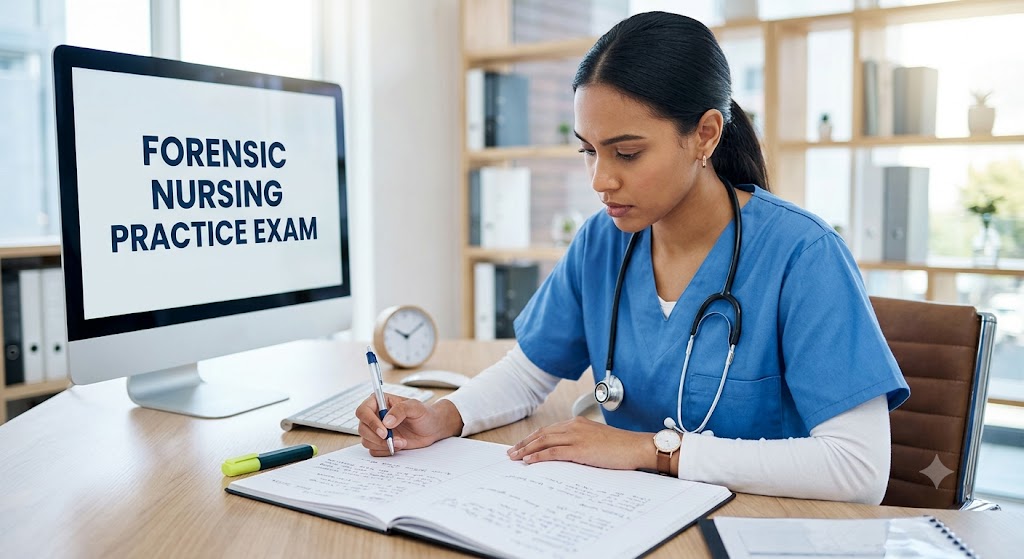
Additional Information
What the Course Entails and Exam Details
A standard forensic nursing curriculum prepares you for the complex realities of dealing with crime victims and the justice system.
The core syllabus heavily focuses on trauma-informed care, ensuring you understand the psychological and physical impact of violence on patients.
You will dive deep into meticulous evidence collection, preservation techniques, and maintaining a strict chain of custody.
Additionally, the coursework covers medical-legal documentation, teaching you how to write objective, court-admissible reports.
Students also learn the intricacies of courtroom testimony, preparing them to serve confidently as expert witnesses during legal proceedings.
Specific tracks may also involve detailed training in sexual assault examinations, domestic violence interventions, and clinical death investigations.
What to Expect in the Final Exam
The final certification exam is a rigorous evaluation designed to test both your theoretical knowledge and your practical decision-making skills.
Typically, the exam consists of 150 to 175 multiple-choice questions, which include a mix of factual recall and complex clinical scenario analysis.
Candidates are generally given a strict time limit of three to four hours to complete the test, demanding excellent time management.
To pass, you must usually achieve a criterion-referenced score, which often translates to correctly answering around 70% to 75% of the scored questions.
The testing environment is highly secure, meaning you will be subjected to strict identification checks and prohibited from bringing any personal items, electronics, or study notes into the exam room.
How to Study and Exam Centers
Successfully passing this exam requires a strategic and dedicated study plan.
Begin by deeply reviewing the official guidelines and core standards published by recognized bodies like the International Association of Forensic Nurses (IAFN).
Taking multiple practice exams is one of the most effective ways to familiarize yourself with the question formats and pinpoint areas where you need more review.
Forming study groups with fellow nurses can also provide emotional support and diverse perspectives on complex legal-medical scenarios.
When you are ready to test, the exams are typically administered through major global testing networks such as Meazure Learning or Pearson VUE.
You can choose to take the exam at a secure, physical testing center located in major cities, or you may opt for live online proctoring from the quiet and comfort of your own home.
Job Opportunities from the Course
Earning your forensic nursing certification opens the door to a variety of impactful and uniquely specialized career paths.
Sexual Assault Nurse Examiner (SANE): Provide compassionate, specialized care and conduct forensic examinations for victims of sexual assault.
Forensic Nurse Investigator: Work closely with medical examiners and law enforcement to investigate sudden, unexplained, or violent deaths.
Legal Nurse Consultant: Review medical records, advise attorneys on health-related legal cases, and provide expert testimony in court.
Correctional Nurse: Deliver essential medical care and forensic evaluations to inmates within jails, prisons, and juvenile detention centers.
Domestic Violence Nurse Examiner: Specialize in treating and documenting injuries for victims of intimate partner violence while connecting them to vital legal resources.
Frequently Asked Questions
Reviews
5.0
Based on 0 reviews
Leave a Review
No reviews yet. Be the first to review!