
Forest Pest Control Category 2 Practice Test
$69.00
- Buy to unlock unlimited access to all Quiz questions and Answers in this Quiz.
- After purchase you can print a PDF of the whole quiz at any point. The PDF will contain the questions and the correct answers.
About this Exam
The Forest Pest Control Category 2 certification is a specialized credential designed for professionals who manage, protect, and maintain forest environments.
This certification verifies your expertise in safely applying pesticides and managing pest populations that threaten timber, woodlands, and forest nurseries.
It is ideal for forestry technicians, commercial pesticide applicators, conservationists, and land managers who want to demonstrate their commitment to environmental safety and regulatory compliance.
Taking a practice exam is the most effective way to gauge your readiness, build confidence, and ensure you are fully prepared to earn your state-issued applicator license.
Ready to test your knowledge?
Buy Now to Access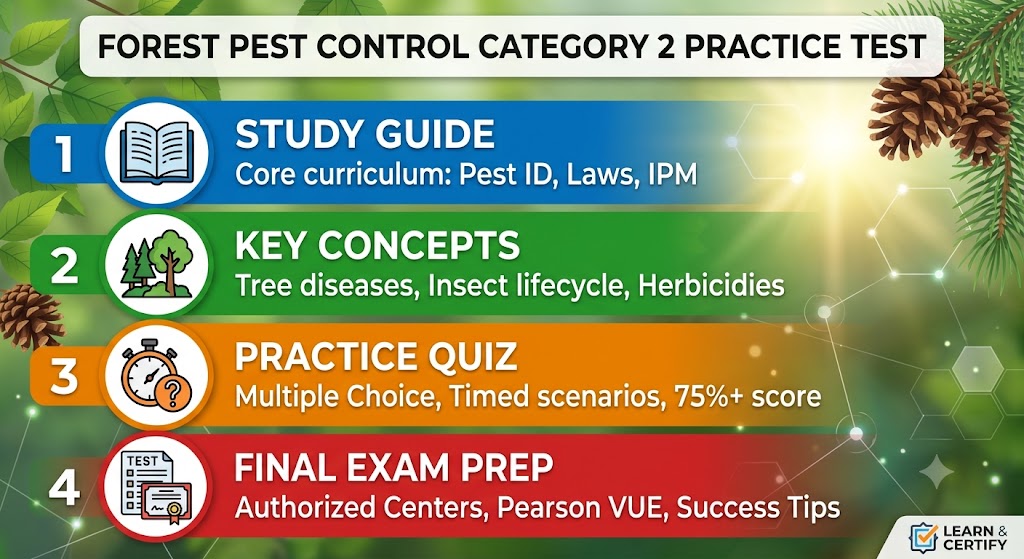
Additional Information
What the Course Entails and Exam Details
To succeed in this field, the course curriculum covers a comprehensive range of topics tailored to forest ecosystems.
You will dive deep into identifying common forest pests, including invasive insects, destructive diseases, and competing weed species.
The syllabus heavily emphasizes Integrated Pest Management (IPM) strategies, teaching you how to balance chemical, biological, and mechanical control methods.
Additionally, you will learn about proper pesticide handling, equipment calibration, environmental hazards, and groundwater protection.
A critical component of the course is mastering state and federal pesticide laws to ensure that all your applications are strictly compliant with current environmental regulations.
What to Expect in the Final Exam
The final certification exam is a closed-book, multiple-choice test designed to evaluate both your theoretical knowledge and practical decision-making skills.
While the exact number of questions varies by state, most exams feature between 50 and 100 questions that you must complete within a two- to three-hour time limit.
You should expect scenario-based questions that require you to calculate application rates, choose the correct protective gear, and identify pests from descriptions or images.
Most regulatory agencies require a passing score of 70% to 75% to successfully earn your credential.
Strict exam rules apply, meaning mobile phones, unapproved calculators, and outside study materials are strictly prohibited inside the testing room.
How to Study and Exam Centers
Effective preparation requires a combination of structured reading and active testing.
Start by thoroughly studying your state's official Category 2 Forest Pest Control manual, paying special attention to glossary terms, warning labels, and mathematical formulas.
Take full-length practice exams regularly to familiarize yourself with the phrasing of the questions and to improve your time management skills.
When you are ready to take the official test, you will typically need to register through your state's Department of Agriculture or environmental protection agency.
Many states have partnered with authorized third-party testing organizations like Pearson VUE, allowing you to easily schedule and sit for a computer-based exam at a local physical testing center.
Job Opportunities from the Course
Earning your Category 2 certification opens the door to a variety of rewarding and high-demand career paths in environmental and agricultural sectors.
Commercial Pesticide Applicator: Work independently or with agricultural firms to safely treat large tracts of forested land.
Forestry Technician: Assist in managing timber resources, conducting pest surveys, and maintaining overall forest health for private or government lands.
Forest Nursery Manager: Oversee the cultivation of tree seedlings while protecting them from devastating diseases and insect infestations.
Conservation Scientist: Partner with state or federal agencies to implement long-term strategies that protect vulnerable ecosystems from invasive pests.
Timber Operations Manager: Ensure that valuable logging tracts remain healthy and pest-free leading up to harvest season.
Frequently Asked Questions
Reviews
5.0
Based on 0 reviews
Leave a Review
No reviews yet. Be the first to review!