
Forklift Australia Practice Test
$69.00
- Buy to unlock unlimited access to all Quiz questions and Answers in this Quiz.
- After purchase you can print a PDF of the whole quiz at any point. The PDF will contain the questions and the correct answers.
About this Exam
Obtaining a forklift license in Australia is a fundamental requirement for anyone seeking work in warehousing, logistics, construction, or manufacturing.
This certification validates that an individual possesses the essential skills and knowledge required to safely and competently operate a forklift.
This course is specifically designed for individuals aspiring to become licensed forklift operators, looking to enhance their employability, and aiming to work in industries where material handling is a core operation.
The practice test serves as a critical tool to help candidates assess their readiness for the official high-risk work (HRW) license assessment, ensuring they are well-prepared to demonstrate their proficiency in both theoretical knowledge and practical operation.
Ready to test your knowledge?
Buy Now to Access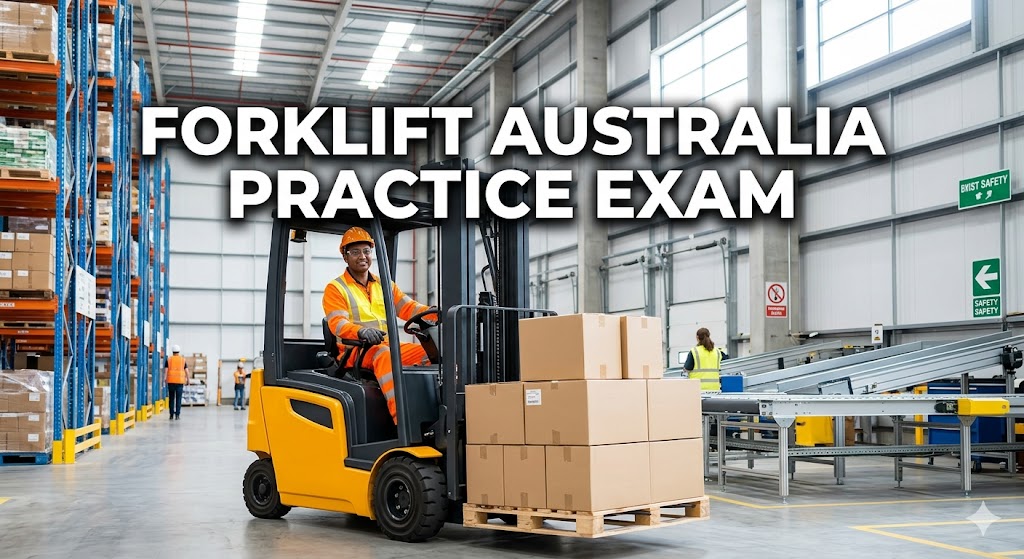
Additional Information
What the Course Entails and Exam Details
The comprehensive training leading up to the forklift assessment covers a wide spectrum of essential skills and safety protocols.
Key topics included in the course syllabus are:
Comprehensive understanding of OHS/WHS regulations relevant to forklift operation.
Detailed pre-operational and post-operational vehicle safety checks.
Mastering the controls, indicators, and maneuvering techniques of a forklift.
Safe loading, lifting, transporting, and stacking of various materials and pallet types.
Hazard identification, risk assessment, and implementing effective control measures within a workplace environment.
Understanding load capacity, stability triangles, and the effects of center of gravity.
Emergency procedures and protocols for safe operation in different conditions and layouts.
The certification process culminates in a formal assessment conducted by an accredited assessor, validating that the trainee meets the required competency standards.
What to Expect in the Final Exam
The final assessment for a forklift high-risk work license is a comprehensive evaluation comprising two major components: a theoretical (knowledge) component and a practical skill assessment.
1. Theoretical Exam: This section often consists of a combination of multiple-choice questions, short-answer questions, and calculations related to load capacity and weight distribution. Candidates must demonstrate an in-depth understanding of safe work practices, relevant legislation, and equipment operation. The theoretical exam usually requires a very high passing score, often exceeding 90% in some jurisdictions.
2. Practical Assessment: This component evaluates the candidate's ability to operate a forklift safely and proficiently in a controlled environment. Candidates will be required to perform a range of tasks, including:
Conducting pre-start checks.
Maneuvering the forklift safely around obstacles and in tight spaces.
Lifting, stacking, and destacking loads at various heights.
Correctly securing loads and managing shifts in the load's center of gravity.
Demonstrating safe parking and shutdown procedures.
There is typically a time limit for the practical component, and failure to perform a 'critical safety task' can result in an immediate failure of the entire assessment.
How to Study and Exam Centers
Effective preparation is the key to success in both the theoretical and practical exams. Consider the following study strategies:
Review Training Materials: Thoroughly study the learner guides, manuals, and resources provided during your training course. These are your primary sources of information.
Utilize Practice Tests: Engage with as many practice questions and online mock tests as possible. This helps to reinforce knowledge, identify weak areas, and become familiar with the types of questions asked.
Focus on Practical Experience: Maximise your time on the forklift during the practical training sessions. Practice key maneuvers repeatedly under the guidance of your instructor.
Simulate Exam Scenarios: In your practice sessions, try to replicate the tasks you will be required to perform in the practical assessment, paying close attention to safety checks and proper technique.
Form Study Groups: Collaborating with peers can help to share knowledge, discuss tricky topics, and practice with each other.
To sit for the final assessment, you must enrol with a Registered Training Organisation (RTO) or a workplace that is authorised to deliver high-risk work license assessments.
The practical component of the exam must be carried out at a registered facility or an approved workplace that meets the necessary safety and operational standards.
Job Opportunities from the Course
Upon successfully obtaining your forklift high-risk work license, a variety of career paths in critical industries will open up. The specific job titles and roles include:
Forklift Operator
Warehouse Assistant
Storeperson
Logistics Coordinator
Material Handler
Construction Site Worker
Distribution Center Team Member
Manufacturing Operative
Dock Worker/Stevedore
Frequently Asked Questions
Reviews
5.0
Based on 0 reviews
Leave a Review
No reviews yet. Be the first to review!