
Forklift Certification Practice Test
$69.00
- Buy to unlock unlimited access to all Quiz questions and Answers in this Quiz.
- After purchase you can print a PDF of the whole quiz at any point. The PDF will contain the questions and the correct answers.
About this Exam
Operating a forklift is a skilled and responsible role that requires specialized training and legal certification in many regions, designed to ensure the safety of operators and their coworkers in bustling industrial environments. This certification process validates an individual's knowledge of safety protocols, operational techniques, and regulatory compliance (like general safety standards). This comprehensive practice test is specifically designed for anyone aspiring to become a certified forklift operator or those looking to refresh their skills and ensure they are fully prepared for the formal evaluation. By simulating the exam experience, this resource helps you build confidence, identify knowledge gaps, and ultimately succeed in obtaining this vital vocational credential.
Ready to test your knowledge?
Buy Now to Access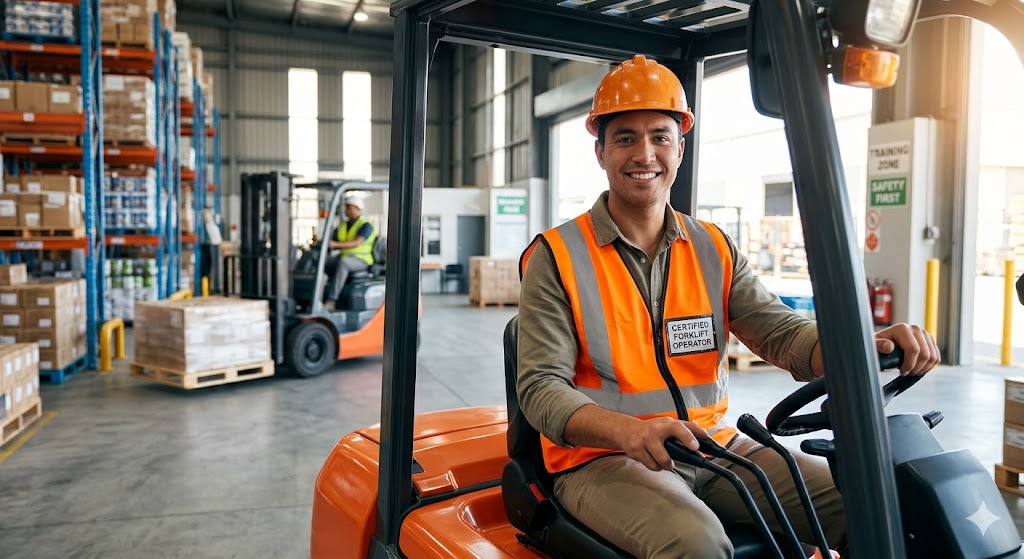
Additional Information
What the Course Entails and Exam Details
The underlying forklift certification course blends theoretical knowledge with practical skills training. While specific programs vary, the typical course covers a comprehensive set of topics that form the basis of the exam:
Fundamental Safety Principles: Understanding forklift stability, the "stability triangle," potential hazards, and proper safety equipment (PPE).
Types of Forklifts: Characteristics, controls, and common use cases for various classes of forklifts.
Pre-Operational Inspection: Step-by-step procedures to check the vehicle's condition, including hydraulic systems, tires, and controls, before each shift.
Operational Techniques: Safe driving, steering, maneuvering in tight spaces, traveling on inclines, and speed control.
Load Handling: Assessing load capacity and balance, and proper techniques for lifting, lowering, transporting, stacking, and unstacking loads.
Fueling and Charging: Safe practices for refueling internal combustion engines or recharging and maintaining electric batteries.
Regulatory Compliance and Company Rules: General knowledge of safety standards and common workplace specific rules for forklift operation.
What to Expect in the Final Exam
The official forklift certification exam is almost universally a two-part evaluation, measuring both your theoretical understanding and your practical ability. Here is what you can typically expect for each portion:
1. Written/Theory Examination:
Format: Usually a comprehensive written or computerized test consisting of multiple-choice or true/false questions.
Content: Questions will cover the detailed topics outlined in the course, from safety signs and load handling rules to maintenance procedures.
Passing Score: Requirements can be stringent; many programs require a high passing grade, such as 70% to 80% or higher.
Time Limits: Are typically provided and are reasonable but designed to ensure efficient assessment.
Rules: Standard testing conditions, including requiring photo identification and prohibiting the use of reference materials, unless otherwise specified. Many reputable training programs offer opportunities for reassessment if you don’t pass on the first attempt, allowing you to focus on your weak areas and try again.
2. Practical Skills Evaluation:
Format: A hands-on demonstration of your ability to operate the specific type(s) of forklift you are being certified for, evaluated by a qualified instructor.
Content: This usually involves a standardized practical test that assesses your performance on key tasks, such as:
Performing a thorough pre-operational check.
Maneuvering through a designated obstacle course.
Safe traveling with and without loads.
Correct load lifting, tilting, lowering, and precise stacking on racking systems.
Safe parking and shut-down procedures.
Passing Criteria: The assessment might be based on a checklist where you must perform certain critical safety steps correctly (some programs require 100?curacy on key safety items) or a penalty point system where you must stay under a certain threshold. The primary focus is on demonstrating competent and consistently safe operation.
How to Study and Exam Centers
How to Study:
Engage with your Training Material: Pay close attention to the course materials provided by your authorized training program, whether they are physical manuals, online modules, or practical workbooks.
Utilize Practice Tests: This is crucial. Use online practice tests like this one, as well as any provided by your training source, to familiarize yourself with the question types and formatting of the written exam. Take multiple versions of the practice test to ensure well-rounded preparation.
Review Safety Guidelines: Commit key concepts like the "stability triangle," load center and capacity calculations, proper horn usage, and the importance of seatbelts and overhead guards to memory. These are core safety elements that are guaranteed to appear on the test.
Get Practical Experience: Whenever possible and safe, get hands-on time with a forklift under proper supervision during your training. Even observing experienced operators and mentally visualizing the steps can be beneficial.
Discuss with Your Instructor: Don’t hesitate to ask your instructors clarifying questions about any difficult concepts or techniques.
Simulate the Practice: Practice the pre-operational checklist and basic maneuvers (if equipment is safely available for practice) repeatedly. Visualization and repetition are powerful tools.
Exam Centers:
Unlike some general academic tests, forklift certification is typically administered through specialized training providers rather than generalized testing centers like Pearson VUE. The locations for these exams are:
Authorized Forklift Training Schools: These are dedicated schools and vocational centers specializing in various types of equipment training.
Employer Training Programs: Very common in warehouse and industrial settings, many employers have their own internal, approved training programs and instructors to certify their employees on-site.
Employer-Contracted Training: Some employers hire external, certified training companies to conduct training and testing at their workplace.
Online Components: The theoretical (written) part of the exam may sometimes be offered through secure online portals by the training provider, followed by an in-person practical evaluation. The full course, including the written and the essential practical test, must be completed through a structured, authorized program for official certification.
Job Opportunities from the Course
Obtaining a forklift certification is a critical step that significantly enhances your employability and unlocks numerous career paths within logistics, warehousing, manufacturing, and construction. A valid certification is often a key requirement for roles like:
Forklift Operator: This is the most direct application, involving the primary responsibility of operating various classes of forklifts.
Warehouse Associate: Moving goods safely with a forklift is a core task in efficient warehouse operations.
Material Handler: Responsible for receiving, storing, moving, and shipping materials using a range of equipment, including forklifts.
Shipping and Receiving Clerk: While focused on documentation and logistics coordination, being certified can be a major asset, allowing you to assist with physical movement of goods.
Production Operative: Certification can allow you to move materials to and from production lines.
Logistics Assistant: Supporting broader logistics operations, with potential for certified task assistance.
Construction Laborer: Some forklift types are heavily used on construction sites, making this certification valuable.
Inventory Control Specialist: Safely accessing and moving inventory for audits or re-organization requires forklift proficiency.
Frequently Asked Questions
Reviews
5.0
Based on 0 reviews
Leave a Review
No reviews yet. Be the first to review!