
Foundation of Kinesiology Practice Test
$69.00
- Buy to unlock unlimited access to all Quiz questions and Answers in this Quiz.
- After purchase you can print a PDF of the whole quiz at any point. The PDF will contain the questions and the correct answers.
About this Exam
The Foundation of Kinesiology exam evaluates a student’s fundamental understanding of human movement, biomechanics, and the physiological processes of the human body.
It serves as a critical benchmark for individuals pursuing degrees in sports science, physical education, physical therapy, and health promotion.
This examination is specifically designed for undergraduate students, aspiring fitness professionals, and future rehabilitation specialists who need to prove their foundational knowledge before advancing to specialized clinical or athletic training courses.
By passing this test, candidates demonstrate that they possess the necessary scientific background to analyze, improve, and protect human physical performance safely.
Ready to test your knowledge?
Buy Now to Access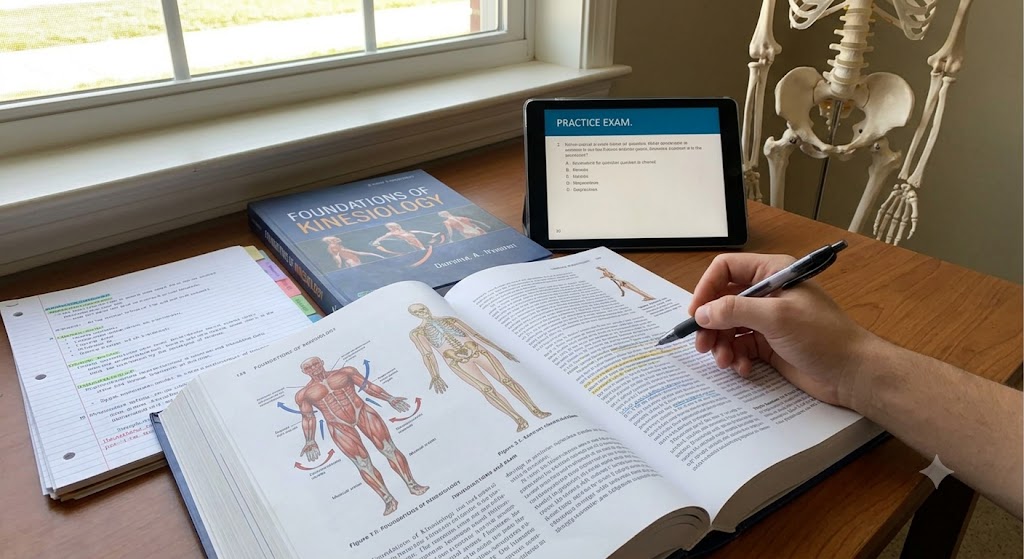
Additional Information
What the Course Entails and Exam Details
A comprehensive Foundation of Kinesiology course covers a dynamic blend of anatomy, physiology, biomechanics, and motor behavior.
Students delve deeply into the musculoskeletal system to understand how bones, joints, and muscles collaborate to produce movement.
The syllabus also heavily emphasizes exercise physiology, detailing how the cardiovascular and respiratory systems respond to acute and chronic physical stress.
Furthermore, learners explore the psychological and sociological factors that influence sports participation and overall human performance.
The exam directly reflects this multidimensional curriculum, testing both theoretical concepts and the practical application of kinesiological principles in real-world health and fitness scenarios.
What to Expect in the Final Exam
The final exam is typically structured to test a broad spectrum of cognitive skills, ranging from basic anatomical recall to complex biomechanical problem-solving.
Candidates should expect a rigorous format that primarily consists of multiple-choice and matching questions, though many variations also include short-answer and essay prompts for case studies.
Most institutions and certification boards allocate a time limit of between 90 and 120 minutes to complete the test.
To achieve a passing score, examinees generally must earn a minimum of 70% to 75%, depending on the specific university or accrediting body.
Strict rules govern the testing environment, including the prohibition of outside anatomical charts, unauthorized electronics, and unapproved medical reference materials.
How to Study and Exam Centers
Mastering the mechanics of the human body requires a strategic, multi-sensory approach to studying.
Utilizing visual aids like anatomical flashcards, skeletal models, and labeling worksheets is highly recommended to memorize muscle origins, insertions, and actions.
Taking a Foundation of Kinesiology practice exam is one of the most actionable strategies, as it helps identify knowledge gaps and familiarizes you with the pacing of the actual test.
For the final examination, testing procedures vary based on your educational path.
University students typically take the exam in supervised, on-campus academic testing centers or through secure online proctoring portals like Canvas or Blackboard.
If this test is part of a national fitness certification, candidates will often schedule their exam through authorized third-party testing facilities, such as Pearson VUE or Prometric centers, which offer both physical locations and secure at-home proctored options.
Job Opportunities from the Course
Successfully mastering this foundational material and passing the exam unlocks a diverse array of rewarding career paths in health, wellness, and sports medicine. Below are some of the primary job opportunities available:
Clinical Kinesiologist: Designing specialized exercise programs to help patients recover from injuries, manage chronic diseases, and improve overall functional mobility.
Athletic Trainer: Working directly with sports teams to prevent, diagnose, and treat muscle and bone injuries.
Physical Therapy Aide / Assistant: Supporting licensed physical therapists in helping patients rehabilitate from surgeries or severe injuries.
Exercise Physiologist: Analyzing patients' fitness levels to develop safe, effective exercise regimens for health maintenance and cardiovascular improvement.
Strength and Conditioning Coach: Enhancing the physical performance of amateur and professional athletes through scientifically backed training programs.
Health and Wellness Coordinator: Managing corporate or community wellness programs that promote healthy lifestyles, nutrition, and regular physical activity.
Physical Education Teacher: Educating youth in school settings about motor skills, teamwork, and the importance of lifelong physical fitness.
Frequently Asked Questions
Reviews
5.0
Based on 0 reviews
Leave a Review
No reviews yet. Be the first to review!