
Foundations of Pharmacy Practice Sterile Compounding Practice Exam
$69.00
- Buy to unlock unlimited access to all Quiz questions and Answers in this Quiz.
- After purchase you can print a PDF of the whole quiz at any point. The PDF will contain the questions and the correct answers.
About this Exam
The Foundations of Pharmacy Practice Sterile Compounding certification is a critical milestone for pharmacy technicians and pharmacists aiming to advance their clinical expertise. This specialized credential is designed for healthcare professionals who are responsible for preparing sterile preparations, such as intravenous (IV) admixtures, ophthalmic drops, and parenteral nutrition.
Whether you are a student just entering the field or a seasoned technician looking to formalize your skills in an aseptic environment, this certification validates your ability to maintain sterility, ensure patient safety, and strictly adhere to USP <797> guidelines. It serves as the gold standard for proving your technical competence in one of the most high-stakes areas of pharmacy practice.
Ready to test your knowledge?
Buy Now to Access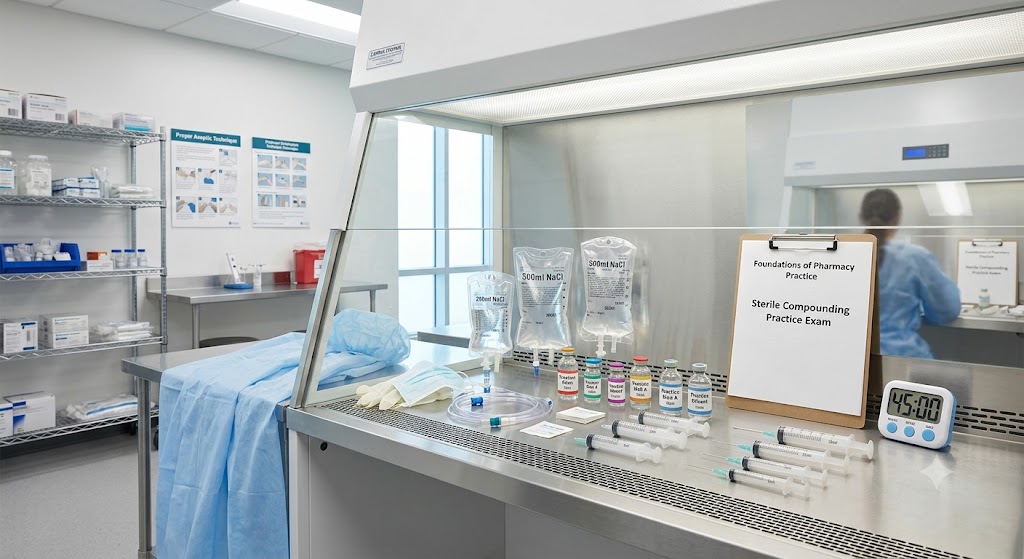
Additional Information
What the Course Entails and Exam Details
This course provides a comprehensive curriculum that bridges theoretical knowledge with real-world application. Candidates explore the rigorous principles of aseptic technique, cleanroom behavior, and environmental monitoring. The core syllabus includes detailed instruction on hand hygiene, garbing protocols, proper use of primary engineering controls (such as laminar airflow workbenches and biological safety cabinets), and the calculations necessary for preparing sterile products. Additionally, the curriculum covers quality assurance, record keeping, and the legal implications of sterile compounding. Students are taught to identify high-risk versus low-risk preparations and are trained in the correct methods for media-fill testing and fingertip sampling.
What to Expect in the Final Exam
The final exam is designed to be a rigorous assessment of both your technical knowledge and your ability to maintain sterility under pressure. Typically, the exam consists of a proctored multiple-choice component that tests your understanding of USP <797> regulations, stability, and compatibility. Following the written portion, many programs require a practical "hands-on" assessment. During this phase, you will be observed in a simulated cleanroom environment where you must perform a series of sterile transfers correctly. You must maintain a strict passing score—often 80% or higher—within a set time limit, usually ranging from 60 to 90 minutes. Rules are strict: any breach in aseptic technique, such as touching the critical sites of a syringe or needle, results in automatic failure.
How to Study and Exam Centers
Success in this exam relies heavily on repetitive, disciplined practice. Begin by reviewing the official USP <797> guidelines thoroughly. Use flashcards to memorize abbreviations, beyond-use dating (BUD) calculations, and drug compatibility charts. Practical simulation is equally important; use your home or lab workspace to practice your "first-air" movements repeatedly until they become muscle memory. Many candidates benefit from creating a checklist of the order of operations for garbing and cleaning. When you are ready to test, check with your program coordinator, as many exams are hosted through authorized testing portals or at specific clinical training sites. If your program uses a third-party testing vendor, you may be directed to schedule your session via Pearson VUE or a similarly accredited testing center. Always verify your registration details at least two weeks before your scheduled date.
Job Opportunities from the Course
Earning this certification significantly enhances your resume and opens doors to specialized roles within the healthcare system. Certified professionals are highly sought after for their specific ability to handle complex sterile preparations. Career paths include:
Hospital Pharmacy Technician specializing in IV admixture.
Sterile Compounding Pharmacist.
Infusion Center Compounding Specialist.
Quality Assurance Pharmacy Lead.
Oncology Pharmacy Compounding Tech.
Pharmacy Operations Supervisor in a sterile environment.
Cleanroom Compliance Coordinator.
Frequently Asked Questions
Reviews
5.0
Based on 0 reviews
Leave a Review
No reviews yet. Be the first to review!