
Fourth Class Steam Engineer Practice Exam
$69.00
- Buy to unlock unlimited access to all Quiz questions and Answers in this Quiz.
- After purchase you can print a PDF of the whole quiz at any point. The PDF will contain the questions and the correct answers.
About this Exam
The Fourth Class Steam Engineer Certification is a
fundamental credential required to legally operate and maintain boilers,
pressure vessels, and auxiliary machinery in industrial, commercial, and
institutional plants. This entry-level trade certification is designed for
aspiring energy, process, and stationary engineers who are new to the field.
Achieving this certification validates a foundational understanding of critical
power plant principles, safety protocols, and operational procedures, marking
the essential first step in a rewarding career dedicated to managing vital
heating and power systems. It is the crucial cornerstone for anyone intending
to advance further to higher-class engineering roles.
Ready to test your knowledge?
Buy Now to Access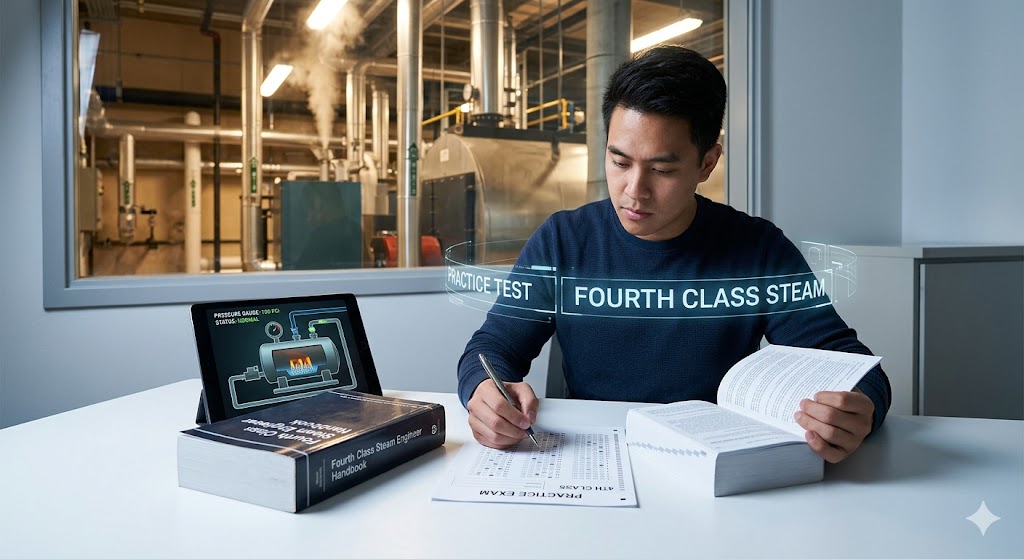
Additional Information
What the Course Entails and Exam Details
This comprehensive course, often split into Part A and Part
B, provides a blended theory and practical foundation necessary to safely
manage steam-generating equipment. The Part A curriculum builds a base of
technical knowledge, covering topics such as essential safety regulations and
occupational health, preparatory math for basic mechanical calculations,
foundational elementary chemistry and thermodynamics, and principles of
material science, welding, and non-destructive examination. It also introduces
critical tools like piping and valves, electricity fundamentals, and plant
instrumentation and controls. In contrast, Part B delves directly into
practical plant applications, focusing on boiler construction, design, and
operating systems. Key areas include lubrication and pump principles, boiler
safety devices, comprehensive plant operation strategies (including start-up
and shutdown), water treatment, and prime movers such as steam turbines and
engines. It also provides introductions to associated systems like building
services, refrigeration, and HVAC. Candidates typically must show proof of
enrollment in or completion of an approved training course and, in some
jurisdictions, require verified minimum operational experience (steam time)
before attempting the examination.
What to Expect in the Final Exam
The Fourth Class Steam Engineer Final Examination is a
rigorous assessment, traditionally standardized across many jurisdictions via
the Standardization of Power Engineer Examinations Committee (SOPEEC). It is a
closed-book test, typically consisting of two distinct exam papers: Part A and
Part B. Each paper is composed entirely of 100 multiple-choice questions,
challenging your recall and application of the complex concepts studied. You
will generally be allotted a strict time limit of three hours to complete each
paper. To pass, a candidate must achieve a minimum score of 65% on each of the
two examinations. Successfully passing both parts is a requirement for
certification. Some regions may also require a separate practical skills
examination or verification of vocational lab hours to fully complete the
certification process, although the core theoretical test remains the
multiple-choice format described.
How to Study and Exam Centers
Preparation requires a dedicated, multifaceted strategy.
Start by deeply reviewing the official syllabus and the recommended technical
text, often the PanGlobal Fourth Class Power Engineering modules. Complement
your reading by utilizing flashcards for key definitions, equations, and safety
codes. Engaging in a structured 4th Steam Practice Test environment is vital;
take numerous practice exams under timed conditions to identify specific areas
where your knowledge is weakest and to familiarize yourself with the multiple-choice
structure. Practical knowledge can be reinforced by working directly with
operating machinery in an approved vocational plant lab. Examinations are
coordinated by regional technical safety authorities and are administered at
various authorized locations, which frequently include specific community
college test centers, technological institutes, and dedicated physical testing
centers. For maximum flexibility, online portals and computer-based testing,
particularly through vendors like Pearson VUE, may be available in some
jurisdictions. Candidates must apply for exam eligibility and pay the required
fee through their provincial or state technical safety authority well in
advance of their chosen date.
Job Opportunities from the Course
A Fourth Class Steam Engineer Certificate opens a wide array
of stable and critical career paths across diverse industries. The knowledge of
energy conversion and thermal systems is always in demand for facility
operation and manufacturing. Potential job titles and roles this certification
unlocks include:
- Fourth
Class Power Engineer
- Boiler
Operator
- Stationary
Engineer
- Energy
Plant Technician
- Building
Operator
- Facility
Maintenance Technician
- Process
Operator (Boiler/Steam)
- Plant
Utilities Operator
- Plant
Mechanic
- Refrigeration
Operator
Frequently Asked Questions
Reviews
5.0
Based on 0 reviews
Leave a Review
No reviews yet. Be the first to review!