
FPS Pharmaceutical Sciences Exam 5 Practice
$69.00
- Buy to unlock unlimited access to all Quiz questions and Answers in this Quiz.
- After purchase you can print a PDF of the whole quiz at any point. The PDF will contain the questions and the correct answers.
About this Exam
The FPS Pharmaceutical Sciences Practice Exam 5 is a comprehensive and indispensable tool for students nearing the end of their pharmaceutical sciences program. It is specifically designed to assess and reinforce the core knowledge required to succeed in a final, comprehensive, or licensure-qualifying examination. This practice exam is suitable for students enrolled in diverse pharmaceutical science degrees, bridging the gap between academic theory and practical application. By using this guide, you will be able to gauge your readiness, identify areas of strength, and pinpoint topics that require further review before the high-stakes final test. Its ultimate purpose is to build confidence, minimize surprises, and ensure that you are fully prepared for a successful transition from student to professional.
Ready to test your knowledge?
Buy Now to Access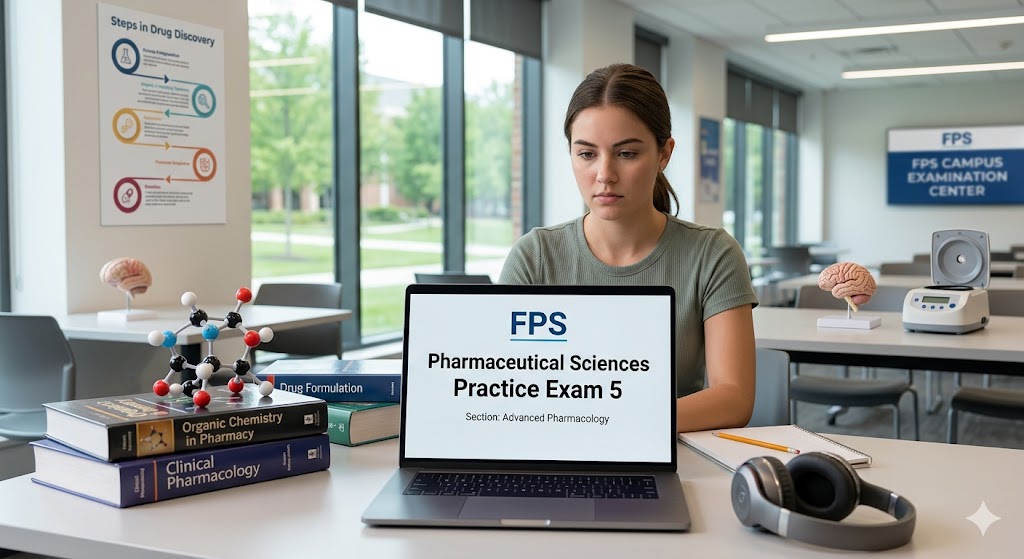
Additional Information
What the Course Entails and Exam Details
This practice exam is modeled after the comprehensive, multi-disciplinary curriculum found in advanced pharmaceutical sciences programs. It incorporates a wide variety of topics, reflecting the interconnected nature of the field. The questions are designed to challenge your understanding of key concepts, mechanistic models, and their critical applications.
Core areas covered in the FPS Pharmaceutical Sciences curriculum and simulated in this exam include:
Pharmacology: Study of drug mechanisms of action, therapeutic effects, and adverse reactions.
Pharmaceutics and Drug Delivery: Principles of dosage form design, manufacturing, and novel drug delivery systems.
Medicinal Chemistry: The rational design of new drug molecules and the study of their chemical properties and structure-activity relationships.
Pharmacokinetics and Pharmacodynamics: The processes of drug absorption, distribution, metabolism, excretion, and how drugs produce their biological effects.
Pharmaceutical Analysis: Methods for identifying, purity testing, and quantifying pharmaceutical substances.
Clinical Pharmacy: Application of pharmaceutical knowledge to direct patient care and medication management.
Biopharmaceutics: The influence of formulation variables on the rate and extent of drug absorption.
Regulatory Affairs: Introduction to the guidelines and procedures for drug approval and market surveillance.
What to Expect in the Final Exam
While specific procedures can vary based on the educational institution, the final comprehensive exam that this practice test simulates is typically a rigorous evaluation. It is designed to be a decisive test of all material learned throughout the program. Students should expect a modern format that often includes online-proctored sessions or administration within a specific testing center.
Key characteristics to anticipate in the final exam:
Format: Primarily Multiple-Choice Questions (MCQ). The questions will be a mix of standalone factual recall, clinical case scenarios requiring synthesis of information, and problem-solving exercises in pharmaceutics and pharmacokinetics.
Time Limit: The exam is time-constrained, often lasting between 3 to 5 hours, demanding not just knowledge but also time management skills.
Passing Score: Students are required to meet a minimum score, which is specified by the university or examining board, to demonstrate competency.
Proctoring: The test will be administered under strict security conditions, which can include both live human proctors in physical centers and AI-based proctoring in online scenarios.
Calculations: A significant portion will test your ability to perform essential calculations in doses, pharmacokinetics, and pharmaceutical compounding.
How to Study and Exam Centers
Preparation for a comprehensive exam requires a consistent, structured approach over time. Relying on this practice exam is a cornerstone of a successful strategy. Treat each attempt as a real test, timing yourself to build your stamina and pacing. Utilize this study guide as a diagnostic tool, creating a revision timetable that prioritizes your weakest areas.
Actionable study strategies:
Practice with Multiple Practice Exams: Use the FPS Pharmaceutical Sciences Practice Exam 5 and other available practice papers to encounter a wide variety of question types and difficulty levels.
Review all Core Course Materials: Go back to your notes, textbooks, and primary literature for deep conceptual understanding. Do not just memorize answers; understand the concepts behind them.
Form Study Groups: Collaborating with peers allows you to teach difficult concepts, which is an excellent way to reinforce your own learning, and can expose you to different problem-solving methods.
Simulate Test Conditions: Regularly practice in a quiet, distraction-free environment and stick strictly to the actual exam time limits.
Identify Weak Points: Use the practice exam to identify specifically which sub-topics you need to revise most, allowing for targeted and efficient study.
Job Opportunities from the Course
A strong performance on a comprehensive pharmaceutical sciences exam and completion of the underlying degree provides a strong foundation for diverse career paths. This qualification, combined with a potential professional license, unlocks exciting opportunities in both private and public sectors.
Here are just a few of the job titles and career paths this certification unlocks:
Pharmacist (Community or Hospital): Dispensing medications, managing patient therapy, and providing health advice, which often requires additional state licensing.
Pharmaceutical Scientist (R&D): Researching and developing new drugs, formulations, and delivery systems within the industry or academia.
Regulatory Affairs Specialist: Navigating complex guidelines to ensure that new drugs and medical products comply with government regulations (e.g., FDA).
Quality Control (QC) / Quality Assurance (QA) Analyst: Testing drug products to ensure they meet stringent quality and safety standards.
Clinical Research Associate (CRA): Managing, monitoring, and evaluating data from clinical trials to ensure they are conducted properly.
Medical Science Liaison (MSL): Acting as a crucial academic link between pharmaceutical companies and healthcare professionals, sharing scientific data.
Pharmacovigilance Officer: Monitoring, evaluating, and preventing adverse effects and other safety problems associated with medicinal products.
Product Manager: Leading the strategic planning and marketing efforts for a pharmaceutical product.
Frequently Asked Questions
Reviews
5.0
Based on 0 reviews
Leave a Review
No reviews yet. Be the first to review!