
FRA Tier 2 Qualification Practice Test
$69.00
- Buy to unlock unlimited access to all Quiz questions and Answers in this Quiz.
- After purchase you can print a PDF of the whole quiz at any point. The PDF will contain the questions and the correct answers.
About this Exam
The FRA Tier 2 Qualification is a technical certification based on the Federal Railroad Administration (FRA) Track Safety Standards, specifically 49 CFR Part 213, focusing on the regulations for track designated as Classes 2 through 5. These track classes support increasingly higher operating speeds, requiring Inspectors to demonstrate a high degree of knowledge in track geometry, structure, and general condition analysis to ensure safe operations. This qualification is designed primarily for Track Inspectors, Track Foreman, Maintenance Supervisors, and Railroad Safety Personnel who are responsible for the inspection, maintenance, and safe passage of trains over secondary and higher-speed track networks. Achieving this qualification validates your competency in identifying safety defects and prescribing necessary remedial actions.
Ready to test your knowledge?
Buy Now to Access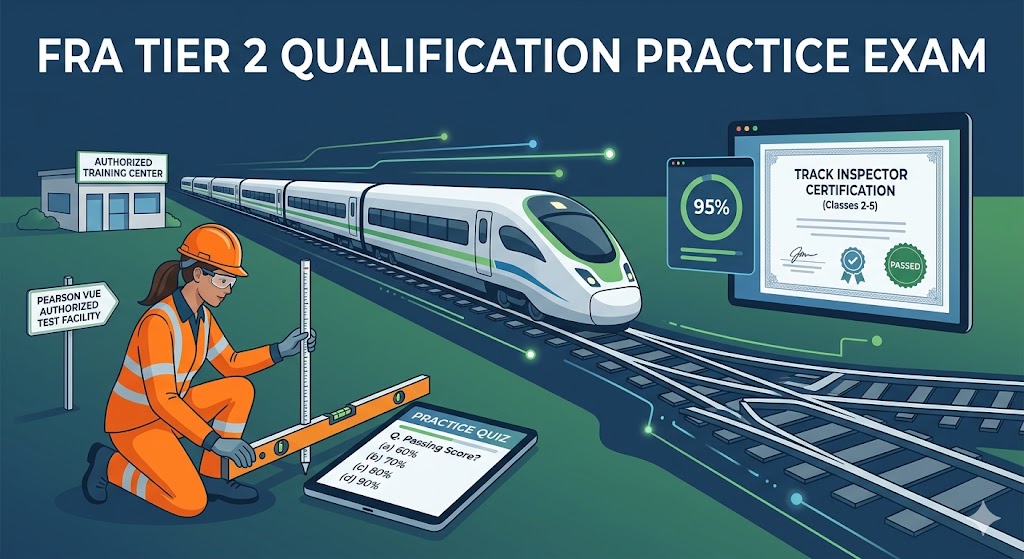
Additional Information
What the Course Entails and Exam Details
This examination is not just a test of memorization; it is a rigorous validation of your ability to apply complex federal safety standards to real-world scenarios.
Core Topics Covered
The curriculum and corresponding qualification exam extensively cover the full spectrum of 49 CFR Part 213 for Track Classes 2-5, including:
Subpart A – General: Scope, Responsibility for Compliance, and Designation of Qualified Persons.
Subpart C – Track Geometry: Including critical measures like Gage, Alinement, Cross-level, Curve Speed limitations, and Runoff.
Subpart D – Track Structure: Understanding defects in Ballast, Crossties (concrete, wood, and composite), Defective Rail, Rail End Mismatch, and Fastenings.
Subpart E – Track Appliances: Standards for Switches, Frogs, and Guard Rails.
Subpart F – Inspection: Regulatory requirements for the frequency and method of required inspections.
What to Expect in the Final Exam
While the exact administration of the FRA Tier 2 Qualification Exam can vary depending on the authorized training provider or individual railroad, candidates should prepare for a thorough evaluation that typically includes both theoretical and practical components.
1. The Written Examination
This segment usually consists of a substantial number of multiple-choice and scenario-based questions. Candidates must demonstrate deep knowledge of Part 213 definitions, threshold values for different track classes, and the regulatory deadlines for remedial action. Some exams may be "open book" to mimic real-world field access to regulations, but speed and accuracy are paramount.
2. The Field Evaluation (Practical)
You will likely be required to perform an on-ground track inspection under the supervision of an authorized examiner. You must demonstrate proficiency in using standard inspection tools, correctly identifying specific, pre-determined track defects, accurately measuring geometry deviations, and filing a formal inspection report that includes the correct regulatory remedial action.
Passing Score and Time Limits
The passing standard is high to ensure safety compliance. You are typically required to achieve a score of 80% or higher on both the written and the practical portions of the evaluation. There are often strict time limits for the written exam, designed to test your familiarity and confidence in navigating the regulations.
How to Study and Exam Centers
Preparation is the absolute key to success. This is not a "cram-session" test; it requires a combination of deep study and practical experience.
Top Study Strategies
Immerse Yourself in 49 CFR Part 213: Your fundamental textbook is the official Federal Code of Regulations. Read, highlight, and memorize the key geometric thresholds and defect definitions for Track Classes 2, 3, 4, and 5.
Combine Study with Field Practice: Apply what you are reading in the field. Take a gauge, level board, and 62-foot cord to actual track and practice measuring geometry, profile, and alinement deviations. Practice identifying effective versus ineffective ties and measuring rail wear.
Utilize This Practice Exam: This practice resource is designed to mimic the complexity and scenario-based style of the real test. Regular use will help you identify weak areas in your knowledge base and improve your speed in referencing Part 213.
Enroll in an Authorized Training Course: Many professional training organizations and large railroad carriers offer dedicated "Track Inspector Level II" courses that include formal training and the qualification exam.
Where and How to Take the Exam
The FRA itself typically does not administer the basic Inspector qualifications; instead, it is done by authorized entities that train to the federal standard. Candidates usually take the examination at the following locations:
Authorized Railway Training Centers: Academic or technical institutes that offer certified railway safety training.
Internal Railroad Training Facilities: Many Class I, regional, and short-line railroads administer the test internally to qualify their own workforce.
Public Safety Organizations: Certain state-level public transportation safety divisions may facilitate the testing for their inspectors.
Consult with your supervisor or employer to identify your required and authorized testing facility.
Job Opportunities from the Course
A valid FRA Tier 2 Qualification is a highly sought-after credential that significantly expands your career opportunities within the railroad and transportation sectors. It unlocks specialized roles in both safety oversight and maintenance leadership.
This certification prepares you for and is often a mandatory requirement for the following job titles:
Federal Railroad Safety Inspector (Track)
Certified Track Inspector (Railroad Internal)
Maintenance of Way (MOW) Supervisor / Roadmaster
Track Foreman
Senior Track Maintenance Worker
Railroad Consultant / Safety Auditor
Chief Engineer (for smaller or regional railroads)
Rail Transportation Quality Assurance Manager
Frequently Asked Questions
Reviews
5.0
Based on 0 reviews
Leave a Review
No reviews yet. Be the first to review!