
FRC Crescendo Rules Practice Test
$69.00
- Buy to unlock unlimited access to all Quiz questions and Answers in this Quiz.
- After purchase you can print a PDF of the whole quiz at any point. The PDF will contain the questions and the correct answers.
About this Exam
Welcome to your essential first step toward competition mastery in the 2024 FIRST Robotics Competition season: CRESCENDO℠ presented by Haas. The FRC Crescendo Rules Practice Exam is designed as a rigorous self-assessment tool for students, mentors, and prospective referees who need to know the game manual inside and out. It goes beyond simple memorization, challenging participants to apply field rules, scoring dynamics, and safety protocols to complex, real-world match scenarios.
This practice exam is crucial for anyone striving to be a part of a Drive Team—Drivers, Operators, Human Players, and Technicians—as well as strategy personnel. It ensures that when the adrenaline is pumping during a two-minute and 30-second match, your knowledge of what is legal, what scores, and what incurs penalties is instantaneous and accurate. Mastering this content is the key to maximizing your alliance's score and avoiding the devastating Tech Fouls that can cost matches.
Ready to test your knowledge?
Buy Now to Access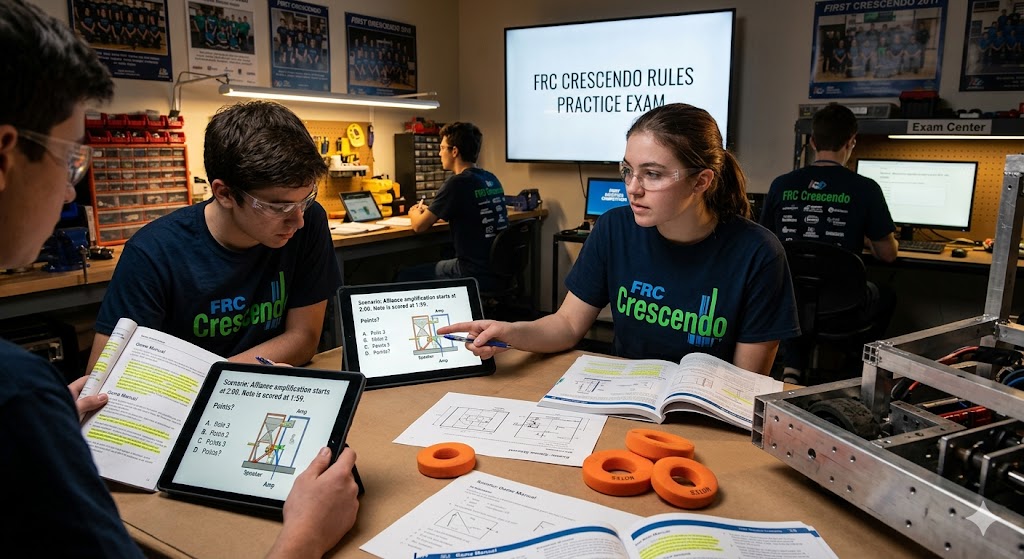
Additional Information
What the Course Entails and Exam Details
This study program is focused entirely on the official 2024 FRC CRESCENDO℠ Game Manual. The core curriculum involves a deep dive into the legal language of the rules, field illustrations, and official Team Updates. The practice exam typically covers several critical domains of knowledge:
Field Layout and Game Pieces: Understanding the exact dimensions and zones, including the Starting Zones, Wing, Amp Zone, Speaker, Source, Stage, and the physical properties of the orange foam NOTES.
Match Scenarios and Timing: The progression from the 15-second Autonomous period to the 2-minute and 15-second Teleoperated period, concluding with the crucial endgame buzzer.
Scoring Mechanics: Detailed knowledge of how points are awarded for scoring NOTES in the SPEAKER (amplified vs. non-amplified) and AMP, as well as the endgame points for PARKING, ONSTAGE (climbing), HARMONY, and TRAP.
Ranking Points (RP): Grasping how to earn the Melody Bonus and Ensemble Bonus RPs to advance in competition standings.
Rules and Penalties: A major focus on safety rules (S-rules), ROBOT-to-ROBOT interaction rules (G-rules) including pinning and obstruction, and game-specific rules. Participants must differentiate between a standard FOUL and a Tech Foul.
Robot Constraints: Understanding size, weight, BUMPER, and starting configuration limitations that must be maintained during a match.
What to Expect in the Final Exam
While the "final exam" may be administered differently depending on your team's internal process or if you are training to be an official Referee, a proper FRC Crescendo Rules Practice Exam mimics the format you will face when rule knowledge matters most. You can typically expect a digital or written test comprised of approximately 30 to 50 questions.
The format is usually a combination of Multiple Choice and Scenario-Based True/False questions. These questions are notoriously tricky; they often present a complex sequence of field interactions and ask you to calculate the final point value or determine which team receives a penalty.
There is rarely a single, standardized passing score set by FIRST, but many top-tier FRC teams require their Drive Teams to pass their internal rules test with a score of 90% or higher before they are allowed to operate the robot at an event. You should expect a strict time limit (e.g., 60 seconds per question) to simulate the pressure of a real match environment. Remember: during a match, you cannot check the manual.
How to Study and Exam Centers
Effective study for this exam requires more than a casual read-through of the manual. Our expert recommendation is to use a tiered approach to mastering the material.
Read and Highlight: Start by reading the entire Game Manual once. Highlight key numbers (like point values and penalty seconds) and defining vocabulary (like "Momentary" or "Repeated").
Use Official Resources: Pay close attention to the official FIRST Q&A system and all published Team Updates. These clarify ambiguous situations and often change or refine rules.
Active Practice: Take simulated practice tests. Many FRC teams and community members create online practice portals on platforms like Kahoot!, Google Forms, or specific team websites (look on Chief Delphi for community-shared resources).
Scenario Discussions: Sit down with your team and verbally walk through "What If" scenarios. (e.g., "What happens if we score an amplified NOTE after the buzzer but before the amplification period officially ends?").
Exam Centers: Unlike standard standardized tests, there are no Pearson VUE or physical "exam centers" for this practice test. Your exam center is your team's workshop, classroom, or your own computer at home. The exam is accessed through online portals created by the FRC community or provided to you by your team’s mentors.
Job Opportunities from the Course
While mastering the rules of a robotics game may seem niche, the skills gained are directly applicable to high-value career paths in the engineering and technical sectors. Employers value the dedication, analytical thinking, and attention to detail required to master complex regulatory frameworks.
Manufacturing Engineer: Appliying complex regulatory and safety standards to production environments.
Technical Project Manager: Managing technical teams within a strict set of constraints and deadlines.
Robotics Technician: Troubleshooting, operating, and maintaining complex automated systems within operational guidelines.
Process Improvement Specialist: Analyzing complex systems (like a match) to optimize for efficiency and maximum output (score).
Quality Assurance (QA) Analyst: Verifying that mechanical systems or software code adhere strictly to design and regulatory requirements.
FIRST Referee: While often a volunteer position, serving as an official referee demonstrates exceptional leadership and rules comprehension, significantly boosting a professional resume.
Frequently Asked Questions
Reviews
5.0
Based on 0 reviews
Leave a Review
No reviews yet. Be the first to review!