
FRCNW Enlisted Aviation Warfare Specialist (EAWS) Board Practice Test
$69.00
- Buy to unlock unlimited access to all Quiz questions and Answers in this Quiz.
- After purchase you can print a PDF of the whole quiz at any point. The PDF will contain the questions and the correct answers.
About this Exam
The Enlisted Aviation Warfare Specialist (EAWS) qualification is a highly respected milestone and insignia within the United States Navy, signifying a Sailor's proficiency and comprehensive knowledge across all aspects of naval aviation. Developed to recognize enlisted personnel who have mastered the demanding skills and intricate systems that keep naval aircraft flying and operational, EAWS represents a dedication to aviation excellence and warfare capability. This qualification is designed for enlisted Sailors serving in aviation-related ratings – from maintenance technicians and air traffic controllers to ordnancemen and aircrew – who are assigned to deployable aviation units, capable ships, or Aircraft Intermediate Maintenance Detachments (AIMD), including those at commands like Fleet Readiness Center Northwest (FRCNW). Achieving EAWS status not only demonstrates expertise to superiors and peers but also instills a deep sense of pride and professional accomplishment.
Ready to test your knowledge?
Buy Now to Access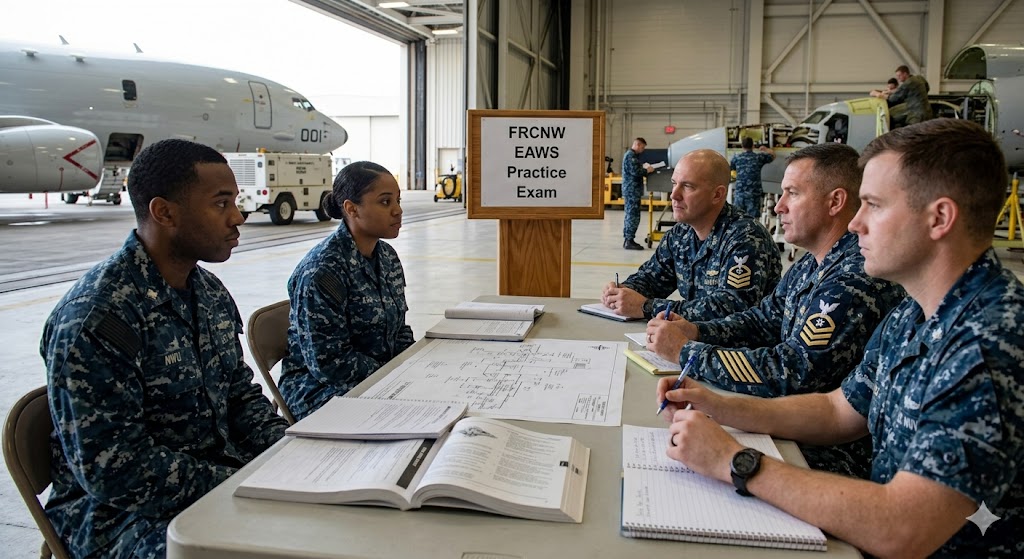
Additional Information
What the Course Entails and Exam Details
Preparing for the EAWS qualification is a comprehensive journey, not a single course. It revolves around completing extensive Personnel Qualification Standards (PQS) which are divided into two main parts: Common Core (general naval aviation knowledge applicable fleet-wide) and Unit-Specific (knowledge tailored to the specific aircraft platform or mission of the Sailor’s command). The PQS serves as a detailed syllabus, requiring Sailors to study, understand, and then get signatures from designated qualifiers for hundreds of line items covering a vast array of topics, including:
Aviation Technical Knowledge: In-depth understanding of airframes, engines, electrical systems, avionics, weapons systems, and support equipment.
Aviation Safety: Rigorous procedures, flight deck safety, hangar bay operations, and general mishap prevention.
Naval Aviation Heritage and Doctrine: The rich history, key milestones, and foundational principles guiding naval aviation.
Enlisted Ratings: Duties, responsibilities, and interactions of the various aviation ratings.
Aircraft and Ship Familiarization: Knowledge of different naval aircraft types, their missions, and the aviation capabilities of Navy ships.
Operational Procedures: Airfield operations, Naval Air Training and Operating Procedures Standardization (NATOPS), and flight operations.
Maintenance Programs: Understanding the Naval Aviation Maintenance Program (NAMP), inspections, and standard practices.
Damage Control and Survival: Key procedures for firefighting, first aid, chemical/biological/radiological warfare defense, and aircrew survival equipment.
The culmination of this rigorous preparation is not typically a single final exam in the traditional sense, but rather a sequence of evaluations. This includes potentially multiple-choice written practice tests and preliminary exams to gauge progress and reinforce knowledge. The final hurdle, however, is a formal, comprehensive oral board, where the Sailor must confidently and accurately answer questioning from a panel of senior enlisted specialists and officers, often including Chief Petty Officers and above. To pass, a Sailor must demonstrate exceptional recall and synthesis of both common core and unit-specific knowledge. Written elements would often have a specified passing percentage and potentially time limits, while the board is an interactive assessment of confidence and expertise, typically taking one or more hours with no strict "time limit" per se but intense, focused interrogation. There are no standardized universal time limits for the process, but Sailors are usually expected to complete the qualification within 12 months of reporting to a relevant command.
What to Expect in the Final Exam
When we talk about "What to Expect in the Final Exam" for the EAWS Practice Test or the actual EAWS qualification, we are primarily referring to preparing for and navigating the culmination board. However, it's important to understand the typical progression:
PQS Completion & Preliminary Testing: Your journey begins with diligently working through the PQS, getting line-item sign-offs, and often passing preliminary written quizzes or tests to solidify understanding and gain permission to proceed. Commands like FRCNW might also administer command-wide written practice tests for the board.
The Actual Evaluation Process:
Format: The final assessment is overwhelmingly an oral board. You will face a panel of senior aviation personnel (typically Chief Petty Officers, Senior Chiefs, Master Chiefs, and potentially an officer chair). Expect intense, probing questioning across the entire spectrum of EAWS knowledge – common core and unit-specific. It's not just about reciting facts; it's about explaining why things work, interconnected systems, and proper procedures. There could be written practice tests to simulate part of the challenge or general command-led practice.
Passing Score/Requirements: There isn't a simple numerical score for the board. Pass or fail is determined by the collective judgment of the board members on whether you have demonstrated the requisite knowledge, confidence, and professionalism expected of an Enlisted Aviation Warfare Specialist. A failure on a written test or in specific board areas might require re-study and re-evaluation.
Time Limits & Rules: There are no fixed, navy-wide time limits for an EAWS oral board, but they can be mentally demanding and typically last anywhere from one to several hours. Proper military bearing, confident communication, and respectful interaction are crucial rules of engagement throughout. Some commands might have specific time constraints for written preliminary tests.
The Challenge: The board is designed to be challenging, simulating the pressure and knowledge retrieval needed in operational environments. Expect questions that test depth, practical application, and scenarios. Practice boards are essential to build confidence and refine your ability to articulate complex information under pressure.
How to Study and Exam Centers
Effective studying is key to acing the EAWS practice test and, ultimately, the qualification process. Here’s a blueprint for success:
Own Your PQS: Make the Personnel Qualification Standard your bible. Study each line item thoroughly. Don't just look for answers; understand the concepts, systems, and procedures referenced. Read the associated official publications, instructions, and manuals (like NATOPS and NAMP).
Utilize Study Guides & Resources: Seek out official Navy study guides, command-specific resources, and reputable online platforms offering flashcards, quizzes, and practice materials tailored to EAWS. Look for specific study aids relevant to the aircraft at FRCNW or your unit. Use these resources to reinforce knowledge and identify areas needing more attention. Practice tests for the board, both written and simulated oral, are invaluable.
Attend Study Groups & Classes: Many commands offer organized EAWS classes or study groups. Participate actively. Learn from instructors, collaborate with peers, ask questions, and share insights. Group study can provide motivation, different perspectives, and effective knowledge sharing.
Engage with Qualifiers: Don't just approach qualifiers for signatures. Treat them as valuable sources of knowledge. Ask detailed questions about specific systems, procedures, and their practical experiences. Demonstrating genuine curiosity and deep understanding during sign-offs will impress qualifiers and better prepare you for the board.
Practice, Practice, Practice - Especially for the Board: The most critical preparation is the oral practice. Conduct simulated boards with peers, senior specialists, and anyone willing to quiz you. Practice articulating your knowledge clearly, concisely, and confidently under pressure. Simulate the entire board experience, including potential trick questions and stressful scenarios. Record yourself or have others give feedback on your content, delivery, and bearing.
Exam Centers: Unlike standard standardized tests, EAWS qualifications and associated practice tests are command-based. There are no specific "Exam Centers" like Pearson VUE. Your PQS completion, written preliminary tests, and the final culminating board are all administered within your command, such as Fleet Readiness Center Northwest (FRCNW) or your individual squadron. The board is typically composed of qualified senior members from within your own or affiliated commands. Your command EAWS coordinator will guide you through the process, scheduling written tests and coordinating your oral board when you are ready.
Job Opportunities from the Course
Earning your EAWS wings is not just a badge of honor; it opens significant doors for career advancement and enhanced opportunities within the Navy aviation community and beyond. The specialized knowledge and demonstrated commitment reflected in this qualification are highly valued. Some of the benefits and potential career impacts include:
Accelerated Advancement: Achieving EAWS is a significant career milestone that can contribute points towards advancement to Petty Officer Second Class, Petty Officer First Class, and especially Chief Petty Officer. For many aviation rates, having EAWS status is considered crucial, and sometimes even mandatory by certain points, for promotion beyond Petty Officer Second Class.
Enhanced Performance & Respect: Deepened expertise across various aviation domains translates directly to improved job performance, increased confidence, and greater respect from peers, supervisors, and leadership. Qualified specialists are often entrusted with more complex tasks and responsibilities.
Leadership Roles: Earning EAWS demonstrates initiative, dedication, and knowledge – key qualities for leadership positions like Work Center Supervisor, Leading Petty Officer (LPO), or Leading Chief Petty Officer (LCPO) within an aviation command.
Specialized Assignments: The broad yet detailed understanding of aviation systems and operations can make you a strong candidate for more specialized and desirable assignments within the Navy, both afloat and ashore, potentially in RDT&E (Research, Development, Test & Evaluation), specialized maintenance units, or unique operational commands.
Future Opportunities: The specialized technical skills, knowledge of naval aviation systems, and proven dedication can significantly bolster post-Navy career prospects in civilian aviation, defense contracting, engineering, and related technical fields. Many employers highly value military qualifications like EAWS as indicators of rigorous training, technical competence, and strong work ethic.
Frequently Asked Questions
Reviews
5.0
Based on 0 reviews
Leave a Review
No reviews yet. Be the first to review!