
FS3 Aircraft Performance Practice Test
$69.00
- Buy to unlock unlimited access to all Quiz questions and Answers in this Quiz.
- After purchase you can print a PDF of the whole quiz at any point. The PDF will contain the questions and the correct answers.
About this Exam
The FS3 Aircraft Performance Practice Test is a vital educational tool for pilot trainees, particularly those within structured flight training programs or navigating the "Flight Simulation 3" stage of their curriculum. This exam evaluates a student's core competency in understanding and predicting an aircraft's operational capabilities across a variety of flight phases and environmental conditions. It is designed for aspiring pilots who need to master the practical application of aerodynamic principles and performance data before advancing to more complex simulation or flight training. Success on this practice test demonstrates a pilot's ability to make data-driven decisions that are essential for flight safety and efficiency.
Ready to test your knowledge?
Buy Now to Access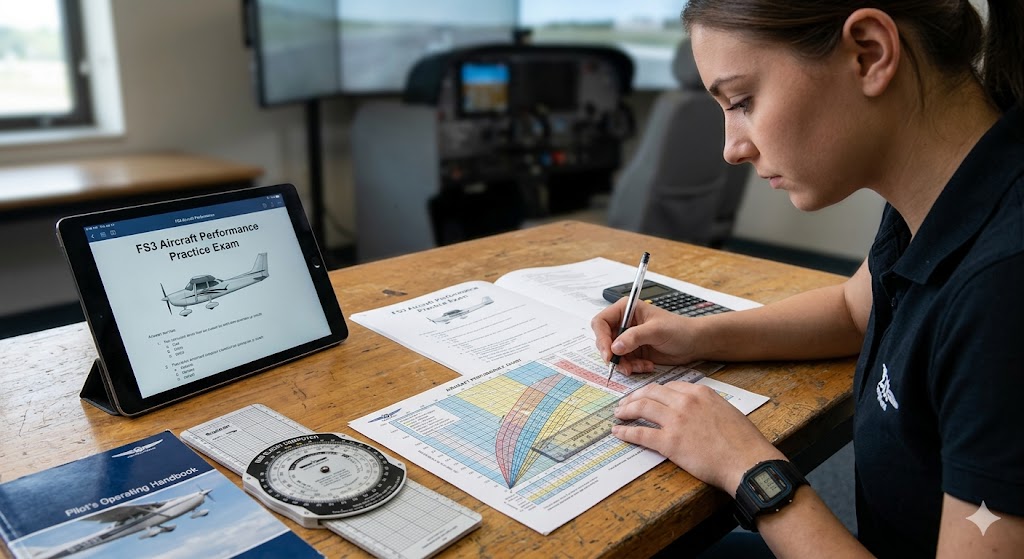
Additional Information
What the Course Entails and Exam Details
This course provides the mathematical and theoretical foundation for understanding how an aircraft operates. It moves beyond basic flight mechanics to detailed analysis. Key topics included in the syllabus are:
Aerodynamic Fundamentals: A review of the four forces of flight (lift, weight, thrust, drag) and how they intersect to determine performance.
International Standard Atmosphere (ISA): Understanding how changes in altitude, temperature, and pressure affect air density and, consequently, aircraft performance.
Weight and Balance: The critical relationship between an aircraft's center of gravity and its flight characteristics.
Takeoff and Landing Performance: Calculating ground roll, distance to clear obstacles, and landing distances under various conditions, including wind, runway surface, and slope.
Climb Performance: Distinguishing between Best Angle of Climb ($V_X$) and Best Rate of Climb ($V_Y$) and the factors affecting climb rate.
Cruise and Descent: Evaluating range, endurance, and fuel flow at different power settings, as well as planning optimal descents.
Performance Charts and Graphs: Developing the skill to accurately interpret and use complex performance data provided in a Pilot’s Operating Handbook (POH).
What to Expect in the Final Exam
While the exact format can vary slightly by institution, students should prepare for a rigorous evaluation. The final exam typically features:
Format: A time-limited, multiple-choice examination.
Question Types: Questions will cover theoretical concepts, but a significant portion will be scenario-based, requiring students to solve calculation problems and interpret performance charts and graphs from a sample POH.
Passing Score: Most flight schools require a minimum passing score, often 70% or 75%, reflecting the standard for FAA knowledge tests.
Time Limit: Expect a strict time limit, such as 90 to 120 minutes, simulating the pressure of real-world operational decision-making.
Aids: Students are usually permitted, and often required, to use a flight computer (E6B or electronic equivalent) and a provided sample Pilot’s Operating Handbook.
How to Study and Exam Centers
Preparation for the FS3 Aircraft Performance Practice Test requires a mix of rote learning and practical application. Effective study strategies include:
Master the Formulas: Dedicate time to internalizing the formulas for lift, drag, rate of climb, and other performance calculations.
Practical Chart Work: Practice, practice, practice. Spend hours working with takeoff, climb, cruise, and landing charts for the training aircraft. Understand the 'how' and 'why' behind the intersecting lines.
Take Mock Exams: Utilize multiple practice tests to get comfortable with the exam’s structure, types of questions, and, critically, the time constraint.
Review your POH: Treat the Pilot's Operating Handbook as your primary textbook. Focus on Section 5 (Performance) and Section 6 (Weight and Balance).
Form Study Groups: Collaborating with other students can clarify difficult concepts and expose you to different problem-solving methods.
Exam Centers: The final, official examination associated with the FS3 level is almost universally administered directly by your authorized flight school or part 141 training academy. It is a mandatory milestone internal to their structured training program. If this test is a prerequisite for a national certification (like a commercial pilot knowledge test), that official exam would be taken at a dedicated computer testing center, such as those in the Pearson VUE or PSI networks.
Job Opportunities from the Course
A strong grasp of aircraft performance is fundamental for safety and is a core skill for any professional pilot. Successfully completing this course and the subsequent pilot certifications it supports opens a wide range of career opportunities:
Commercial Pilot: Flying for charter operations, aerial photography, or corporate flight departments.
Airline Pilot: Pilot positions with regional, national, or international airlines.
Certified Flight Instructor (CFI): Teaching the next generation of pilots, the perfect way to build flight hours and mastery.
Cargo Pilot: Transporting goods for major logistics companies.
Flight Dispatcher: Utilizing performance data to plan and oversee flight operations from the ground.
Military Pilot: Various roles within the air branches of the armed forces.
Aircraft Performance Engineer: A specialized role within aircraft manufacturing or modification companies.
Frequently Asked Questions
Reviews
5.0
Based on 0 reviews
Leave a Review
No reviews yet. Be the first to review!