
FTC Decode 2026 Rules and Scoring Practice Test
$69.00
- Buy to unlock unlimited access to all Quiz questions and Answers in this Quiz.
- After purchase you can print a PDF of the whole quiz at any point. The PDF will contain the questions and the correct answers.
About this Exam
Prepare yourself for the highly anticipated FIRST Tech Challenge (FTC) upcoming season with the comprehensive FTC Decode 2026 Rules and Scoring Practice Exam. This specialized preparatory assessment is essential for FTC students, coaches, mentors, and prospective referees who need to achieve absolute clarity on the newly released Game Manual. Mastery of the specific rules and complex scoring nuances of the "Decode 2026" game is often the defining factor between a good performance and a championship-winning strategy. This practice test ensures your entire team is aligned, compliant, and ready to maximize their scoring potential from the very first qualification match.
Ready to test your knowledge?
Buy Now to Access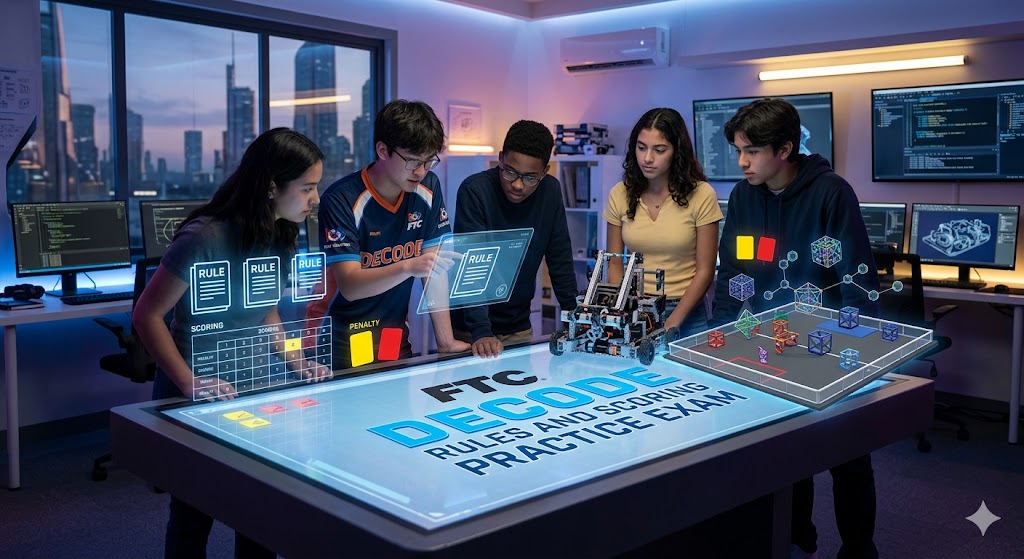
Additional Information
What the Course Entails and Exam Details
This practice exam is not a traditional academic course but a robust knowledge assessment focused entirely on the operational rules of the competitive robotics season. It rigorously covers the contents of the official Game Manual (Part 2), which details the specifics of the "Decode 2026" challenge.
Key areas covered include:
Game Field Layout and Personnel: Deep knowledge of field zones, scoring areas, and the precise roles and allowed actions of drive team members and human players.
Scoring Mechanics: Detailed breakdown of how points are awarded in the Autonomous Period, the Driver-Controlled (TeleOp) Period, and the critical Endgame phase.
Robot Constraints and Inspection: Understanding the volumetric limits, starting configurations, and legal mechanisms specific to this year’s challenge.
Penalties and Violations: Clear interpretation of Minor and Major Penalties, including pinning, interference, blocking, and actions that result in Yellow or Red Cards.
Ranking Points (RP) and Tie-Breakers: How qualification rankings are determined beyond simple wins and losses, including specific bonus criteria for Decode 2026.
What to Expect in the Final Exam
This practice assessment simulates the high-stakes environment of a robotics competition, where split-second rule interpretations are vital. The actual official certification for referees is often managed through the FIRST scoring system, but this practice test mirrors that rigor.
Format: The test typically consists of 40 to 60 multiple-choice questions, true/false scenarios based on hypothetical match play, and "fill-in-the-blank" scoring calculations based on complex game states.
Passing Score: A high threshold (often 90% or higher) is required to demonstrate true mastery, as errors in rule interpretation can lead to devastating penalties in a real match.
Time Limit: Expect a timed environment (e.g., 60 minutes) to encourage quick, accurate recall of the rules, simulating the pressure of a live event.
Focus: Strong emphasis on identifying edge cases, understanding the hierarchy of rules, and accurately calculating final scores from varied match scenarios.
How to Study and Exam Centers
Success requires deep immersion in the official documentation rather than standard studying methods.
Primary Source: Read the official FIRST Tech Challenge Game Manual (Part 1 and especially Part 2 for Decode 2026) multiple times.
Simulate and Script: Physically set up key scoring scenarios on a practice field (or use CAD simulations) and physically act out the rules as a drive team or referee.
Analyze Q&A: Regularly check the official FIRST Game Q&A forum, as answers provided there are official rule clarifications that often overwrite initial interpretations.
Team Quizzing: Use these practice questions to quiz your team members during meetings to ensure collective rules knowledge.
Exam Centers: This practice exam is delivered digitally through optimized online learning portals accessible worldwide. The official volunteering certifications (like Referee or Head Referee) are usually managed through the FIRST volunteer dashboard and completed online. The actual testing ground for this knowledge is at official FTC Qualifying Tournaments, Regional Championships, and the FIRST Championship.
Job Opportunities from the Course
While not a professional certification in the traditional sense, mastering the complex logical frameworks, compliance requirements, and scoring systems of FTC translates directly into skills valued in numerous high-tech fields. It demonstrates analytical thinking, high-level attention to detail, and systemic understanding.
Career paths benefited by this mastery include:
Systems Engineer: Applying rigid constraints to complex operational problems.
Robotics Technician: Maintaining and operating automated systems within defined protocols.
Project Manager (Technical): Managing scope, rules, and compliance in technical projects.
Quality Assurance (QA) Analyst: Rigorously testing systems against detailed specifications.
FIRST Volunteer (Referee/Head Referee/Judge): Essential leadership roles within the FIRST community.
Logistics Coordinator: Managing complex, rule-based operations and scheduling.
Here is the SEO-optimized title and a comprehensive article designed to prepare students for the FIRST Tech Challenge 'Decode 2026' season.
This guide provides crucial insights into the new game rules, scoring mechanisms, and study strategies to ensure your team's success.
FTC Decode 2026 Rules and Scoring Practice Exam
Description
Prepare yourself for the highly anticipated FIRST Tech Challenge (FTC) upcoming season with the comprehensive FTC Decode 2026 Rules and Scoring Practice Exam. This specialized preparatory assessment is essential for FTC students, coaches, mentors, and prospective referees who need to achieve absolute clarity on the newly released Game Manual. Mastery of the specific rules and complex scoring nuances of the "Decode 2026" game is often the defining factor between a good performance and a championship-winning strategy. This practice test ensures your entire team is aligned, compliant, and ready to maximize their scoring potential from the very first qualification match.
What the Course Entails and Exam Details
This practice exam is not a traditional academic course but a robust knowledge assessment focused entirely on the operational rules of the competitive robotics season. It rigorously covers the contents of the official Game Manual (Part 2), which details the specifics of the "Decode 2026" challenge.
Key areas covered include:
Game Field Layout and Personnel: Deep knowledge of field zones, scoring areas, and the precise roles and allowed actions of drive team members and human players.
Scoring Mechanics: Detailed breakdown of how points are awarded in the Autonomous Period, the Driver-Controlled (TeleOp) Period, and the critical Endgame phase.
Robot Constraints and Inspection: Understanding the volumetric limits, starting configurations, and legal mechanisms specific to this year’s challenge.
Penalties and Violations: Clear interpretation of Minor and Major Penalties, including pinning, interference, blocking, and actions that result in Yellow or Red Cards.
Ranking Points (RP) and Tie-Breakers: How qualification rankings are determined beyond simple wins and losses, including specific bonus criteria for Decode 2026.
What to Expect in the Final Exam
This practice assessment simulates the high-stakes environment of a robotics competition, where split-second rule interpretations are vital. The actual official certification for referees is often managed through the FIRST scoring system, but this practice test mirrors that rigor.
Format: The test typically consists of 40 to 60 multiple-choice questions, true/false scenarios based on hypothetical match play, and "fill-in-the-blank" scoring calculations based on complex game states.
Passing Score: A high threshold (often 90% or higher) is required to demonstrate true mastery, as errors in rule interpretation can lead to devastating penalties in a real match.
Time Limit: Expect a timed environment (e.g., 60 minutes) to encourage quick, accurate recall of the rules, simulating the pressure of a live event.
Focus: Strong emphasis on identifying edge cases, understanding the hierarchy of rules, and accurately calculating final scores from varied match scenarios.
How to Study and Exam Centers
Success requires deep immersion in the official documentation rather than standard studying methods.
Primary Source: Read the official FIRST Tech Challenge Game Manual (Part 1 and especially Part 2 for Decode 2026) multiple times.
Simulate and Script: Physically set up key scoring scenarios on a practice field (or use CAD simulations) and physically act out the rules as a drive team or referee.
Analyze Q&A: Regularly check the official FIRST Game Q&A forum, as answers provided there are official rule clarifications that often overwrite initial interpretations.
Team Quizzing: Use these practice questions to quiz your team members during meetings to ensure collective rules knowledge.
Exam Centers: This practice exam is delivered digitally through optimized online learning portals accessible worldwide. The official volunteering certifications (like Referee or Head Referee) are usually managed through the FIRST volunteer dashboard and completed online. The actual testing ground for this knowledge is at official FTC Qualifying Tournaments, Regional Championships, and the FIRST Championship.
Job Opportunities from the Course
While not a professional certification in the traditional sense, mastering the complex logical frameworks, compliance requirements, and scoring systems of FTC translates directly into skills valued in numerous high-tech fields. It demonstrates analytical thinking, high-level attention to detail, and systemic understanding.
Career paths benefited by this mastery include:
Systems Engineer: Applying rigid constraints to complex operational problems.
Robotics Technician: Maintaining and operating automated systems within defined protocols.
Project Manager (Technical): Managing scope, rules, and compliance in technical projects.
Quality Assurance (QA) Analyst: Rigorously testing systems against detailed specifications.
FIRST Volunteer (Referee/Head Referee/Judge): Essential leadership roles within the FIRST community.
Logistics Coordinator: Managing complex, rule-based operations and scheduling.
Frequently Asked Questions
Reviews
5.0
Based on 0 reviews
Leave a Review
No reviews yet. Be the first to review!