
FTU MQ‑9 Systems 1 Practice Test
$69.00
- Buy to unlock unlimited access to all Quiz questions and Answers in this Quiz.
- After purchase you can print a PDF of the whole quiz at any point. The PDF will contain the questions and the correct answers.
About this Exam
The FTU MQ-9 Systems 1 Practice Test is a crucial milestone for aircrew and maintenance personnel preparing to operate and maintain the MQ-9 Reaper Unmanned Aerial Vehicle (UAV). Designed primarily for U.S. Air Force, Air Force Reserve, and Air National Guard personnel, as well as defense contractors, this initial systems exam is the first gate within the Formal Training Unit (FTU) pipeline. It comprehensively evaluates a student's foundational understanding of the MQ-9's interconnected subsystems, ensuring they possess the technical knowledge required before progressing to advanced simulator and live flight training. Successfully passing this test is a non-negotiable step toward earning the coveted Initial Qualification Training (IQT) certification.
Ready to test your knowledge?
Buy Now to Access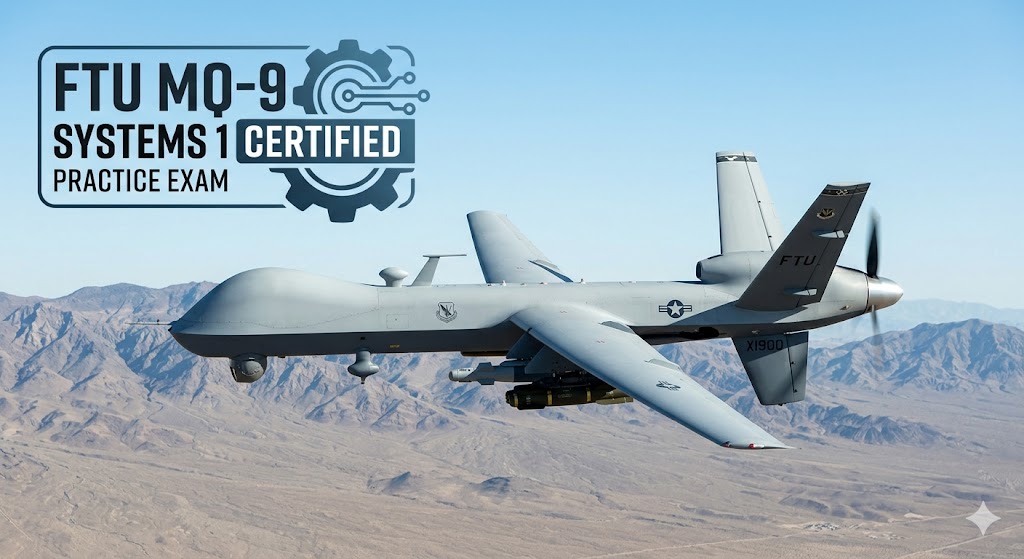
Additional Information
What the Course Entails and Exam Details
This examination is the culmination of intensive ground-based academic instruction. The course covers the functional theory, operation, and normal/emergency procedures for all major MQ-9 Reaper systems. Key syllabus areas include:
Airframe and Propulsion: Detailed study of the Honeywell TPE331 turboprop engine, fuel system, and structural limitations.
Electrical System: Complete understanding of the high-capacity power system, AC/DC distribution, and battery backups.
Avionics and Flight Controls: Comprehensive knowledge of the redundant flight control computers, navigation sensors, and autopilot functions.
Communication Systems: Deep dive into line-of-sight (C-Band) and beyond-line-of-sight (Ku-Band) satellite datalinks, ARC-210 radios, and the Predator Primary Satellite Link (PPSL).
Payload Systems: Functional understanding of the Multi-Spectral Targeting System (MTS-B), including EO/IR camera operation, laser designators, and synthetic aperture radar (SAR).
Weapons Systems: Overview of the stores management system and the integration of AGM-114 Hellfire missiles and GBU-12/38 precision-guided bombs.
What to Expect in the Final Exam
The actual MQ-9 Systems 1 final exam is a rigorous, time-limited assessment, and this practice test is designed to mirror its intensity. The final test is typically a closed-book examination administered via a secure computer portal. You should expect a mix of formatted multiple-choice, select-all-that-apply, and complex functional scenario questions. The exam duration is usually between two and three hours. The passing score is exceptionally high, often requiring an 80% or 85% to demonstrate mastery, as there is zero room for systems ignorance in unmanned operations. Examinees must be able to recall specific system limitations, switch logic, and critical memory items under time pressure.
How to Study and Exam Centers
Preparation for the Systems 1 test demands dedication to the "books." Start by creating a detailed study plan that partitions each major subsystem. Reviewing the authoritative USAF Technical Manuals (TOs), AFMAN 11-2MQ-9 Volume 1, and General Atomics systems descriptions is essential. Create flashcards for critical limitations, switch functions, and acronyms. Actively use any provided Computer-Based Training (CBT) modules, but augment them by sketching out functional diagrams to understand the 'why' behind system responses. Group study, where you teach a system to your peers, is highly effective. Finally, utilize this FTU MQ-9 Systems 1 Practice Test repeatedly to identify weak areas and build mental stamina.
Because this is a military qualification exam, you cannot take it at a standard commercial testing center. The official final exam is only administered at authorized USAF Formal Training Units, which are generally located at major MQ-9 operating bases like Creech AFB, Holloman AFB, or March ARB. For contracting personnel, exams may be administered at specific, authorized General Atomics Aeronautical Systems facilities.
Job Opportunities from the Course
Successfully completing the MQ-9 FTU curriculum and earning systems certification directly unlocks critical, high-demand career paths in the unmanned aviation sector. Potential job titles and career avenues include:
MQ-9 Reaper RPA Pilot (Pilot-in-Command)
MQ-9 Reaper Sensor Operator
Unmanned Aircraft Systems (UAS) Systems Engineer
MQ-9 Maintenance Technician (Avionics/Propulsion/GCS)
UAS Flight Test Engineer
Tactical Unmanned Aerial Systems (TUAS) Instructor
Defense Contractor Field Service Representative (FSR)
Frequently Asked Questions
Reviews
5.0
Based on 0 reviews
Leave a Review
No reviews yet. Be the first to review!