
Functional Safety Practice Exam
$69.00
- Buy to unlock unlimited access to all Quiz questions and Answers in this Quiz.
- After purchase you can print a PDF of the whole quiz at any point. The PDF will contain the questions and the correct answers.
About this Exam
The Functional Safety certification, often tied to standards like IEC 61508 or ISO 26262, validates an individual's competence in designing, managing, and auditing safety-critical systems. This practice exam is designed for engineers, technicians, and managers involved in automotive, process, robotics, and industrial automation who require a rigorous assessment of their understanding before taking the formal qualification exam. The objective is to simulate the exam environment and identify areas where further study is needed.
Ready to test your knowledge?
Buy Now to Access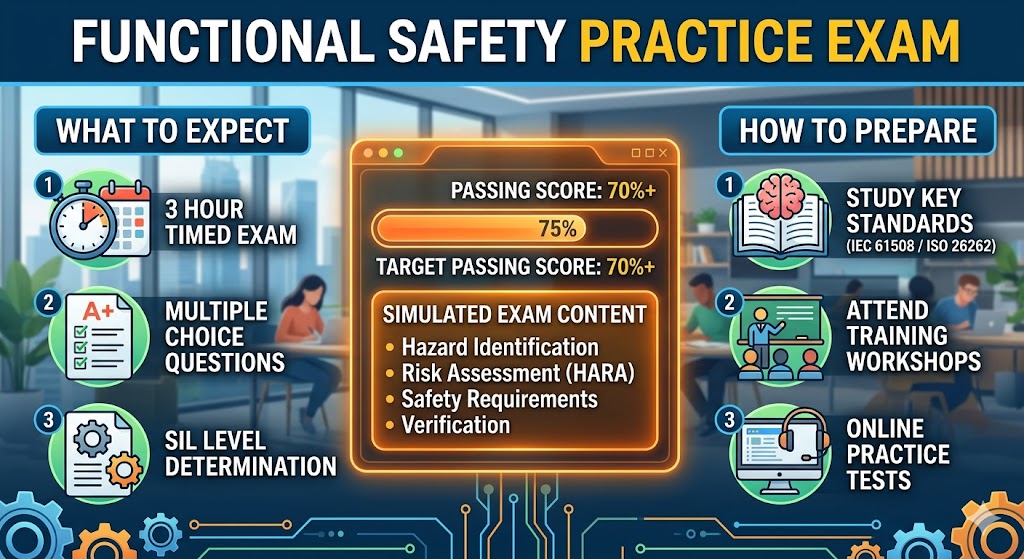
Additional Information
What the Course Entails and Exam Details
This comprehensive practice exam rigorously evaluates knowledge across the safety life cycle, beginning with hazard identification and risk assessment methodologies. Participants will be tested on safety requirements allocation, safety integrity level (SIL) determination and verification, and the development of safety-related electronic and programmable electronic systems (E/E/PE). The syllabus extends to software design guidelines for safety, hardware safety requirements, management of functional safety, and maintenance and operation procedures, ensuring a holistic understanding of risk reduction strategies.
What to Expect in the Final Exam
While actual exam formats can vary slightly depending on the awarding body (such as TÜV SÜD, TÜV Rheinland, or exida), most functional safety certification exams follow a strict structure.
They are generally structured as follows:
Format: Primarily multiple-choice questions designed to test both theoretical knowledge and practical application.
Time Limit: Typically ranges from three to four hours for a single-day comprehensive exam.
Passing Score: A minimum score, often around 70% to 75%, is required to achieve certification.
Rules: Many of these exams allow the use of official, unmarked standards documents (e.g., IEC 61508 Parts 1–7 or ISO 26262 Parts 1–12), but closed-book portions may also apply depending on the specific program.
How to Study and Exam Centers
Preparation for this challenging exam requires a structured approach.
Candidates are strongly advised to:
Immerse themselves in the Standards: This is the most crucial step. Read and understand the primary standards relevant to your certification track (IEC 61508 or ISO 26262). Know how to quickly locate specific clauses and requirements.
Take a Preparatory Course: Attending an official, multi-day functional safety course is highly recommended, as it provides expert context and practical examples.
Use Practice Exams: Continuously take practice assessments to build speed and familiarize yourself with the question types.
Exam distribution is typically managed directly by the authorized certification bodies. These organizations often offer the exam following an in-person or virtual training workshop. Candidates should coordinate with providers like TÜV SÜD or exida to schedule their exam, which may be hosted at their facilities, on-site for large corporate groups, or through secure online proctoring systems.
Job Opportunities from the Course
A certification in Functional Safety significantly boosts professional credibility, opening doors to advanced engineering and leadership roles across several sectors:
Functional Safety Engineer: Responsible for designing and implementing safety functions in automotive (ADAS/EV), aerospace, or process industries.
Safety Manager/Lead: Overseeing the entire safety management process, ensuring compliance across large-scale projects.
Systems Engineer: Integrating complex safety-critical systems while adhering to relevant standards.
Hardware or Software Functional Safety Engineer: Specialized roles focusing on component-level compliance (e.g., microcontroller safety mechanisms or embedded software verification).
Safety Auditor/Assessor: Independent verification of safety lifecycles for certification bodies or internal compliance teams.
Frequently Asked Questions
Reviews
5.0
Based on 0 reviews
Leave a Review
No reviews yet. Be the first to review!