
Fundamental Code Calculations Practice Test
$69.00
- Buy to unlock unlimited access to all Quiz questions and Answers in this Quiz.
- After purchase you can print a PDF of the whole quiz at any point. The PDF will contain the questions and the correct answers.
About this Exam
Mastering the National Electrical Code (NEC) calculations is a pivotal step for electricians aiming to gain licensure and advance in their careers. The "Fundamental Code Calculations Practice Test" is an essential resource specifically designed for electricians, electrical engineers, and students preparing for the challenging certification exams, such as Journeyman or Master Electrician, in the United States. This practice test provides a structured and comprehensive review of the calculations required by the NEC, ensuring candidates are well-equipped to apply complex code requirements to real-world electrical installations and navigate the actual exam with confidence.
Ready to test your knowledge?
Buy Now to Access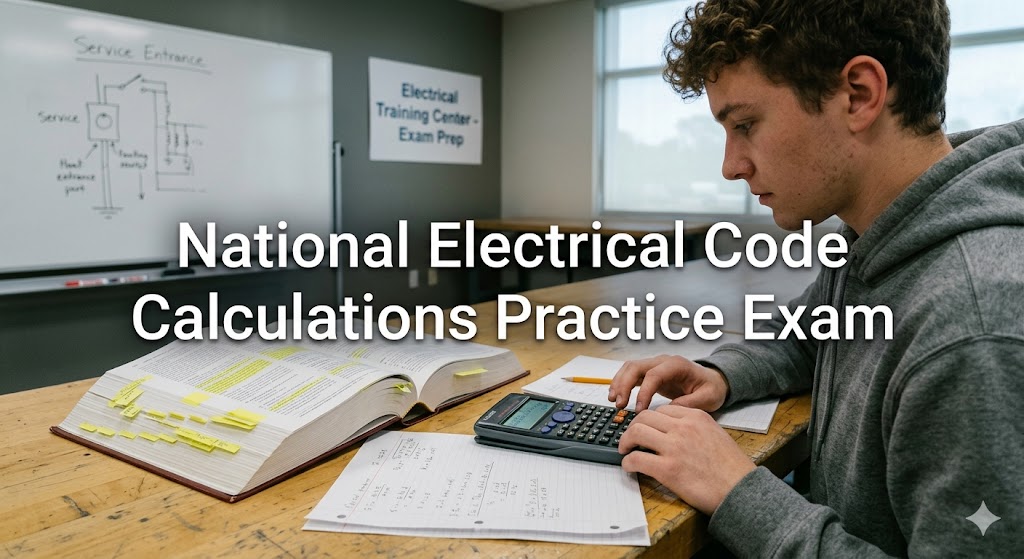
Additional Information
What the Course Entails and Exam Details
This practice test mirrors the rigors of the official NEC exam, focusing intensely on key calculation methodologies. It covers essential topics, including:
Load Calculations for residential and commercial spaces.
Conductor Sizing and ampacity adjustments based on environmental conditions.
Voltage Drop calculations for single-phase and three-phase systems.
Grounding and Bonding conductor sizing, including requirements for electrodes and equipment.
Overcurrent Protection device (OCPD) sizing for various circuit types.
Motor and Transformer calculations according to Article 430 and 450.
Conduit and Raceway Fill calculations, ensuring proper fit for multiple conductors.
Box and Enclosure fill calculations, in accordance with Article 314.
The questions are meticulously designed to test your understanding of multiple NEC Articles, including 210, 220, 230, 240, 250, 310, 314, 430, 450, and 725, among others.
3. What to Expect in the Final Exam
While the exact structure of your final licensing exam will vary by state or local jurisdiction, the calculations section typically shares common characteristics:
Format: The NEC calculations portion is almost exclusively Multiple-Choice Questions (MCQs). These questions often present a complex electrical installation scenario and require you to perform several sequential steps to arrive at the correct NEC-compliant answer.
Time Limits: These exams are typically timed, and the time allocated for the calculations portion is limited. This section is known for being time-consuming and challenging.
Difficulty: Calculations questions are generally considered the most demanding part of the exam.
Materials Allowed: Most jurisdictions permit you to use your National Electrical Code book during the exam (often the specific edition referenced by your state). However, using the actual code book to perform complex calculations efficiently requires significant practice.
Passing Score: The required passing score (often a percentage) varies by jurisdiction and the type of license (e.g., Journeyman vs. Master).
How to Study and Exam Centers
Effective preparation for NEC calculations involves a combination of theoretical understanding and intensive practice. Here is a proven strategy:
Master the Code: Your primary resource must be the National Electrical Code. Practice navigating the index and relevant tables efficiently. Know where the calculation-intensive articles and annexes are located.
Practice with Multiple Resources: Do not rely on a single practice test. Use various calculation guides, study materials, and practice exams (like this one) from different publishers to encounter diverse question formats.
Time Yourself: Since the actual exam is timed, practice answering calculation questions under time pressure to improve speed and accuracy.
Focus on Process: For every incorrect answer, understand why it was incorrect. Did you look up the wrong table? Miss an environmental derating factor? Miscalculate a load?
Take a Preparatory Course: Consider enrolling in a formal NEC exam prep course, which often includes dedicated calculation workshops led by experienced instructors.
Exam Centers: The location for your exam depends on your licensing jurisdiction.
State-Run Testing: Some states conduct the testing directly or through their own online platforms.
Third-Party Testing Services: Many jurisdictions utilize independent testing organizations. The most common are:
Pearson VUE
PSI Testing Services
Prometric
To take the exam, you will typically need to pre-register and pay a fee. Upon registration, you will select an available testing date at an approved, secure testing center or schedule an online proctored exam if offered by your testing service.
Job Opportunities from the Course
Passing your licensing exam is often contingent upon mastering these calculations. Achieving licensure significantly enhances your career trajectory and increases your earning potential. The "Fundamental Code Calculations Practice Test" helps you qualify for and excel in the following roles:
Journeyman Electrician
Master Electrician
Electrical Contractor (Owner)
Electrical Inspector (Municipal or Third-Party)
Electrical Field Engineer (Construction)
Plant Electrician (Maintenance)
Estimator for Electrical Projects
Design Engineer Assistant (Electrical)
Frequently Asked Questions
Reviews
5.0
Based on 0 reviews
Leave a Review
No reviews yet. Be the first to review!