
Fundamentals of Critical Care Support (FCCS) Practice Test
$69.00
- Buy to unlock unlimited access to all Quiz questions and Answers in this Quiz.
- After purchase you can print a PDF of the whole quiz at any point. The PDF will contain the questions and the correct answers.
About this Exam
The Fundamentals of Critical Care Support (FCCS) course is a premier educational program developed by the Society of Critical Care Medicine (SCCM). It is designed to provide healthcare professionals—including physicians, nurses, physician assistants, and respiratory therapists—with the essential knowledge and skills required to manage critically ill patients.
Whether you are a seasoned professional looking to refresh your expertise or a clinician entering a high-acuity setting for the first time, this course bridges the gap between general care and specialized intensive care. Preparing for the certification ensures you are well-equipped to handle the immediate, life-saving decisions that define the critical care environment.
Ready to test your knowledge?
Buy Now to Access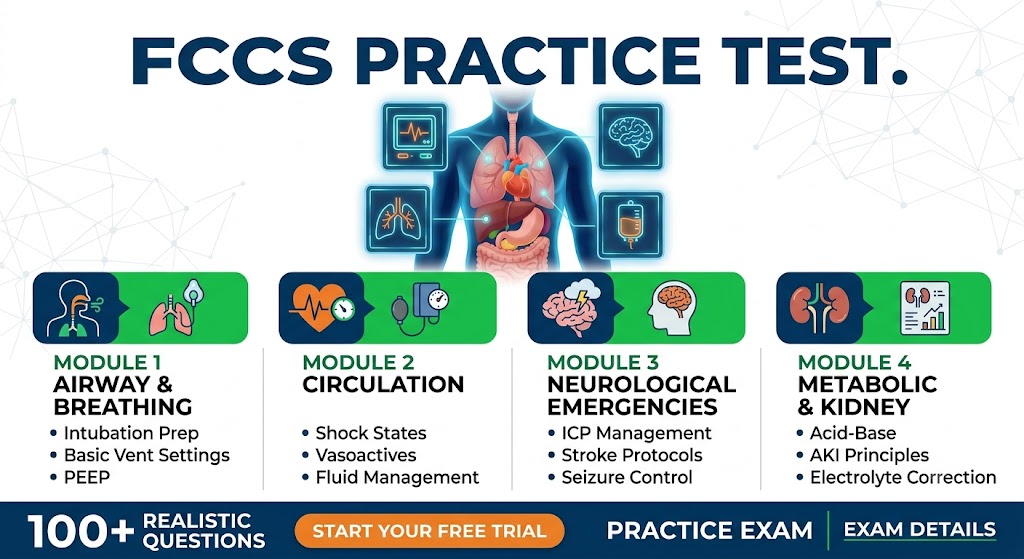
Additional Information
What the Course Entails and Exam Details
The FCCS curriculum covers a comprehensive array of core competencies necessary for the rapid assessment and management of the unstable patient. Students gain proficiency in identifying and treating complex physiological issues through both didactic lectures and hands-on skill stations.
Key topics typically included in the syllabus are:
Airway management and basic mechanical ventilation.
Recognition and management of shock states, including hypovolemic, cardiogenic, and distributive.
Neurological support, focusing on intracranial pressure and stroke protocols.
Identification of metabolic and electrolyte disturbances.
Acute kidney injury and acid-base disorder management.
Sedation, analgesia, and neuromuscular blockade in the ICU.
Sepsis management and infection control.
What to Expect in the Final Exam
The FCCS final exam is designed to test your clinical judgment and your ability to apply course principles to real-world scenarios.
The format is generally comprised of multiple-choice questions that challenge your decision-making processes under pressure. While specifics can vary based on the provider, the exam typically focuses on:
Clinical case studies that require identifying critical priorities.
Interpretation of laboratory results and diagnostic data.
Theoretical understanding of equipment used in the ICU.
To pass, participants must meet a pre-determined score threshold set by the SCCM guidelines. The exam is timed, requiring efficient management of your test-taking speed, and it is usually administered immediately following the completion of the didactic and skill station components of the course.
How to Study and Exam Centers
Effective preparation is the key to succeeding in the FCCS exam. Because the material is highly clinical, rote memorization is rarely sufficient. Instead, focus on understanding the underlying pathophysiology of critical illness.
Study strategies include:
Reviewing the official SCCM FCCS textbook thoroughly before attending the course.
Utilizing practice tests to familiarize yourself with the question style and time constraints.
Participating actively in all hands-on skill stations, as these frequently provide clues for the exam content.
Creating clinical "cheat sheets" for vasopressor dosages, ventilator settings, and shock protocols to reinforce memory.
Regarding location, the FCCS course is not typically taken at a Pearson VUE center. Instead, it is hosted by authorized medical institutions, hospitals, and universities that have partnered with the SCCM to provide the training. You can find a list of upcoming courses by searching the official SCCM course catalog on their website. Ensure you register well in advance, as these courses often have limited seating to maintain the quality of the hands-on instruction.
Job Opportunities from the Course
Earning your FCCS certification demonstrates a high level of competency, making you a more attractive candidate for specialized roles in high-acuity settings. This certification serves as a professional credential that often opens doors to more challenging and rewarding career paths.
Potential career paths include:
Intensive Care Unit (ICU) Nurse
Critical Care Paramedic
Emergency Department (ED) Physician or Nurse
Surgical Intensive Care Specialist
Rapid Response Team (RRT) Member
Transport Nurse or Flight Medic
Critical Care Physician Assistant or Nurse Practitioner
Frequently Asked Questions
Reviews
5.0
Based on 0 reviews
Leave a Review
No reviews yet. Be the first to review!