
Fundamentals of Geology Practice Exam
$69.00
- Buy to unlock unlimited access to all Quiz questions and Answers in this Quiz.
- After purchase you can print a PDF of the whole quiz at any point. The PDF will contain the questions and the correct answers.
About this Exam
The Fundamentals of Geology exam serves as a foundational step for aspiring professionals in the earth sciences. It is generally the critical first prerequisite towards achieving licensure as a Professional Geologist (PG) in jurisdictions that regulate the practice of geology. This comprehensive guide and accompanying practice exam are meticulously designed for final-year undergraduate students, graduate students, or recent geology graduates who are preparing for the official qualification administered by the National Association of State Boards of Geology (ASBOG). Our practice materials help candidates gauge their understanding of core geological principles and build the practical confidence required to succeed in a formal testing environment.
Ready to test your knowledge?
Buy Now to Access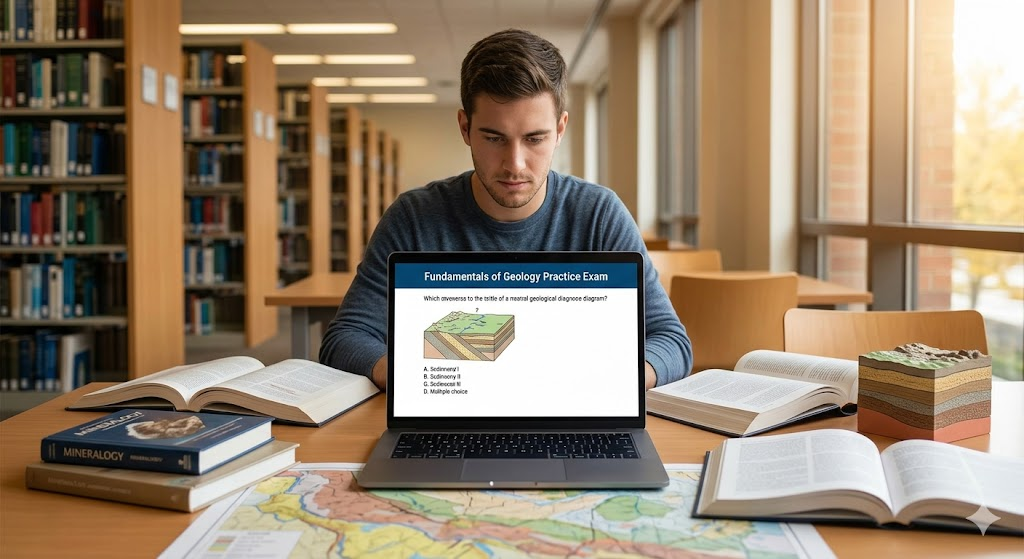
Additional Information
What the Course Entails and Exam Details
This preparation curriculum covers a broad syllabus reflecting the eight fundamental domains of geology required of early-career professionals. Candidates must demonstrate proficiency across several core areas. The syllabus includes Earth Materials, focusing on mineralogy, petrology, and geochemistry. It also covers Geomorphology, Surficial Processes, and Quaternary Geology. A significant portion is dedicated to Structural Geology, Tectonics, and Seismology, as well as Sedimentology, Stratigraphy, and Paleontology. Furthermore, the practice exam evaluates understanding of Field Methods and Geological Mapping techniques. Practical applications are emphasized in specialized fields like Hydrogeology, Environmental Geochemistry, Engineering Geology, and Economic Geology (encompassing mining and energy resources).
What to Expect in the Final Exam
The actual computerized Fundamentals of Geology (FG) exam consists of 140 multiple-choice questions. Candidates are allotted a maximum of four hours to complete the examination. The exam utilizes a raw score system which is converted to a scaled score, with 70 typically representing the minimum passing threshold, though the required number of correct answers may fluctuate slightly between different versions of the test. While specific calculators are permitted, the exam strictly prohibits bringing unauthorized resources into the test center. The questions evaluate both recall of fundamental facts and the practical ability to analyze geological diagrams, cross-sections, and scenarios.
How to Study and Exam Centers
Effective preparation for the Fundamentals of Geology practice exam requires a balanced study strategy utilizing recommended textbooks and official reference materials. Candidates should prioritize reviewing geological maps, cross-sections, and the identification of minerals and rocks. The most efficient strategy involves taking this simulated practice exam to establish a baseline performance and identify knowledge gaps in specific domains. Focus your intensive study time on these identified weak areas before re-testing. Regarding test centers, this particular practice guide is accessible online through our digital portal. Registration for the official FG exam must be approved by your specific state or jurisdictional licensing board. Once authorized, the official computer-based exam is typically scheduled and administered at authorized Prometric testing centers located throughout the United States and Canada.
Job Opportunities from the Course
Mastering the knowledge foundational to this practice exam is a major step toward a lucrative and dynamic career in the geosciences. Success in this area is a powerful indicator to potential employers that you possess the necessary core skills. A selection of career paths opened or enhanced by preparing for and achieving eventually this qualification includes:
Environmental Geologist
Engineering Geologist / Geotechnical Engineer
Hydrogeologist
Mining and Exploration Geologist
Petroleum Geologist / Energy Geoscience Specialist
Geological Mapper / Structural Geologist
State or Federal Regulatory Geologist (e.g., USGS or state environment agencies)
Seismologist or Volcanologist (often requiring further specialized study)
Natural Hazards Risk Analyst
Frequently Asked Questions
Reviews
5.0
Based on 0 reviews
Leave a Review
No reviews yet. Be the first to review!