
Fundamentals of HIPAA Practice Exam
$69.00
- Buy to unlock unlimited access to all Quiz questions and Answers in this Quiz.
- After purchase you can print a PDF of the whole quiz at any point. The PDF will contain the questions and the correct answers.
About this Exam
The Health Insurance Portability and Accountability Act (HIPAA) is the cornerstore of healthcare data protection in the United States, and maintaining compliance is not just a legal requirement but a fundamental component of patient trust. This certification is specifically designed to validate an individual's foundational knowledge of the key rules governing Protected Health Information (PHI). It is ideal for a broad spectrum of professionals, including healthcare providers, administrative and front-office staff, medical billing and coding specialists, and healthcare students preparing to enter clinical rotations. By earning this certification, you demonstrate to employers that you possess the essential understanding necessary to handle sensitive patient data ethically, securely, and in strict accordance with federal regulations.
Ready to test your knowledge?
Buy Now to Access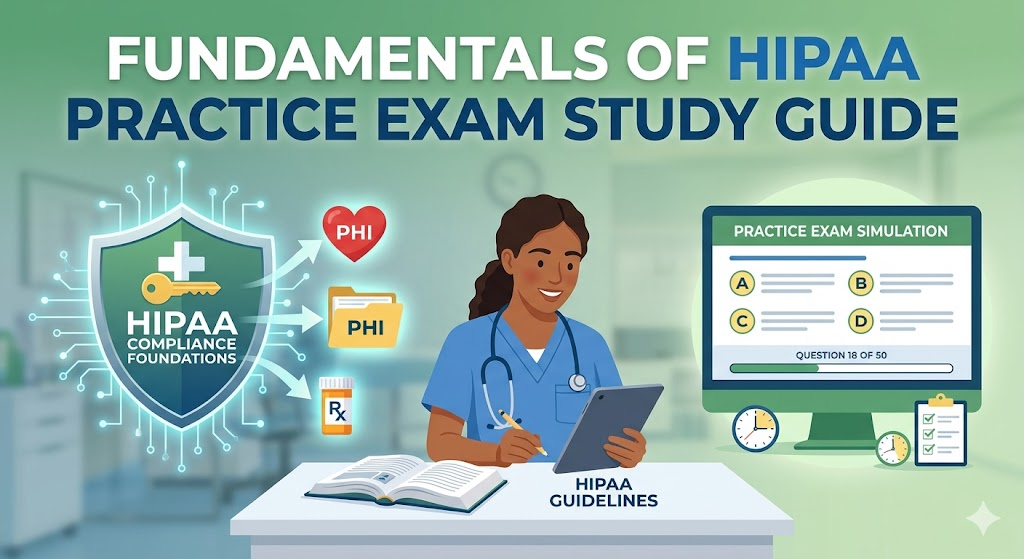
Additional Information
What the Course Entails and Exam Details
This comprehensive course or study program covers the core domains of HIPAA regulation, providing you with the mandatory knowledge needed to identify and manage PHI. The primary focus is on the four principal pillars of HIPAA.
You will master the HIPAA Privacy Rule, which dictates how PHI can be used and disclosed, including the "Minimum Necessary" standard and patient rights.
You will also gain a clear understanding of the HIPAA Security Rule, which outlines the administrative, physical, and technical safeguards required to protect Electronic Protected Health Information (ePHI).
The training ensures familiarity with the HIPAA Breach Notification Rule, which clarifies the necessary procedures for notifying individuals, the government, and sometimes the media, following a data breach.
Lastly, the program covers the nuances of HIPAA Enforcement and Violations, identifying the various tiers of penalties and the importance of compliance audits.
What to Expect in the Final Exam
While the specific administrator of your exam might vary, most foundational HIPAA exams share a standard structure designed to test retention and practical scenario-based understanding. You should expect a computer-based, multiple-choice question (MCQ) format. The exam is typically closed-book, and for some digital platforms, it may be remotely proctored to ensure academic integrity.
The number of questions usually ranges from 40 to 60, designed to assess knowledge across all the core HIPAA domains.
Passing scores are generally set around 70% to 75%, requiring you to answer a substantial number of questions correctly.
You will likely be allotted a time limit of 60 to 90 minutes to complete the test, demanding that you manage your time effectively while reading questions carefully. Be prepared for scenario-based questions that ask you to apply HIPAA rules to realistic healthcare situations.
How to Study and Exam Centers
Effective preparation is the key to success on the Fundamentals of HIPAA Practice Exam. Your strategy should blend comprehensive review with active testing. Begin by mastering the legal definitions: you must understand precisely what constitutes PHI, ePHI, a Covered Entity (CE), and a Business Associate (BA). We recommend dedicating significant time to taking timed practice tests to become comfortable with the question style and manage your pacing. When reviewing your practice test results, focus heavily on explaining why the correct answer is correct and why the distractors are wrong.
This exam is administered almost exclusively through digital platforms and secure online portals provided by accredited training organizations. You will typically purchase an exam voucher and access the test from your own computer at a scheduled time. Unlike some massive professional certifications, it is rarely administered through physical third-party centers like Pearson VUE. Ensure you are taking the test through a reputable, recognized compliance training provider to guarantee your certification holds industry value.
Job Opportunities from the Course
Earning this foundational HIPAA certification is an immediate differentiator on your résumé, validating your competence in data privacy within the highly regulated healthcare sector. This credential can be the deciding factor for entry-level positions and provides a foundation for rapid advancement into compliance-focused roles.
The career paths this certification unlocks include, but are not limited to:
Healthcare Compliance Specialist
HIPAA Privacy Officer
Medical Billing and Coding Specialist
Healthcare Administrator
Medical Records Technician
Privacy Analyst
Healthcare Auditor
Patient Registration Coordinator
Health Information Manager
Healthcare IT Security Analyst
Frequently Asked Questions
Reviews
5.0
Based on 0 reviews
Leave a Review
No reviews yet. Be the first to review!