
Funeral Service Practice Exam
$69.00
- Buy to unlock unlimited access to all Quiz questions and Answers in this Quiz.
- After purchase you can print a PDF of the whole quiz at any point. The PDF will contain the questions and the correct answers.
About this Exam
The Funeral Service Practice Exam is an essential preparatory tool designed for aspiring funeral directors, morticians, and embalmers. This comprehensive simulation is crafted for students who have completed or are nearing the completion of an accredited mortuary science program. It serves as the ultimate final rehearsal before sitting for the official National Board Exam (NBE) or state-specific licensing boards. This tool is vital for validating academic knowledge, identifying critical information gaps, and building the necessary test-taking endurance required to succeed in a demanding professional field.
Ready to test your knowledge?
Buy Now to Access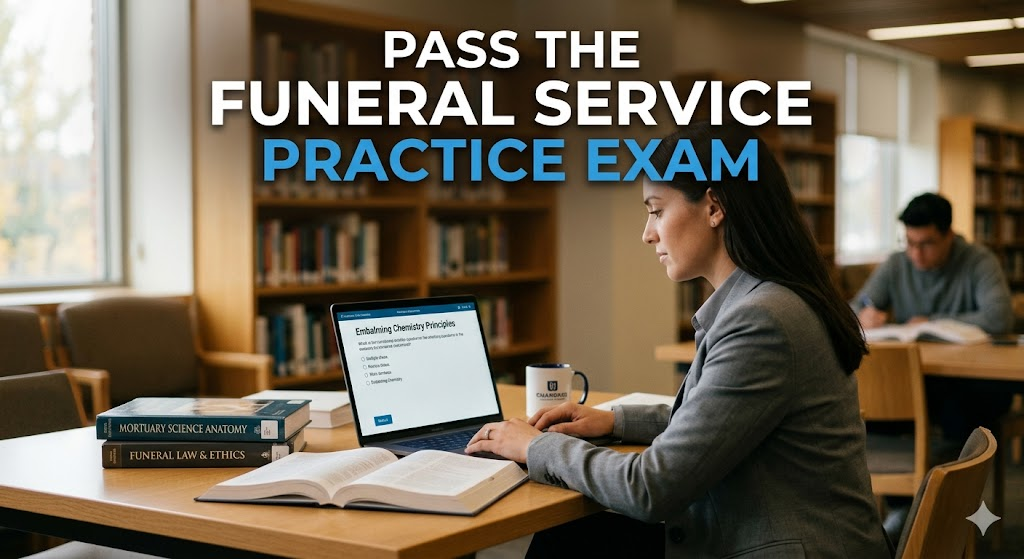
Additional Information
What the Course Entails and Exam Details
This study program encompasses the entire spectrum of knowledge required for contemporary funeral service practice. It is structured to cover the two primary pillars of licensure: Funeral Service Arts and Funeral Service Sciences.
Within the Arts domain, students will review sociology of funeral service, history of funeral service, psychology of grief, and the intricate laws and ethical regulations governing the industry, including FTC Funeral Rule compliance. It also includes funeral arranging, merchandising, and funeral home management.
Within the Sciences domain, the focus shifts to the technical. Topics include human anatomy, physiology, chemistry, pathology, microbiology, and the precise techniques of embalming, restorative art, and crematory operations. The practice program ensures that students are familiar with the nomenclature and procedural standards required for professional competency.
What to Expect in the Final Exam
When sitting for the actual licensing exam, candidates must prepare for a rigorous, computer-based testing environment. While practice tests may vary in length, the official National Board Exam, for instance, consists of hundreds of multiple-choice questions divided into separate Arts and Sciences sections. Candidates are usually allocated a strictly enforced time limit—often around two hours per section—to complete the assessment. Passing requirements are typically set around a scaled score of 75. Students should expect strict security protocols at the testing facility; no outside materials are allowed, and candidates are monitored throughout the duration of the exam.
How to Study and Exam Centers
Effective preparation requires a combination of rote memorization, conceptual understanding, and active recall. Students should start by reviewing standard mortuary science textbooks and class notes, then shift focus to taking timed, full-length practice examinations. Simulating real exam conditions is crucial for managing test anxiety.
The actual licensing exams are administered at professional proctored environments. The most common physical testing provider is Pearson VUE, which operates hundreds of secure authorized centers across the country. In some jurisdictions, exams may be administered directly through state licensing boards or within authorized, accredited mortuary science schools. Candidates must typically register through their respective state board or the International Conference of Funeral Service Examining Boards to obtain authorization to test.
Job Opportunities from the Course
Successfully navigating the licensure path facilitated by this preparatory study guide unlocks diverse and stable career opportunities within the deathcare industry.
Licensed professionals can pursue rewarding roles such as Licensed Funeral Director, Licensed Embalmer, Mortician, Funeral Home Manager, or Funeral Arranger. Furthermore, this foundation allows graduates to specialize as Crematory Operators, Pre-need Planning Consultants, Cemetery Superintendents, or Grief Counselors. Dedicated professionals frequently advance to become owners of their own private funeral establishments.
Frequently Asked Questions
Reviews
5.0
Based on 0 reviews
Leave a Review
No reviews yet. Be the first to review!