
Future Business Leaders of America (FBLA) Business Law Practice Exam
$69.00
- Buy to unlock unlimited access to all Quiz questions and Answers in this Quiz.
- After purchase you can print a PDF of the whole quiz at any point. The PDF will contain the questions and the correct answers.
About this Exam
Welcome to your essential resource for mastering the Future Business Leaders of America (FBLA) Business Law competitive event. This guide is specifically designed for ambitious high school students aiming to excel in one of FBLA’s most challenging and rewarding individual competitions.
The FBLA Business Law event tests a student’s understanding of the fundamental legal principles that govern the business world. It goes beyond simple memorization, requiring participants to apply legal concepts to realistic business scenarios. Whether you are aspiring to be an attorney, an entrepreneur, or a corporate leader, a solid grasp of business law is indispensable.
This exam is designed for FBLA members who demonstrate a keen interest in the legal framework of commerce. It provides an excellent platform to showcase your knowledge, critical thinking skills, and readiness for future academic and professional pursuits in law and business.
Ready to test your knowledge?
Buy Now to Access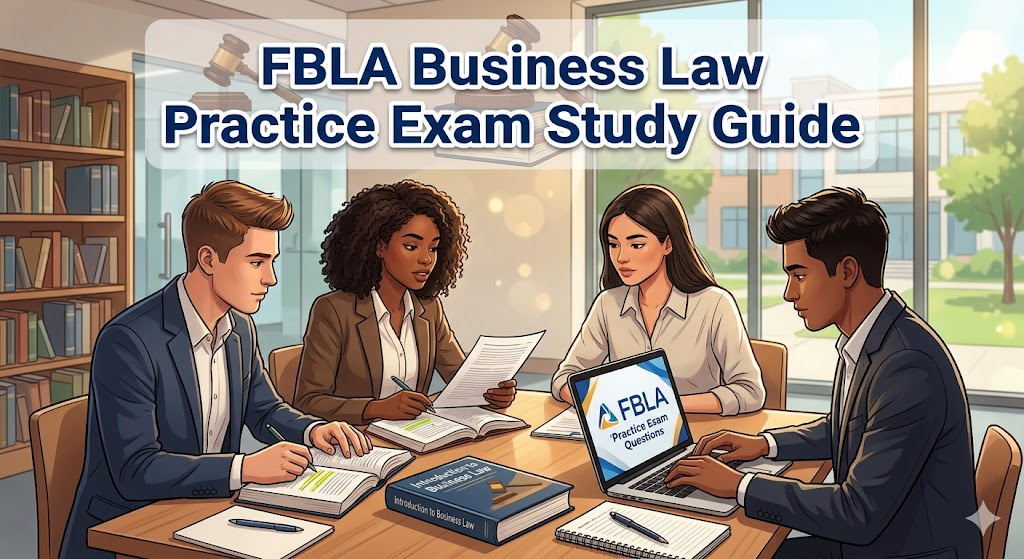
Additional Information
What the Course Entails and Exam Details
To succeed in this event, students must develop a comprehensive understanding of various legal domains. The FBLA Business Law syllabus is extensive, covering topics essential for navigating the legal complexities of modern business operations.
The core areas covered in the exam include, but are not limited to:
Legal Systems and Environment: Structure of the U.S. court system, sources of law (constitutional, statutory, administrative), and alternative dispute resolution.
Contracts: Elements of a valid contract, breach of contract, remedies, and the Statute of Frauds. This is often the most heavily weighted section.
Sales and Uniform Commercial Code (UCC): Laws governing the sale of goods, warranties, and consumer protection.
Property Law: Distinctions between real, personal, and intellectual property (copyrights, trademarks, patents).
Agency and Employment Law: The relationship between principals and agents, employment-at-will, and anti-discrimination laws.
Business Organizations: Legal structures such as sole proprietorships, partnerships, corporations, and LLCs.
Torts and Crimes: Negligence, strict liability, and common business crimes like embezzlement and fraud.
Bankruptcy and Credit: Basic principles of bankruptcy law and debtor/creditor relations.
The objective of the event is to evaluate your ability to analyze complex situations and apply these legal principles accurately.
What to Expect in the Final Exam
The final competition for FBLA Business Law is primarily a written objective test. While specific formats may evolve slightly by year or competition level (Regional, State, National), students can generally expect the following:
Exam Format: The test consists of Multiple-Choice Questions (MCQ). You will need to select the best answer from several options.
Number of Questions: The exam typically contains 100 multiple-choice questions.
Time Limit: Participants are given a strict time limit, usually 60 or 90 minutes, to complete the entire test. Time management is crucial.
Scoring: The final score is based solely on the number of correct answers. There is usually no penalty for guessing, so it is in your best interest to answer every question.
Specific Rules: Only official FBLA materials or approved resources may be referenced before the exam; the test itself is closed-book. Use of calculators is generally not permitted or necessary. Tie-breaker questions are often included to determine rankings in the event of identical scores.
How to Study and Exam Centers
Effective preparation is the key to achieving a top score. A combination of focused study, resource utilization, and practice is essential for success.
Actionable Study Strategies:
Master the FBLA Topic Outline: Begin by thoroughly reviewing the official FBLA competitive events guidelines. This outline provides the definitive list of topics you need to master.
Use High-Quality Textbooks: Utilize introductory business law textbooks, such as those by Miller and Jentz (Cengage) or Beatty and Samuelson. Focus on understanding the "why" behind the law, not just the "what."
Take Practice Exams: This is perhaps the most critical step. Utilize practice tests available through your FBLA chapter advisor, online test banks, and study guides specialized for FBLA events. Analyze your mistakes on these practice tests to identify weak areas.
Create Flashcards: Use digital tools like Quizlet or traditional index cards to memorize key legal terms, definitions, landmark cases, and statutory requirements.
Analyze Case Studies: Practice applying legal principles to hypothetical scenarios. Many textbooks and online resources offer business law case studies that mirror the application-based questions found on the exam.
Where and How to Take the Exam:
Competition Levels: The journey begins at the Regional or District level. Top performers advance to the State Leadership Conference (SLC).
National Leadership Conference (NLC): The highest-ranking students from each state conference qualify to compete at the prestigious National Leadership Conference.
Testing Locations: Regional and State exams are typically held at designated high schools, convention centers, or online through official proctored portals authorized by the state FBLA organization. The National exam is held on-site at the NLC venue, often a major convention center.
Job Opportunities from the Course
Mastering business law through FBLA demonstrates an exceptional level of commitment and knowledge that is highly attractive to universities and future employers. This certification unlocks several career paths and educational opportunities, showcasing skills useful in numerous roles.
Attorney/Lawyer: Provides the fundamental legal knowledge required before entering law school.
Corporate Compliance Officer: Crucial for ensuring businesses adhere to complex legal and regulatory requirements.
Human Resources Manager: Requires a deep understanding of employment law and labor relations.
Paralegal/Legal Assistant: Direct application of research and legal analysis skills in a law firm environment.
Contract Administrator: Essential for drafting, reviewing, and managing business contracts.
Entrepreneur/Business Owner: Vital for navigating the legal risks of starting and operating a new venture.
Risk Manager: Uses legal principles to identify and mitigate potential liabilities for an organization.
Real Estate Agent/Broker: Relies heavily on understanding property law and contract execution.
By dedicating yourself to this exam, you are not just competing; you are building a foundational understanding of the laws that define the modern business landscape. Best of luck with your studies!
Frequently Asked Questions
Reviews
5.0
Based on 0 reviews
Leave a Review
No reviews yet. Be the first to review!