
Future Business Leaders of America (FBLA) Hospitality Management Practice Test
$69.00
- Buy to unlock unlimited access to all Quiz questions and Answers in this Quiz.
- After purchase you can print a PDF of the whole quiz at any point. The PDF will contain the questions and the correct answers.
About this Exam
The FBLA Hospitality Management competitive event is designed to test a student’s understanding of the diverse and dynamic world of the hospitality industry. It is a premier event for Future Business Leaders of America members who are passionate about exploring careers in hotels, restaurants, tourism, and event planning.
The competition evaluates a candidate’s grasp of management principles, operational procedures, marketing, human resources, and the financial aspects specific to the service economy. By focusing on practical application, the event aims to identify future leaders who can successfully navigate this fast-paced sector.
Ready to test your knowledge?
Buy Now to Access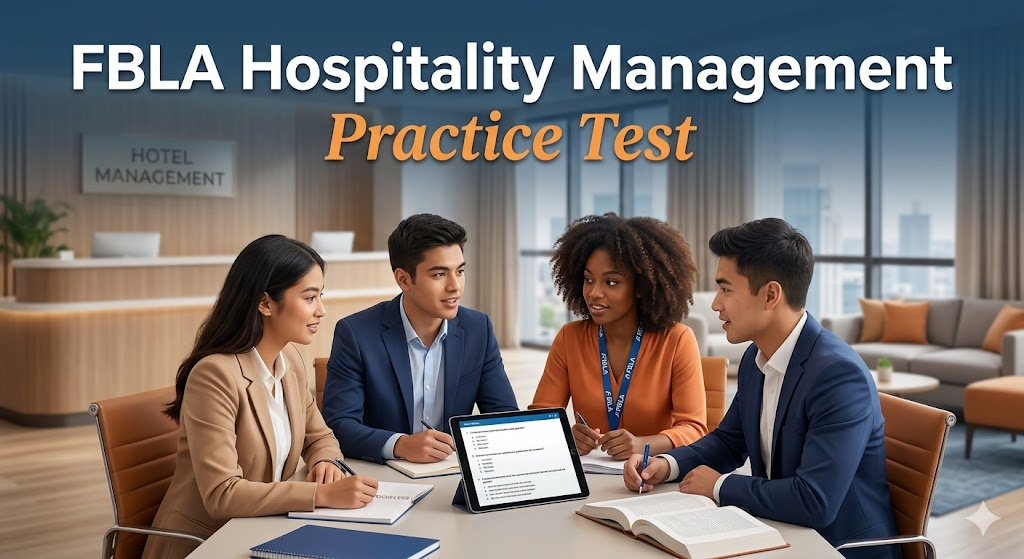
Additional Information
What the Course Entails and Exam Details
To excel in this competition, students must dedicate themselves to studying a curriculum that mirrors real-world hospitality management. The exam is comprehensive and covers several core areas that are essential for successful operations.
Key competencies that are tested include:
Introduction to Hospitality: Understanding the scope of the industry, current trends, and the history of hospitality.
Hotel and Lodging Operations: Knowledge of front office procedures, housekeeping, reservations, and engineering.
Food and Beverage Management: Covering kitchen operations, restaurant service, menu planning, and cost controls.
Marketing and Sales: Principles of effective promotion, digital marketing, revenue management, and customer service strategies.
Human Resources: Recruitment, training, compensation, and legal issues unique to the hospitality workforce.
Tourism and Travel: An overview of the broader tourism sector and its impact.
Financial Management: Basic accounting principles, budgeting, and financial analysis in hospitality.
What to Expect in the Final Exam
The FBLA Hospitality Management competition utilizes a multi-step format that tests both knowledge and application. Understanding this format is crucial for practical preparation.
The preliminary round consists of a rigorous objective test. This test is comprised of multiple-choice questions that assess a student’s mastery of the curriculum listed in section two. Students will be required to answer approximately 100 questions within a specific time limit, usually 60 minutes.
Depending on performance, students may advance to the state and national leadership conferences, where they participate in a decision-making case study or role-play scenario. This practical component challenges participants to apply their knowledge to solve realistic hospitality management problems. Competitors are evaluated based on their critical thinking skills, creativity, and professional presentation.
There is no pre-determined passing score. Students compete against their peers, and the highest-scoring individuals are recognized as winners and may qualify for higher levels of competition.
How to Study and Exam Centers
Effective preparation for the FBLA Hospitality Management Practice Test requires a structured study plan and the right resources. Here are actionable strategies:
Review Official FBLA Materials: FBLA provides competitive event guidelines and official resource lists that are the primary foundation for your study.
Utilize Practice Exams: Taking practice tests is the single most effective way to become familiar with the question style and time constraints. Analyze your answers to identify weak areas.
Consult Hospitality Management Textbooks: Standard high school and introductory college textbooks on hospitality management offer depth and context for all core topics.
Engage in Role-Playing: To prepare for the presentation component, practice case study scenarios with advisors or teammates. Focus on identifying the key problem and developing a professional solution.
Stay Informed About Industry Trends: Hospitality is an evolving field. Reading industry publications can provide insights into current trends and challenges.
Where and How to Take the Exam:
FBLA tests are usually administered locally at your specific school under the supervision of a chapter advisor. The initial levels, including practice opportunities and region-level objective tests, are often taken online through a secure portal. High-performing students then advance to compete at physical venues, including state and national leadership conferences, which are typically held at convention centers or major hotels in various host cities.
Job Opportunities from the Course
A strong performance in FBLA's Hospitality Management competition is not just about winning an award; it provides a direct entry point into one of the largest and most varied industries in the world. The skills developed through preparation unlock a diverse range of career paths.
Here is a clear list of specific job titles and career paths this experience helps to launch:
Hotel Manager or General Manager
Restaurant Manager or Food Service Director
Front Office Manager
Event and Conference Planner
Tourism Development Coordinator
Hospitality Marketing Manager
Catering Director
Revenue Management Analyst
Human Resources Coordinator (Hospitality Specialist)
Executive Housekeeper
Resort Manager or Director
Guest Services Manager
Participation in this competition gives students a competitive advantage in securing internships and entering prestigious hospitality degree programs, further accelerating their career potential in this vibrant field.
Frequently Asked Questions
Reviews
5.0
Based on 0 reviews
Leave a Review
No reviews yet. Be the first to review!