
Future Farmers of America (FFA) Creed Practice Test
$69.00
- Buy to unlock unlimited access to all Quiz questions and Answers in this Quiz.
- After purchase you can print a PDF of the whole quiz at any point. The PDF will contain the questions and the correct answers.
About this Exam
The FFA Creed Practice Exam is a valuable educational resource designed to support and evaluate students preparing for the official FFA Creed Speaking competitive event. This competition, primarily for younger FFA members (often 7th-9th grade), is an early opportunity to build critical communication and leadership skills, gain confidence in public speaking, and deeply understand the core values of the FFA organization. The Creed itself, written by E.M. Tiffany and adopted in 1930, is the foundation of the FFA and expresses the organization's strong belief in the future of agriculture, leadership, and personal responsibility.
This practice is essential for any aspiring FFA member looking to move beyond simple memorization to a true command of the Creed's message and dynamic delivery. It serves as a benchmark to ensure you are ready for the multi-stage competition path, from the chapter level all the way to the National FFA Convention. The experience builds resilience, poise, and a profound appreciation for agricultural traditions and opportunities.
Ready to test your knowledge?
Buy Now to Access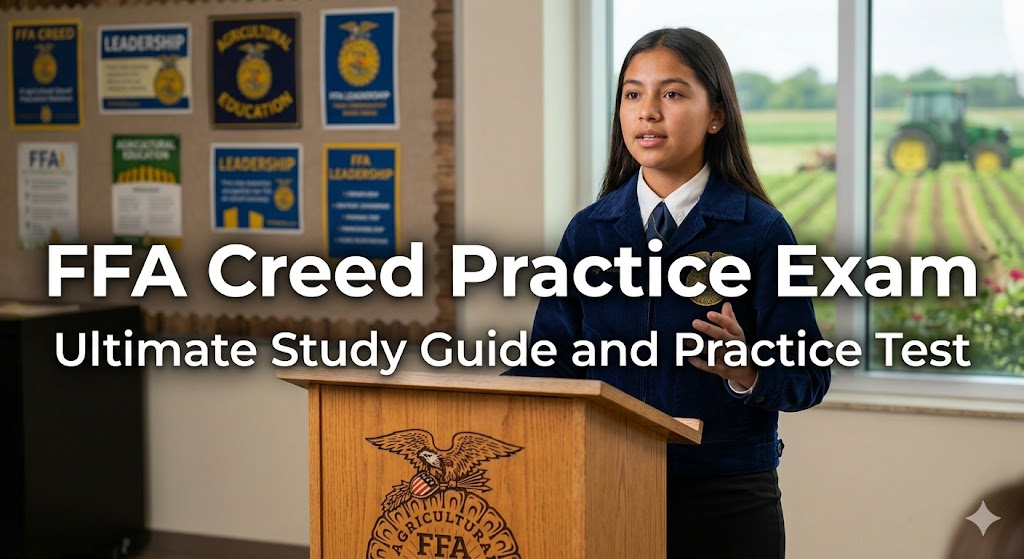
Additional Information
What the Course Entails and Exam Details
This preparatory "course" is the sum of your efforts to prepare for the competitive FFA Creed Speaking event. It doesn't have a syllabus like a school subject but rather a clear set of competencies you must develop:
Memorization of the FFA Creed: You must master the entire five-paragraph, 258-word text, reciting it flawlessly, exactly as it appears in the current Official FFA Manual. Accuracy is paramount and will be heavily scrutinized in the official competition.
Understanding and Interpretation: It's not enough to say the words; you must understand their deep meaning and how they apply to modern agriculture, your community, and your personal life. This preparation involves discussing and reflecting on each line and concept.
Public Speaking and Delivery Skills: You need to work on voice quality (volume, pitch, pace, tone, articulation), poise, gestures, eye contact, and stage presence.
Critically Thinking and Question Response: The official evaluation includes a critical thinking component where you will answer standard and spontaneous questions about the Creed, its message, and the agricultural industry. Your ability to think on your feet, connect the Creed to real-world scenarios, and articulate your answers clearly is vital.
The "Exam Details," in the context of the official competition, focus on the criteria used to evaluate these competencies. This includes structured scoring by a panel of judges on your accuracy, delivery, and response to questions, often contributing to a total score of 1000 points.
What to Expect in the Final Exam
The "Final Exam" for this path is the official competitive event, structured in successive rounds (chapter, district, region, state, and national levels). While this guide is for the practice test context, your ultimate goal is the competition. Here is what you can expect when you step before the judges:
Format: You will draw for speaking order and may be held in isolation before and after your presentation in some rounds. When called, you will approach the front of the room, often stand behind a podium or in a designated area, and be officially introduced. There are typically multiple rounds, each consisting of the recitation and subsequent question period.
Recitation: You will state: "The FFA Creed by E.M. Tiffany" and then proceed with a powerful, memorized recitation. No props or notes are permitted. You must end with "...that inspiring task. Thank you."
Timing: There are strict time limits. Most rules dictate a 4-minute limit for the recitation. Following the presentation, you will have a set amount of time to answer questions, typically 5 minutes total for Q&A, covering a standard set of questions asked to all participants in that round. Point deductions apply for exceeding the time.
Scoring & Rules: Accuracy is crucial; deductions are made for any significant deviation, omission, or word change from the official text. Scoring is based on accuracy, voice, poise, delivery, and the quality and insight of your answers. Judges look for a sincere delivery that conveys the message effectively. While not a numerical "passing score" that gets you a certificate, high scores at each level are required to advance.
Questions: Expect to be asked structured, thought-provoking questions about the Creed's relevance and concepts, such as: "What does 'a faith born not of words but of deeds' mean to you?" or "How can you show leadership in your home and community?"
How to Study and Exam Centers
Actionable Study Strategies:
To prepare effectively, go beyond just reading. This requires active, creative practice:
Daily Repetition: Read the Creed aloud every single day. Make it the first thing you do in the morning.
Paragraph by Paragraph: Memorize the Creed one paragraph at a time. Do not move to the next until the current one is solid. Write it out repeatedly to reinforce the memory.
Record Yourself: Use your phone to record your practice sessions. Listen for errors in recitation and assess your own speed, tone, and clarity. Pay attention to how you project your voice and any verbal pauses or filler words.
Practice in Front of a Mirror: Work on eye contact, natural gestures, and poise. Make sure you don't look stiff or overly theatrical.
Simulate the Question Round: Have your FFA advisor, parent, or teammate ask you common and creative questions. Practice answering them concisely and clearly, drawing from your personal experiences and understanding of the Creed.
Seek Feedback: Present the Creed to seniors, advisors, or community members and ask for constructive criticism. Focus on their input regarding your delivery, accuracy, and overall presence.
Time Your Presentation: Practice with a stopwatch to ensure you can comfortably recite the entire Creed within the 4-minute time limit. Do the same for your mock question responses.
Visual Aids for Memorization: Use index cards with key phrases, highlight different sections, or draw mental pictures to associate with each line.
Understand the 'Why': Discuss the meaning of the Creed with others and reflect on how it applies to modern agriculture, your own goals, and the world around you. True understanding makes delivery much more authentic.
Exam Centers:
You don't take a physical exam in a traditional testing center like a Pearson VUE. The "exam centers" for the FFA Creed Speaking CDE are the venues for the official competitive rounds. Students typically compete:
Chapter Level: Within their own school or local chapter.
Sub-District/District Level: At larger regional locations involving multiple chapters.
State Level: Often held at state FFA conventions or leading agricultural institutions.
National Level: The final competition round takes place at the National FFA Convention in Indianapolis.
Students register and participate through their local high school or middle school agricultural education program and FFA chapter. Contact your local agricultural education teacher or FFA advisor for information on local chapter competitions and how to sign up. All competitive rules and materials are guided by the Official National FFA Organization and the specific rules of your State FFA Association.
Job Opportunities from the Course
While the FFA Creed Speaking competition does not directly result in a specific "certification" for a particular job title, the invaluable skills it develops are highly transferable and sought after in numerous professional fields, especially within the agriculture and communication sectors. Successfully participating in this event builds a foundation for a range of impactful career paths:
Public Speaking and Communication: The ability to articulate thoughts clearly, confidently, and persuasively is a core skill for any professional.
Leadership Development: This training fosters self-confidence, quick thinking, and the ability to inspire and connect with an audience.
Critical Thinking and Decision-Making: Developing responses to unpredictable questions enhances analytical skills and the ability to construct strong, evidenced arguments.
Professionalism and Presence: Mastery of poise and stage presence directly translates to effective client interactions, presentations, and team management.
The experience gained through preparing and participating in the FFA Creed Speaking CDE, and subsequent FFA involvement, can lead directly or indirectly to success in diverse and fulfilling roles, such as:
Agricultural Educator: Teaching future generations about agriculture, leadership, and public speaking.
Agricultural Communications Specialist/Manager: Effectively conveying complex agricultural issues to the public, media, or industry stakeholders through writing, speaking, and digital media.
Public Relations Manager: Managing the public image of agricultural companies, organizations, or causes.
Sales Representative or Manager (Agribusiness): Persuasively presenting products and services in the agricultural sector, building customer relationships, and leading sales teams.
Motivational Speaker or Corporate Trainer: Utilizing public speaking skills to inspire, educate, and train diverse groups in various corporate and community settings.
Agricultural Lobbyist or Advocacy Coordinator: Representing agricultural interests and communicating with policymakers on critical issues affecting the industry.
Policy Analyst or Advisor: Analyzing and communicating the potential impacts of agricultural policy on diverse stakeholders.
Marketing Director (Agri-marketing): Leading strategic marketing efforts to promote agricultural products, services, and brands.
Entrepreneur: Successfully leading, communicating, and representing their own business, especially within agriculture.
Any Professional Leadership Role: Strong leadership and communication skills are essential for managing teams, driving innovation, and achieving organizational goals across all industries.
Remember, this study guide is a tool to help you practice and build your competence for the competitive evaluation. By dedicating yourself to this preparation, you are not just preparing for an exam but for a future marked by premier leadership, personal growth, and career success. Good luck with your practice and your competition journey!
Frequently Asked Questions
Reviews
5.0
Based on 0 reviews
Leave a Review
No reviews yet. Be the first to review!