
Future Farmers of America (FFA) Officer Practice Test
$69.00
- Buy to unlock unlimited access to all Quiz questions and Answers in this Quiz.
- After purchase you can print a PDF of the whole quiz at any point. The PDF will contain the questions and the correct answers.
About this Exam
Embarking on the journey to become an FFA Officer is one of the most prestigious leadership opportunities available to high school students involved in agricultural education. This process is designed for dedicated individuals who want to serve their chapters, represent their communities, and champion the future of the agricultural industry. The FFA Officer Selection Practice Test is not a national standardized exam but rather a crucial preparatory tool modeled after the specific, rigorous evaluations used at chapter, state, and sometimes national levels to identify student leaders. Aspiring officers must demonstrate not only passion and commitment but also deep knowledge of the FFA organization, leadership principles, and parliamentary procedure. If you are a current FFA member aiming to elevate your involvement and develop invaluable skills that will serve you throughout your academic and professional life, mastering this content is your first step toward wearing the coveted blue and gold jacket with "Officer" stitched below your name.
Ready to test your knowledge?
Buy Now to Access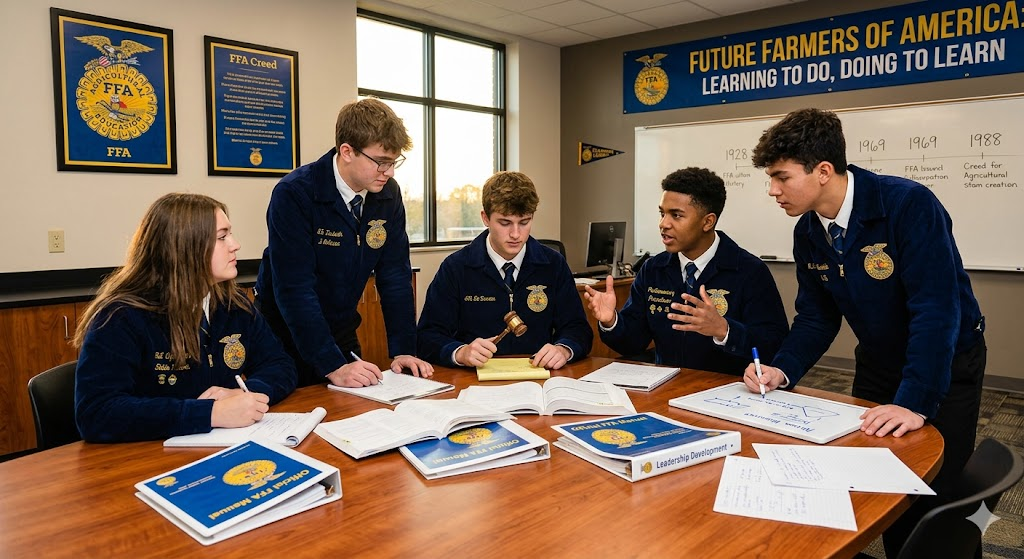
Additional Information
What the Course Entails and Exam Details
The written exam portion of the FFA officer selection process evaluates a candidate’s grasp of essential organizational knowledge and critical skills. A thorough study guide typically covers several core competency areas derived from the Official FFA Manual and related resources.
FFA History and Trivia: You must possess a strong understanding of foundational dates, key historical figures (like Henry Groseclose), the history of the Creed, and the evolution of the organization (including the merge with the NFA).
The FFA Creed: Candidates are often tested on their ability to recite, write out, or correctly sequence paragraphs from E.M. Tiffany’s iconic six-sentence Creed, as well as interpret its meaning.
Parliamentary Procedure: Understanding Robert’s Rules of Order Newly Revised is critical. This section covers definitions of basic motions (privileged, subsidiary, incidental), standard meeting procedures, and the proper way to preside or participate in a meeting.
Current Issues in Agriculture: Officers serve as advocates. You need to be aware of relevant topics impacting the agricultural industry, including technology, environmental sustainability, and agricultural policy.
FFA National Organization: This includes the FFA mission, the emblem’s components and symbolism, the official colors, the motto, the hierarchy (chapter, district/area, state, national), and the duties associated with standard officer positions.
What to Expect in the Final Exam
It is important to note that the final officer selection process varies significantly depending on whether you are running for a position at the chapter, district, or state level. The written exam is rarely the sole determining factor but rather a key component of a comprehensive evaluation that often includes interviews, a prepared speech, an application packet, and sometimes group simulations. When you sit for the written practice test, the format is designed to mirror common practices:
Format: The written exam is most commonly comprised of Multiple Choice and True/False questions. Sometimes short answer questions or fill-in-the-blank (specifically for the Creed or FFA trivia) are included.
Time Limit: While varying by level, a written exam typically lasts between 30 to 60 minutes.
Scoring: The written test score is added to points earned in other areas of the selection process. While there might not be a single "passing" score, high scores are required to proceed to the next round (interviews) in competitive selection pools.
The Main Selection: Remember, passing the test does not mean you are an officer. The final selection is a holistic decision made by a nominating committee based on your total score across all evaluative areas.
How to Study and Exam Centers
Preparation for the FFA Officer Practice Test requires disciplined study and repetition, rather than waiting for formal coursework.
How to Study:
The Official FFA Manual is Your Textbook: This is the absolute primary source for history, structure, ceremonies, and facts. Study it meticulously.
Flashcards are Essential: Create physical or digital flashcards for FFA terminology, historical dates, and key figures. This is a game-changer for information retention.
Master the Creed: Write it out daily. Recite it out loud. Record yourself.
Use Practice Tests: Leverage practice tests provided by your agricultural educator or found on state FFA websites. Timing yourself helps you prepare for the pressure of the actual evaluation.
Form Study Groups: Collaborating with other aspiring officers can provide different perspectives and mutual encouragement.
Exam Centers:
Chapter Level: If you are running for a local chapter office, the exam is typically administered at your high school by your agricultural educator or a local committee.
State Level: State FFA officer exams are always held during state-level events, such as State Leadership Conferences, State Conventions, or specific officer interviews held at authorized state centers or universities. These exams are almost exclusively administered "in person" under the supervision of state FFA staff. You will not find these tests on public testing portals like Pearson VUE; registration is facilitated internally through your agricultural educator and state FFA office.
Job Opportunities from the Course
Successfully serving as an FFA officer does not directly grant a specific professional certification, but it develops a robust portfolio of transferable leadership, communication, and organizational skills that are highly valued by colleges and employers. The experience is often a decisive factor for leadership-track career paths in agriculture and beyond.
Agricultural Educator or FFA Advisor
Agribusiness Sales or Marketing Representative
Agricultural Lobbyist or Policy Analyst
Farm or Ranch Manager
Public Relations Specialist (focusing on Agribusiness)
Natural Resources Manager or Environmental Scientist
Governmental Affairs Specialist (for organizations like the USDA)
Frequently Asked Questions
Reviews
5.0
Based on 0 reviews
Leave a Review
No reviews yet. Be the first to review!