
Future Farmers of America (FFA) Parliamentary Procedure Practice Exam
$69.00
- Buy to unlock unlimited access to all Quiz questions and Answers in this Quiz.
- After purchase you can print a PDF of the whole quiz at any point. The PDF will contain the questions and the correct answers.
About this Exam
The Future Farmers of America (FFA) Parliamentary Procedure Leadership Development Event (LDE) is one of the most prestigious and challenging competitive events offered to high school students. This exam is designed for current FFA members (grades 9-12) who are passionate about agricultural leadership and the mechanics of formal decision-making. Far from being just about agriculture, this event teaches students the universal, essential skills required to run an efficient, democratic meeting. It tests a team's ability to debate effectively, make quick procedural decisions, and conduct business according to established rules. Preparing for this practice exam is the first step toward mastering these crucial life skills.
Ready to test your knowledge?
Buy Now to Access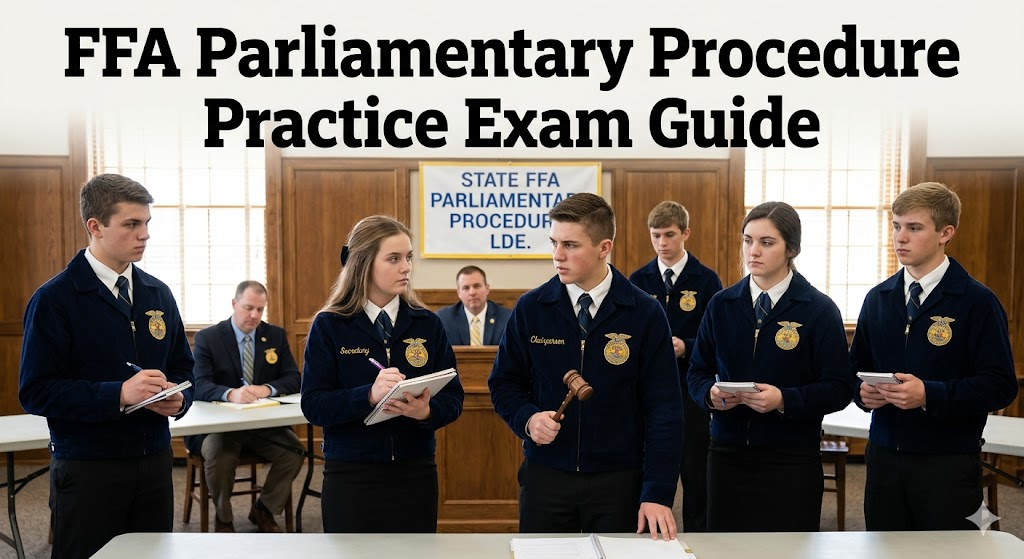
Additional Information
What the Course Entails and Exam Details
The parliamentary procedure course of study requires a deep dive into Robert's Rules of Order, Newly Revised. A successful team must understand not only the definition of motions but also their complex hierarchies and application. The core curriculum entails mastering the five classifications of motions:
Main Motions: The primary method for introducing business.
Subsidiary Motions: Motions that assist in treating or disposing of a main motion (e.g., Lay on the Table, Previous Question, Amend, Commit or Refer).
Privileged Motions: Urgent matters unrelated to the pending business (e.g., Adjourn, Recess, Raise a Question of Privilege).
Incidental Motions: Procedural questions arising from other business (e.g., Point of Order, Appeal, Suspension of the Rules, Parliamentary Inquiry).
Motions that Bring Business Again Before the Assembly: (e.g., Take from the Table, Reconsider, Rescind).
Beyond understanding individual motions, students must know:
Order of Precedence: Which motions rank higher than others.
Voting Requirements: When a simple majority is needed vs. a two-thirds vote.
Debatability and Amendability: Which motions can be discussed or changed.
The Duties of Officers: Specifically, the presiding officer (chair) and secretary.
What to Expect in the Final Exam
While specific contest rules can vary slightly by state, a complete FFA Parliamentary Procedure competitive event generally consists of three distinct components: a written exam, a team presentation, and oral questions. The practice exam you are preparing for typically mimics the Written Exam component.
The Written Practice Exam Format: You should expect 25 to 50 objective, multiple-choice questions. These questions test memorized knowledge of motion characteristics, voting rules, and procedural scenarios.
Passing Score: There is rarely a singular "passing score" in competitive LDEs; rather, your score contributes to your team's overall ranking. Aiming for above 80% is a strong baseline.
Time Limit: You will typically have 30 to 45 minutes to complete the written portion.
Specific Rules: No reference materials are allowed during the test. For the final contest, official FFA dress is usually required for all phases.
The Complete Contest Experience: In the live event, after the written test, your team of six members will conduct a 10–11 minute mock meeting, demonstrating assigned motions and proper debate. Judges score the team on poise, voice, correctness, and the quality of their debate. Following the presentation, individual members and the chair are asked specific oral questions about the motions they handled or general parliamentary law.
How to Study and Exam Centers
Studying for parliamentary procedure requires a mix of rote memorization and practical application. It is one of the few exams where "doing" is just as important as "reading."
How to Study:
Master the Chart: The single most effective tool is a comprehensive motions chart. Memorize the precedence, required vote, debatability, and amendability of every major motion.
Flashcards are Key: Create flashcards for motion definitions, voting rules, and types of motions.
Practice Mock Meetings: This is essential. Conduct full mock meetings with your team, strictly adhering to the rules. Assign roles and challenge each other with complex motion sequences.
Study Robert's Rules of Order: While dense, the Newly Revised (RONR) edition is the ultimate authority. Use study guides to navigate the essential sections.
Use Practice Exams: Take as many practice written tests as possible to identify your weak points in theory.
Watch National Finals: Review recordings of National FFA winning teams to understand the expected level of poise and debate quality.
Exam Centers: Practice exams are usually administered by your local FFA advisor or can be found on state FFA association websites. The actual competitive events are held at various "exam centers," which include:
Local High Schools: For invitationals or district/sub-district contests.
State FFA Conventions: Where state-level competitions are hosted.
The National FFA Convention: The final destination for winning state teams.
Job Opportunities from the Course
Mastering parliamentary procedure unlocks a surprising array of career paths because the ability to lead efficient meetings, understand governance structures, and negotiate complex procedures is highly valued in many professional settings. Here are some specific career paths and job titles:
Professional Parliamentarian: Advising non-profits, homeowners' associations, and corporate boards on proper meeting procedure.
City Clerk / County Clerk: Managing public records and advising local government bodies on procedural law.
Legislative Aide / Chief of Staff: Assisting lawmakers in drafting legislation and navigating legislative procedures.
Government Relations Specialist: Representing organizations to government bodies and understanding public policy processes.
Non-Profit Executive Director / Board Member: Leading organizations and ensuring democratic governance.
Labor Union Representative / Organizer: Conducting orderly meetings and handling grievance procedures.
Corporate Secretary: Maintaining official corporate records and ensuring board meetings comply with regulations.
Human Resources Manager: Managing employee meetings and handling internal dispute resolution.
Education Administrator (e.g., Superintendent, Dean): Leading school boards and administrative meetings.
Law Enforcement Leader: Utilizing structured decision-making processes in high-stakes environments.
Frequently Asked Questions
Reviews
5.0
Based on 0 reviews
Leave a Review
No reviews yet. Be the first to review!