
Gas Heat ESCO Practice Exam
$69.00
- Buy to unlock unlimited access to all Quiz questions and Answers in this Quiz.
- After purchase you can print a PDF of the whole quiz at any point. The PDF will contain the questions and the correct answers.
About this Exam
The Gas Heat ESCO certification is a specialized credential designed for HVAC technicians who want to demonstrate a high level of competence in working with gas-fired heating systems. This certification, offered by the ESCO Group, validates your understanding of the latest technologies, including high-efficiency units, electronic ignition systems, and advanced electrical controls. It is an ideal step for technicians aiming to specialize and increase their earning potential in the heating sector. Achieving this certification indicates to employers and customers that you possess the in-depth knowledge required to service, install, and troubleshoot both older existing systems and modern gas furnaces, ensuring safe and efficient operation.
Ready to test your knowledge?
Buy Now to Access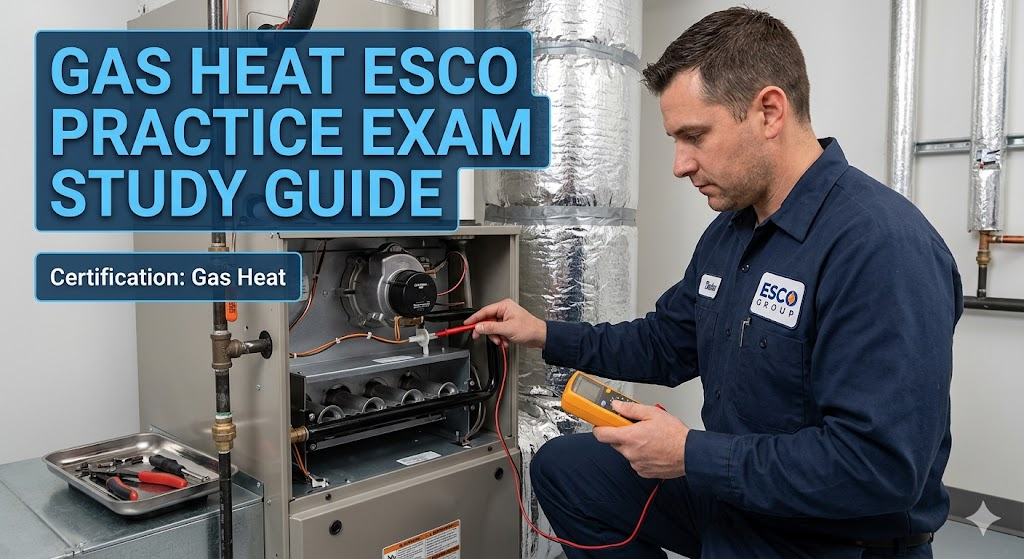
Additional Information
What the Course Entails and Exam Details
This comprehensive course and the subsequent exam cover a wide array of technical subjects critical to a gas heat technician. The curriculum focuses on both natural gas and liquefied petroleum (LP) systems. Key areas of focus include:
Gas Heat Fundamentals: Principles of combustion, properties of natural and LP gas, and combustion air requirements.
System Components and Operation: Detailed study of gas valves, burners, heat exchangers, ignition systems (pilot, HSI, DSI), and fan/limit controls.
Installation Practices: Code compliance based on the National Fuel Gas Code, proper piping sizing and installation, and gas pressure requirements.
Venting Systems: Design and installation of Category I, II, III, and IV venting systems, including troubleshooting common vent issues.
Maintenance and Troubleshooting: Step-by-step diagnostic procedures for electrical and mechanical failures, and preventative maintenance tasks.
Safety Protocols: Carbon monoxide testing, gas leak detection, and personal protective equipment.
What to Expect in the Final Exam
The Gas Heat ESCO certification exam is a rigorous test of your knowledge. Here are the specific details of what to expect:
Format: The final exam consists of multiple-choice questions. These questions are designed to test not just rote memorization, but your ability to apply technical concepts to real-world scenarios.
Passing Score: A passing score of 70% or higher is typically required to earn the certification.
Time Limit: The exam is timed, and candidates generally have between 60 and 120 minutes to complete all questions, depending on the specific exam version.
Specific Rules: The exam is closed-book. You are not allowed to use any reference materials, including code books or calculators, unless specifically permitted by the testing platform for a particular question type.
How to Study and Exam Centers
Preparation is the key to success. Utilize a variety of methods to ensure a thorough understanding of the material:
Review Technical Manuals: Study the manufacturers' installation and service manuals for various types of gas furnaces.
Use Practice Exams: Taking practice tests is highly effective for identifying your knowledge gaps and familiarizing yourself with the multiple-choice format.
Study the Codes: Focus heavily on the National Fuel Gas Code (NFPA 54) as a significant portion of the exam is code-based.
Flashcards: Create flashcards for key terms, gas properties (like BTUs per cubic foot), and pressure settings.
The exam can be taken through various channels:
Online Portals: The ESCO Group provides an online proctored testing option, allowing you to take the exam from a secure location.
Authorized Schools: Many trade schools and community colleges with HVAC programs are authorized ESCO testing centers.
Testing Centers: Pearson VUE and other professional testing centers are also common locations for taking ESCO exams. Visit the ESCO Group website to find a verified testing center or program near you.
Job Opportunities from the Course
Earning the Gas Heat ESCO certification opens doors to a variety of specialized roles within the HVAC industry, enhancing your career path:
HVAC Service Technician (Specializing in Gas Heat)
Gas Furnace Installer
Heating Maintenance Technician
HVAC Field Supervisor
Residential/Commercial Heating Specialist
Technical Trainer for HVAC Systems
HVAC System Designer
Sales Engineer (Heating Equipment)
This certification acts as a critical differentiator in the job market, proving your expertise and commitment to safety and modern technical standards in gas heating.
Frequently Asked Questions
Reviews
5.0
Based on 0 reviews
Leave a Review
No reviews yet. Be the first to review!