
Gas Technician 2 (G2) License Practice Exam
$69.00
- Buy to unlock unlimited access to all Quiz questions and Answers in this Quiz.
- After purchase you can print a PDF of the whole quiz at any point. The PDF will contain the questions and the correct answers.
About this Exam
The Gas Technician 2 (G2) License is the premier certification for skilled tradespeople in Ontario looking to work with natural gas and propane. This recognized credential, administered by the Technical Standards and Safety Authority (TSSA), marks the intermediate stage of a gas technician’s career. It signifies a significant step beyond the introductory G3 level, enabling technicians to work independently on residential and light commercial appliances with an input of up to 400,000 Btuh. Designed for individuals who already hold a G3 license and have completed an approved G2 training program, this certification is essential for building a robust, long-term career in the HVAC (Heating, Ventilation, and Air Conditioning) and fuel-fired equipment industries.
Ready to test your knowledge?
Buy Now to Access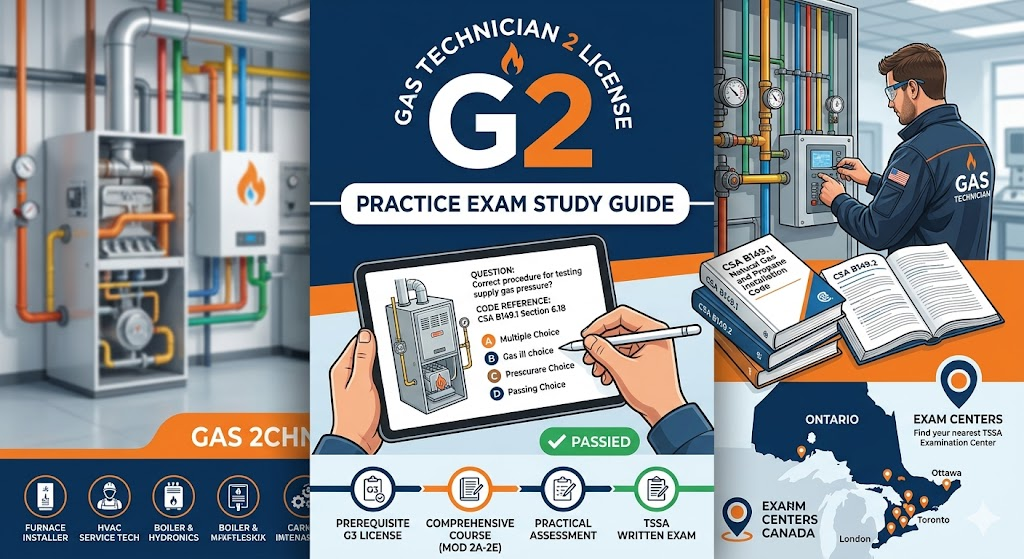
Additional Information
What the Course Entails and Exam Details
A TSSA-approved Gas Technician 2 (G2) program provides the comprehensive theoretical knowledge and hands-on training required to meet provincial standards. The standardized curriculum, often totaling over 400 hours, is delivered through theoretical modules and extensive lab work.
The core curriculum covers critical modules defined by the TSSA and the Canadian Standards Association (CSA):
Gas Piping Fitter: This section deepens knowledge of installation codes, enabling you to design and install piping systems, regulators, valves, and meters for complex residential and light commercial setups.
Domestic Appliance Technician: You will master the fundamentals of gas-fired appliances, including range and clothes dryer installation, servicing, and venting systems.
Forced Air/Space Heating Systems: This is a crucial module covering the complete installation, troubleshooting, and maintenance of modern high-efficiency furnaces and space heaters.
Conversion Burners and Water Heating Systems: You will learn the specific requirements for installing conversion burners and a wide array of water heating equipment, including boilers and hot water tanks.
Electrical and Control Systems: A major component of the G2 entails developing a proficient understanding of electrical theory, control circuits, schematics, and the troubleshooting techniques needed to diagnose complex electrical faults.
Venting, Combustion, and Air Supply: You must demonstrate mastery of proper venting calculations and the selection of air supply systems to ensure appliance safety and code compliance.
What to Expect in the Final Exam
To become a licensed G2 Technician, you must pass a standardized provincial written exam.
Format: The G2 exam is entirely multiple-choice. This format tests your ability to apply logical thinking and technical knowledge to realistic field scenarios.
Passing Score: The TSSA requires a minimum score of 75% to pass the exam and be eligible for the license.
Time Limit: You will typically be given between 3 and 4 hours to complete the exam. Efficient time management is critical.
Required Material: You will be expected to use and reference the current CSA B149.1 Natural Gas and Propane Installation Code and CSA B149.2 Propane Storage and Handling Code during the exam. Knowledge of these codes is paramount.
Prerequisites: You must have successfully completed a G2 training program and had your practical skills assessed by an authorized school before being approved to write the written exam.
How to Study and Exam Centers
Effective study requires a blend of code book mastery, theoretical understanding, and practical experience.
Actionable Study Strategies:
Practice with Purpose: Don't just take practice tests; use G2 Practice Exams with detailed rationales. These explanations help you understand why an answer is correct and deepen your understanding of the underlying concept and code rule.
Master the Code Books: The CSA B149 codes are your most important tool. Do not rely solely on memory; practice navigating the code to find answers efficiently. Use the index and table of contents as your guide.
Focus on Pipe Sizing: This is a frequently tested area. Practice a variety of pipe sizing problems for both natural gas and propane using the proper charts and methods.
Create Troubleshooting Flowcharts: To master the electrical and furnace sections, create diagrams that outline the sequence of operation and the troubleshooting steps for common appliance faults.
Form a Study Group: Collaborating with classmates can expose you to different perspectives and help you articulate your understanding.
Where to Take the Exam: The TSSA delivers its exams through a network of accredited partners. The primary location for the G2 written exam is an authorized training provider or examination center within Ontario. This often includes the very college or private technical school where you completed your G2 coursework. You can find a list of TSSA-approved examination centers on the TSSA’s official website or by contacting the school where you intend to take your training.
Job Opportunities from the Course
Earning a G2 license unlocks a wide array of stable and lucrative career paths across multiple sectors. It is the gold standard for independent, high-level residential and commercial work. Here are some specific job titles and career paths this certification enables:
HVAC Service Technician: Diagnosing, repairing, and maintaining complex heating and cooling systems in homes and commercial properties.
Residential Gas Technician: Specializing in the complete installation and servicing of furnaces, water heaters, and fireplaces.
Furnace Installer: Leading teams in the precision installation of residential forced-air heating systems.
Boiler and Hydronics Technician: Installing and maintaining advanced boiler-based and hydronic heating systems.
Hot Water Tank Installer: Specialized installation of conventional and tankless water heaters.
Service and Maintenance Mechanic: Providing essential preventive maintenance for fuel-fired equipment.
Pipefitter (Gas): Designing and fabricating intricate piping and venting systems.
Apprenticeship Gateway: The G2 license is an excellent foundation for pursuing further advanced apprenticeships, such as G1 (up to unlimited Btuh), 313D (Residential Air Conditioning), 313A (Refrigeration and Air Conditioning Mechanic), 306A (Plumber), or 433A (Industrial Mechanic Millwright).
Subcontractor/Small Business Owner: Many G2 holders choose to work as subcontractors or open their own HVAC companies.
Frequently Asked Questions
Reviews
5.0
Based on 0 reviews
Leave a Review
No reviews yet. Be the first to review!