
Gas Tungsten Arc Welding (GTAW) Setup Practice Test
$69.00
- Buy to unlock unlimited access to all Quiz questions and Answers in this Quiz.
- After purchase you can print a PDF of the whole quiz at any point. The PDF will contain the questions and the correct answers.
About this Exam
The Gas Tungsten Arc Welding (GTAW) Setup Practice Test is an essential evaluative tool designed for aspiring welders, current trainees, and industrial professionals looking to validate their readiness for specialized welding certification exams. GTAW, commonly referred to as TIG (Tungsten Inert Gas) welding, is a highly precise and complex welding process used heavily in industries where exceptional weld quality is critical, such as aerospace, automotive fabrication, and pressure vessel manufacturing. This specific practice test focuses exclusively on the critical pre-welding phase: correctly configuring the machine, selecting the appropriate consumables, and ensuring the workspace is secure. It is the perfect diagnostic tool for anyone enrolled in a welding program, seeking to boost their confidence before a formal practical assessment, or employers looking to evaluate the foundational technical knowledge of new hires.
Ready to test your knowledge?
Buy Now to Access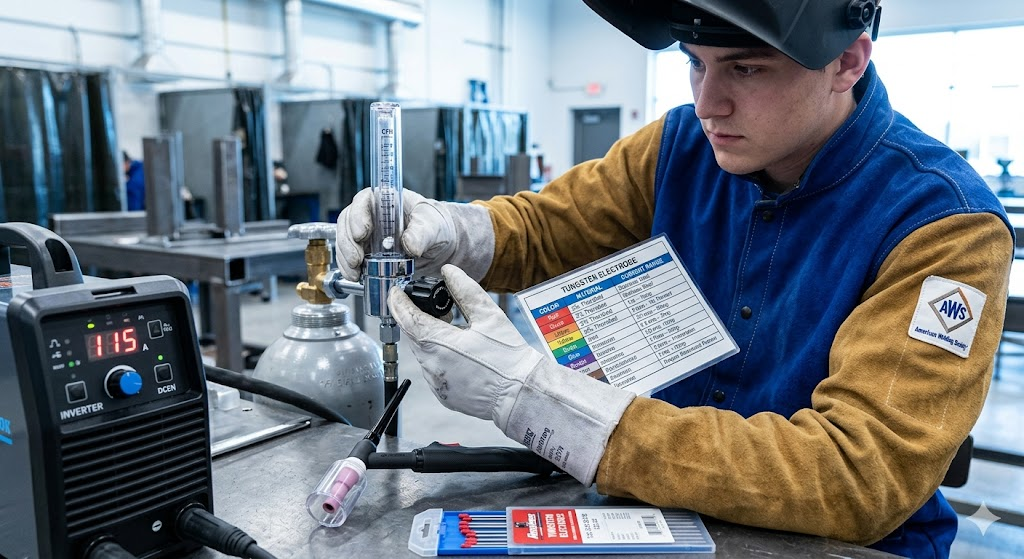
Additional Information
What the Course Entails and Exam Details
This preparation course and practice exam validate your comprehensive knowledge of the variables required to produce a successful TIG weld.
The core domains covered in this practice test include:
Equipment Identification: Correct selection of power sources, high-frequency settings (AC/DC balance and frequency), and torch components (cups, collets, collet bodies, and gas lenses).
Tungsten Electrode Selection: Demonstrating knowledge of the different tungsten alloys (e.g., Thoriated, Lanthanated, Ceriated) and, crucially, selecting the correct diameter and grinding technique for specific materials and currents.
Shielding Gas Management: Identifying the correct inert gas types (typically Argon or Helium/Argon mixes) and setting the proper flow rate on the regulator/flowmeter.
Filler Metal Identification: Identifying different classifications of filler rods (e.g., ER70S-6, ER308L, ER4043) and selecting the correct diameter relative to base material thickness.
Polarity and Amperage Settings: Understanding when to use DC- (Direct Current Electrode Negative) for most steels versus AC (Alternating Current) for aluminum, and setting initial amperage ranges based on joint design.
What to Expect in the Final Exam
While actual certification exams usually include both a multiple-choice knowledge section and a "hands-on" practical weldment evaluation, this GTAW Setup Practice Exam mimics the standard written knowledge component required by major accreditation bodies.
Here is what you can typically expect from the structure of a formal knowledge-based exam:
Exam Format: Multiple-choice questions, which may include visual aids such as diagrams of torch assembly or charts for current settings.
Passing Score Requirements: Standard certification exams (such as those by the AWS) usually require a minimum passing score of 70-75% for the written portion.
Time Limits: Candidates are usually given 60 to 90 minutes to complete the written knowledge exam.
Specific Rules: Standard exams are often "closed-book," prohibiting the use of personal charts, tables, or smart devices during the test.
How to Study and Exam Centers
Effective preparation for this exam requires a blend of visual study and repetitive technical recall.
Recommended Study Strategies:
Use Visual Flashcards: Create flashcards matching different tungsten color codes (e.g., Green/Pure, Red/Thoriated) with their specific applications.
Master the Variables: Study welding parameter charts (such as those provided by Miller or Lincoln Electric) to memorize standard starting amperage and gas flow rates for common material thicknesses.
Identify Torch Components: Practice assembling and disassembling a TIG torch while saying the name of each part out loud.
Take Mock Tests: The single best way to prepare is by taking this GTAW Setup Practice Exam multiple times until you consistently score above 85%.
Where to Take the Official Exam:
The official GTAW certification exams are not typically taken at generalized centers like Pearson VUE.
Authorized Testing Facilities (ATFs): These are specialized institutions (often community colleges or welding schools) approved by organizations like the American Welding Society (AWS) to administer practical and written exams.
Accredited Local Unions: Many union locals (e.g., United Association/UA) administer these exams for their members.
In-House Employer Programs: Some large manufacturing and aerospace employers are authorized to run their own certification programs.
Job Opportunities from the Course
While this practice test is a preparatory step, achieving a full TIG/GTAW certification unlocks a wide array of specialized, high-demand career paths.
Completing the training and certification associated with this skill set provides a direct pathway to the following job titles:
Specialized Aerospace TIG Welder
Precision Motorsports/Automotive Fabricator
Sanitary/Food Grade Pipe Welder (Stainless Steel)
Power Plant and Pressure Vessel Welder
Custom Metal Furniture and Art Fabricator
Structural Aluminum Welder
Robotic TIG Welding Operator
Maintenance and Repair Technician (Specialized Alloys)
Certified Welding Inspector (CWI) (Post-experience specialization)
Welding Instructor (Post-experience specialization)
Frequently Asked Questions
Reviews
5.0
Based on 0 reviews
Leave a Review
No reviews yet. Be the first to review!