
Gas Tungsten Arc Welding (GTAW) WELD 250 Practice Test
$69.00
- Buy to unlock unlimited access to all Quiz questions and Answers in this Quiz.
- After purchase you can print a PDF of the whole quiz at any point. The PDF will contain the questions and the correct answers.
About this Exam
This study guide is designed specifically for students preparing for the Gas Tungsten Arc Welding (GTAW) WELD 250 Practice Test. This advanced-level welding course validation is typically designed for individuals who have completed foundational welding training and are now specializing in the precision and control required for GTAW, also commonly known as TIG (Tungsten Inert Gas) welding. Passing this exam demonstrates proficiency in the theory, safety protocols, and advanced practical applications of TIG welding necessary for high-quality, professional fabrication.
Ready to test your knowledge?
Buy Now to Access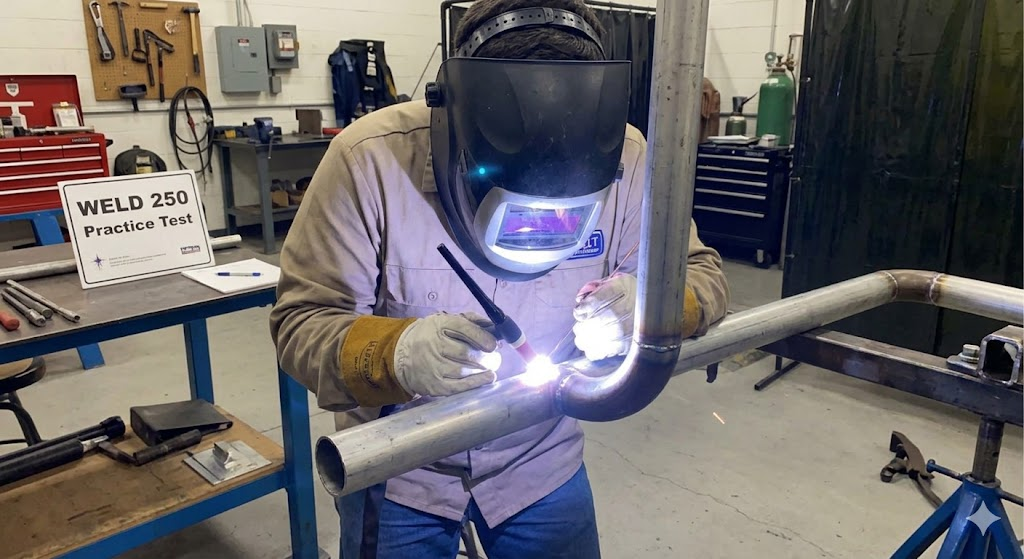
Additional Information
What the Course Entails and Exam Details
The WELD 250 course dives deep into the technical complexities of Gas Tungsten Arc Welding. The associated exam will assess both conceptual knowledge and practical skills. The comprehensive curriculum typically covers the following core areas, which are critical for success on the practice and final test:
Safety Procedures: Stringent safety protocols specific to GTAW, including eye protection, ventilation, and handling compressed shielding gases.
GTAW Equipment Setup and Troubleshooting: Expertly setting up TIG welding machines, understanding high-frequency arc starting, and troubleshooting common equipment issues.
Tungsten Electrode Selection: Choosing and preparing the correct tungsten type (e.g., thoriated, ceriated, lanthanated) and geometry for different base metals and current types.
Shielding Gas Selection and Flow Rates: Understanding the role of argon and helium shielding gases and calculating proper flow rates for optimal weld puddle protection.
Filler Metal Selection: Identifying and selecting the correct filler metal alloys for welding carbon steel, stainless steel, and aluminum based on industry standards (AWS specifications).
Welding Variables: Managing current (amperage), voltage, travel speed, and torch angle to control heat input and weld quality.
Weld Joints and Positions: Developing proficiency in performing high-quality GTAW welds in all positions (flat, horizontal, vertical, and overhead) on various joint configurations (butt, tee, lap, and corner joints).
Metallurgy: Fundamental understanding of how the GTAW process affects the properties of different metals, specifically stainless steel and aluminum.
What to Expect in the Final Exam
While formats can vary slightly by institution, the standard WELD 250 final examination is typically a comprehensive evaluation divided into two distinct parts:
Written Examination: This component tests your theoretical knowledge through multiple-choice questions, true/false statements, and perhaps short-answer questions. It covers all the topics outlined in the curriculum, including safety, equipment, metallurgy, and weld symbols. You will likely face 50 to 100 questions with a set time limit (e.g., 60–90 minutes). A passing score is usually 70% or higher.
Practical Performance Test: This is the critical hands-on portion of the exam. You will be required to demonstrate your proficiency by completing specific TIG welds within a specified timeframe, often to strict American Welding Society (AWS) D1.1 or D1.2 standards. You may need to perform welds in difficult positions (such as 3G or 4G) or on challenging materials like aluminum or thin-gauge stainless steel. Your completed welds will be evaluated based on visual inspection criteria for defects like undercut, porosity, overlap, and proper penetration.
How to Study and Exam Centers
Preparing effectively for the WELD 250 exam requires a combination of focused study and dedicated hands-on practice. Here are actionable strategies for success:
Utilize Practice Tests: Use this GTAW WELD 250 Practice Test iteratively. Simulate exam conditions (time yourself, remove distractions) to identify your knowledge gaps and build test-taking confidence.
Review Your Textbook and Lecture Notes: Go back through the course materials provided by your instructor. Pay close attention to definitions, safety rules, and procedural checklists.
Prioritize Hands-on Practice: This is the most crucial step. Spend significant hours in the welding lab perfecting your TIG technique. Practice setting up the machine, preparing the material, and executing consistent beads in all positions, especially the challenging vertical and overhead ones. Ask your instructor for feedback on your sample welds.
Study AWS Standards: Familiarize yourself with the visual acceptance criteria defined by the relevant AWS welding codes. Knowing what constitutes a passing weld is essential.
Form a Study Group: Collaborate with fellow students to review theory and troubleshoot practical challenges together.
Exam Centers:
The WELD 250 exam is typically administered as a course completion requirement at the authorized educational institution, community college, or technical school where you are enrolled in the welding program. You generally take the test in the same classroom or welding lab where you have been training. Ensure you coordinate with your instructor regarding scheduling, registration, and any necessary testing fees.
Job Opportunities from the Course
Mastering advanced GTAW (TIG) welding through the completion of WELD 250 opens doors to specialized, high-demand, and often lucrative career paths. Here are specific job titles and industries where these precision skills are highly valued:
Aerospace Welder: Specializing in welding critical, lightweight components for aircraft and spacecraft using GTAW on materials like aluminum and titanium.
Motorsports Fabricator/Welder: Building custom chassis, suspension components, and exhaust systems for high-performance racing vehicles, where precision and strength are paramount.
Pipe Welder (Stainless Steel): Performing high-purity TIG welding on stainless steel piping systems used in the food processing, pharmaceutical, and beverage industries.
Nuclear Industry Welder: GTAW is widely used for specialized maintenance and construction within the highly regulated nuclear power sector.
Custom Fabrication Specialist: Creating high-end architectural components, specialized furniture, or artistic installations requiring clean, cosmetically appealing welds on various metals.
Maintenance Welder (High-Tech Manufacturing): Supporting specialized manufacturing processes, such as semiconductor fabrication, where clean GTAW welding is necessary for equipment repair.
By earning this certification, you demonstrate to employers that you possess the advanced technical knowledge and practical proficiency required for top-tier welding positions.
Frequently Asked Questions
Reviews
5.0
Based on 0 reviews
Leave a Review
No reviews yet. Be the first to review!