
Gas Turbine Systems (GS) A School Test 2 Practice
$69.00
- Buy to unlock unlimited access to all Quiz questions and Answers in this Quiz.
- After purchase you can print a PDF of the whole quiz at any point. The PDF will contain the questions and the correct answers.
About this Exam
Welcome to your essential study guide for the Gas Turbine Systems (GS) A School Test 2. This exam is a critical milestone for U.S. Navy Sailors in the Gas Turbine Systems Technician rating, including both Mechanical (GSM) and Electrical (GSE) strands. It is specifically designed to validate the foundational knowledge you have acquired during the initial phases of your 'A' School training at Great Lakes. Passing this test demonstrates your understanding of the core propulsion and power generation systems that drive the modern surface fleet, marking your readiness to advance to more complex system training and eventually, your first shipboard assignment.
Ready to test your knowledge?
Buy Now to Access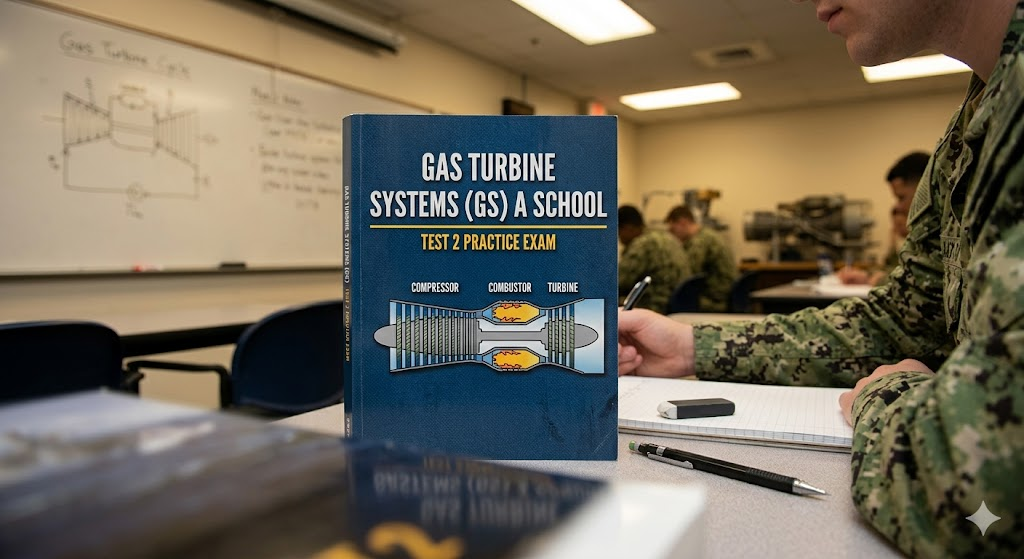
Additional Information
What the Course Entails and Exam Details
The Gas Turbine Systems 'A' School curriculum provides a rigorous introduction to the theory, operation, and maintenance of marine gas turbine engines. Test 2 shifts the focus from basic mechanical or electrical theory to the integrated application of these concepts within actual shipboard systems. You will be tested on your comprehension of:
Gas Turbine Theory and Cycles: A deep dive into the Brayton cycle, focusing on how chemical energy from fuel is converted into thermal and then mechanical energy. You must understand the relationships between temperature, pressure, and volume throughout the engine flow path.
Major Engine Components: Detailed knowledge of construction and function for air intakes, multi-stage axial compressors, combustors (including annular and can-annular types), and high- and low-pressure turbines. Specific components like Inlet Guide Vanes (IGVs), Variable Stator Vanes (VSVs), and bleed valves are heavily featured.
Engine Systems: Comprehensive understanding of vital support systems, including the fuel system (from service tanks to nozzles), lubrication system, start system (pneumatic or hydraulic), and synthetic lube oil systems.
Operational Procedures: Knowledge of standardized operational sequences for engine start, normal operation, and shutdown, including the importance of parameter monitoring (e.g., T5 temperature, Ngg and Npt speeds).
Basic Troubleshooting: The ability to use technical diagrams and data to diagnose common malfunctions, such as compressor stalls, high turbine temperatures, and synthetic oil system failures.
What to Expect in the Final Exam
The Gas Turbine Systems (GS) A School Test 2 is typically administered in a controlled, proctored environment at the Naval Technical Training Center. The exam is fully objective, composed of approximately 50 to 100 multiple-choice questions. It is a timed test, generally allocating two to three hours for completion, requiring you to work efficiently. A passing score, consistent with Navy 'A' School standards, is typically 80% or higher. The questions are designed to not only test recollection of facts but also your ability to apply schematic knowledge to real-world operational scenarios. You will need to interpret system diagrams and predict engine behavior based on given conditions.
How to Study and Exam Centers
Success on Test 2 requires a proactive and varied study strategy. Your primary resource is your trainee guide and classroom notes.
Master the Diagrams: A significant portion of the rating involves understanding flow. Spend time daily tracing fuel, oil, and air flow paths on your system schematics until you can recreate them from memory.
Utilize Flashcards: Create flashcards for key terms, component functions, operational parameters, and limitation values (e.g., maximum T5 temperature).
Form Study Groups: Collaborating with classmates to explain concepts and quiz each other is one of the most effective ways to reinforce learning.
Practice with Purpose: Seek out available practice exams or review questions provided by your instructors. Analyze not just the correct answers, but why the other options are incorrect.
Instructor Assistance: Do not hesitate to ask your instructors for clarification on complex topics before the exam.
The exam is part of your formal pipeline and is taken exclusively at the authorized Gas Turbine Systems 'A' School testing facility within the Center for Naval Engineering (CNE) at Naval Station Great Lakes, IL.
Job Opportunities from the Course
Graduating from 'A' School and passing Test 2 sets you on a clear career path with significant responsibilities and highly transferable skills. This certification leads to various roles, both within the Navy and the civilian sector:
Gas Turbine Systems Technician (Mechanical or Electrical) (GSM/GSE): Your initial rating, responsible for the operation, maintenance, and repair of shipboard propulsion and power generation plants.
Gas Turbine Systems Quality Assurance Supervisor: Overseeing maintenance and ensuring compliance with technical standards and safety protocols.
Marine Gas Turbine Inspector (MGTI): A highly specialized Navy Enlisted Classification (NEC) earned after further training, qualifying you to conduct independent material condition assessments and troubleshoot complex engine issues across the fleet.
Engineering Officer of the Watch (EOOW): A critical watchstanding role on a ship, where you are responsible to the Commanding Officer for the safe and proper operation of the entire engineering plant.
Civilian Power Plant Operator: Utilizing your knowledge of gas turbines, thermodynamics, and large-scale systems in civilian utility or industrial power generation facilities.
Field Service Technician for Turbine Manufacturers: Providing technical support, installation, and repair for companies that manufacture marine and industrial gas turbines, such as General Electric or Rolls-Royce.
Mechanical or Electrical Engineering Technician: Roles in various industries requiring expertise in complex machinery, fluid systems, and power distribution.
Frequently Asked Questions
Reviews
5.0
Based on 0 reviews
Leave a Review
No reviews yet. Be the first to review!