
Gas Turbine Systems Technician – Mechanical (GSM) Chief Practice Test
$69.00
- Buy to unlock unlimited access to all Quiz questions and Answers in this Quiz.
- After purchase you can print a PDF of the whole quiz at any point. The PDF will contain the questions and the correct answers.
About this Exam
The Gas Turbine Systems Technician – Mechanical (GSM) Chief certification is a pinnacle of technical and leadership achievement within the United States Navy's engineering community.
It represents the advancement to the senior enlisted rank of Chief Petty Officer (E-7). This designation is designed for highly skilled First Class Petty Officers (GSM1) who have demonstrated exceptional technical proficiency in marine gas turbine propulsion plants and proven leadership capabilities. A GSM Chief is not only a technical expert but also a vital manager of personnel, equipment, and complex engineering operations, acting as a bridge between the division officers and the junior enlisted workforce.
Ready to test your knowledge?
Buy Now to Access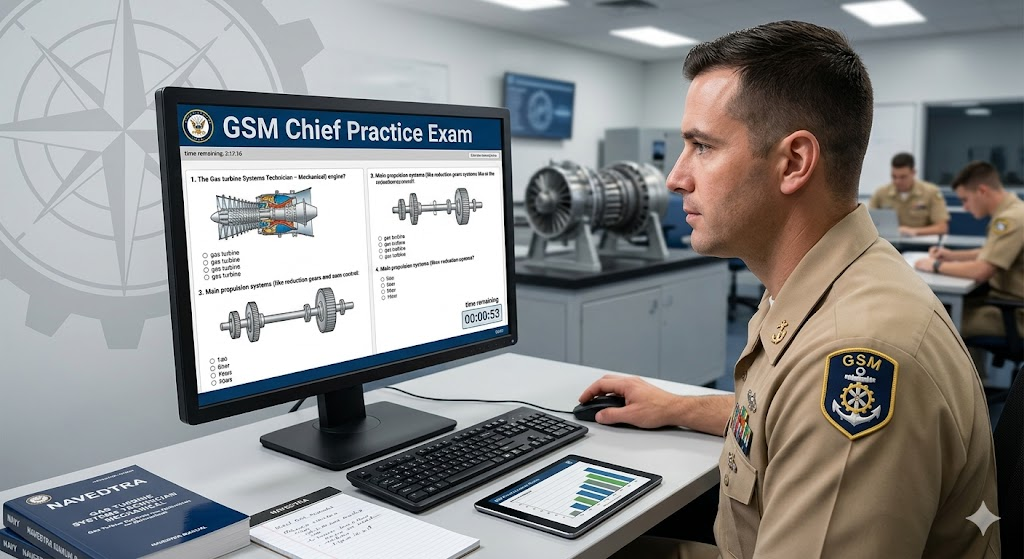
Additional Information
What the Course Entails and Exam Details
The path to becoming a GSM Chief is less of a single "course" and more a culmination of years of experience, specialized training, and a rigorous evaluation process.
A GSM Chief must possess a profound understanding of gas turbine engines, specifically those used for main propulsion on Navy surface ships, along with their associated mechanical systems. This includes reduction gears, shafting, controllable pitch propellers, and extensive auxiliary equipment. Beyond the technical, a Chief must be an expert in administrative programs. The knowledge required for the advancement exam encompasses:
Advanced Gas Turbine Operations: Mastery of starting, operating, and shifting configurations of main propulsion and generator systems.
Preventive and Corrective Maintenance: Overseeing major repairs, complex troubleshooting, and ensuring the adherence to strict Planned Maintenance System (PMS) requirements.
Quality Assurance (QA) and Safety: Implementing safety protocols, including Operational Risk Management (ORM), and managing quality assurance programs for critical systems.
Leadership and Personnel Management: Leading large engineering teams, mentoring junior sailors, and handling division-level administration.
Technical Administration: Handling technical manuals, managing official logs, and reporting equipment status to senior leadership.
Specific Specialized Knowledge: Understanding advanced topics like the Marine Gas Turbine Inspector (MGTI) program, borescope inspections, and propulsion control systems.
What to Expect in the Final Exam
The actual "exam" for advancement to GSM Chief is the United States Navy's official E-7 Advancement Examination.
This is a comprehensive, timed, multiple-choice test. While the exact number of questions can vary slightly by cycle, it typically consists of approximately 175 to 200 questions. The exam is structured to test two primary areas:
In-Rate Knowledge: This section focuses on the specific technical details of the GSM rating at the Chief level, covering advanced mechanics, propulsion systems, maintenance, and relevant technical programs.
Professional Military Knowledge (PMK): This section tests general military history, traditions, leadership principles, military justice, and Navy-wide administrative regulations.
The exam is paper-based, requiring the use of a bubble sheet, and typically has a time limit of around three hours. It is important to note that the passing of the written exam is only one component. A candidate’s final multiple score (FMS), which determines advancement, is heavily weighted towards their performance evaluations (FITREPs), time in rate, and awards, in addition to the exam score. Only a specific top percentage of sailors, as determined by Navy-wide quotas, are selected for Chief after being declared "selection board eligible" (SBE) by passing the exam and meeting all other requirements.
How to Study and Exam Centers
Preparation for the GSM Chief exam requires a dedicated, multi-faceted study plan.
Actionable strategies include:
Study the Official Bibliography (BIB): The single most crucial study tool is the current official Bibliography for advancement. This list, published for each exam cycle, specifies the precise NAVEDTRA manuals, technical manuals, and references that the questions will be drawn from. Focus your study here.
NAVEDTRA Manuals: Thoroughly review the relevant Gas Turbine Systems Technician – Mechanical (3 & 2) and (Chief) non-resident training courses.
Utilize Simulated Practice Tests: Use comprehensive practice exams, like the [GSM Chief Practice Test], to familiarize yourself with the question format, time constraints, and to identify areas where you need further study.
Flashcards and Study Groups: Create digital or physical flashcards for complex systems, equations, and leadership concepts. Organize study groups with fellow first-class petty officers to discuss and reinforce technical and PMK material.
Seek Mentorship: Engage with current GSM Chiefs and Senior Chiefs. They can provide invaluable insight into the leadership expectations and the focus areas of the exam.
Exam Centers and How to Take the Exam: The E-7 Navy Advancement Exam is administered under strict supervision at designated physical locations. These include authorized command educational services offices (ESO), specific training centers on military bases worldwide, or sometimes, at Pearson VUE professional testing centers for particular components or special programs. Registration is handled internally within the candidate’s chain of command and educational services staff.
Job Opportunities from the Course
Advancing to the rank of GSM Chief is a monumental career step, unlocking key senior enlisted leadership and technical management positions within the Navy.
The specific job titles and career paths this certification opens include:
Engineering Division Leading Chief Petty Officer (Div LCPO)
Engineering Department Leading Chief Petty Officer (Dept LCPO)
Marine Gas Turbine Inspector (MGTI)
Gas Turbine "C" School Instructor
Regional Maintenance Center (RMC) Maintenance Coordinator
Propulsion Plant Manager (U16A NEC)
Senior Technical Advisor to ship’s leadership
Engineering Trial Board member for new ships
Recruiter or Recruit Division Commander (RDC) – a key leadership tour.
Frequently Asked Questions
Reviews
5.0
Based on 0 reviews
Leave a Review
No reviews yet. Be the first to review!